Wednesday, 30 April 2014

New biomass sustainability requirements for the Renewable Heat Incentive

Ofgem has revealed more detail on how it intends to roll out and implement sustainability requirements for biomass fuels.

This is particularly important as it not only affects the owners and operators of RHI accredited biomass boilers but also producers and traders of biomass fuels.

The guidance applies to both the non-domestic (commercial) and domestic RHI and participants will need to comply with requirements from date they come into force (although the precise dates are not stated).

All participants are strongly encouraged to start sourcing from a supplier on the forthcoming Biomass Suppliers List (BSL) supplier in advance of the criteria coming into force later this year.

The new requirements also take into account participants who self-supply, for example an estate that processes wood chip from its own woodland.  Details on this can be found below.

From Autumn 2014 (no earlier than 1st October 2014)

Biomass fuel used by RHI participants must meet a lifecycle greenhouse gas (GHG) emissions target of 34.8g CO2 equivalent per MJ of heat.

Don't panic!  All this means is that the fuel (chip, logs, pellets) must achieve a 60% GHG saving against the EU fossil fuel average.  And it is the supplier of the fuel that has to demonstrate the GHG saving and not the end user (although the end user will have new reporting responsibilities if they are participating in the RHI).
From Spring 2015 (subject to the Parliamentary process)

Ofgem plans for biomass fuel to meet land criteria, which will differ for different types of biomass:
For woodfuel the criteria are outlined in the UK Timber Standard for Heat and Electricity.
How do non-domestic RHI participants comply?

This is rather simple actually.  A new Biomass Suppliers List (BSL) is currently being set up.  This is being managed by the good people at Woodsure who have been appointed by Ofgem to manage the BSL.  The alternative option is to self-report directly to Ofgem.
Participants can switch between these methods.  Of the two the BSL route sounds more straightforward to us.
  • Sourcing woodfuel from the Biomass Suppliers List (BSL)
    • Participants may still need to also provide Ofgem with a quarterly declaration that the biomass fuel they have used was sourced from a supplier registered on the BSL and marked as sustainable.
  • Self-reporting to Ofgem on the sustainability of their fuel
    • This will involve making a quarterly declaration to Ofgem of the lifecycle GHG emissions associated with each consignment of fuel used in that quarter, and provide an annual independent audit of the lifecycle GHG emissions associated with biomass used in that reporting year.
For the domestic RHI all fuel used from the date the criteria come into force must be sourced from a supplier registered on the BSL at the time the fuel was purchased. Participants are required to make an annual declaration to Ofgem that the biomass fuel used meets this requirement.
Self-suppliers (domestic and non-domestic) < 1 MW

Participants self-supplying woodfuel from the same estate as the installation will be able to register on the BSL as a self-supplier without undertaking an assessment against the sustainability criteria if the boiler is less than 1MW capacity. 

Ofgem recommendeds:
  • Self-suppliers provide some evidence of their ability to self-supply, such as a Forestry Commission approved management plan. 
  • Self-suppliers should register on the BSL before the sustainability criteria come into force in Autumn 2014.
Self-supplying participants who cannot meet all of their needs from their own woodland will be able to top up with fuel purchased from a BSL supplier.

Tuesday, 22 April 2014

Updated commercial RHI tariffs announced

Ofgem has recently released the updated tariffs for the commercial RHI scheme.  These changes have taken place primarily due to the annual inflation of the RHI, the third increase since the scheme was launched.  However, changes have also taken place in response to increasing uptake of the scheme, particularly in the small and medium biomass projects.

The inflation of the tariff, this year by 2.7%, affects those already in receipt of payments from Ofgem as well as installations that will become accredited after April 1st 2014.

The following table focuses on the biomass tariff.  For example, for boilers sized up to 199 kW the Tier 1 tariff has increased from 8.6 p/kWh to 8.8 kWh (the Tier 2 tariff from 2.2 to 2.3 p/kWh).  The last column in the following table shows the updated tariff (from 01/04/2014).


Whilst these changes are not earth shattering the increases help to further enhance the economics of RHI accredited biomass boilers.  For example, the annual RHI payment for a 199 kW boiler serving a 280,000 kWh heat load would increase by around £500 per year.

The only downside to these changes is the reduction in the tariff for medium-scale biomass boilers that were accredited after July 1st 2013 (Tier 1 down to 5.1 p/kWh and Tier 2 remains at 2.2 p/kWh).  This change indicates that degression has taken place in the medium category due to rising uptake of the RHI in this category.

Whilst the overall expenditure for the RHI is proceeding according to forecast it is clear that the small biomass category has seen the largest increase in expenditure.


Ofgem states that:

"Forecast spend over the next 12 months for small commercial biomass is £44.4m. This means that estimated spend for this technology is already £10.4m above its 30 April 2014 individual technology trigger point of £34.0m. This increases the possibility of a reduction to this tariff in the next quarter. However, this would only occur if next quarter’s 50% trigger for the scheme as a whole of £96.4m was also exceeded, which would require a £10.1m increase in total expenditure over March and April."

Other developments include:

  • Forecast spend over the next 12 months for medium & large commercial biomass has increased by 4% and 6% respectively.
  • Forecast spend for small heat pumps has seen a significant increase of 25% in the last month.
  • Forecast spend for all other tariff categories have seen little to no activity this month and remain considerably below their individual tariff triggers for the next quarter.

The future risk of degression is summarised by Ofgem as follows:

"Whether any reductions occur next quarter depends on how well the scheme overall, and each technology tariff, performs during March and April and whether total scheme spend grows by £10.1 million in that time. An increase of this size would occur if the scheme was to continue to grow at the rate we have seen this month which would cause the 50% total scheme trigger of £96.4m to be hit. DECC will receive the data needed to make this forecast in May, and will publish the next quarterly degression announcement by 1 June 2014, following which, any reduced tariffs would come into effect from 1 July 2014."

Thursday, 3 April 2014

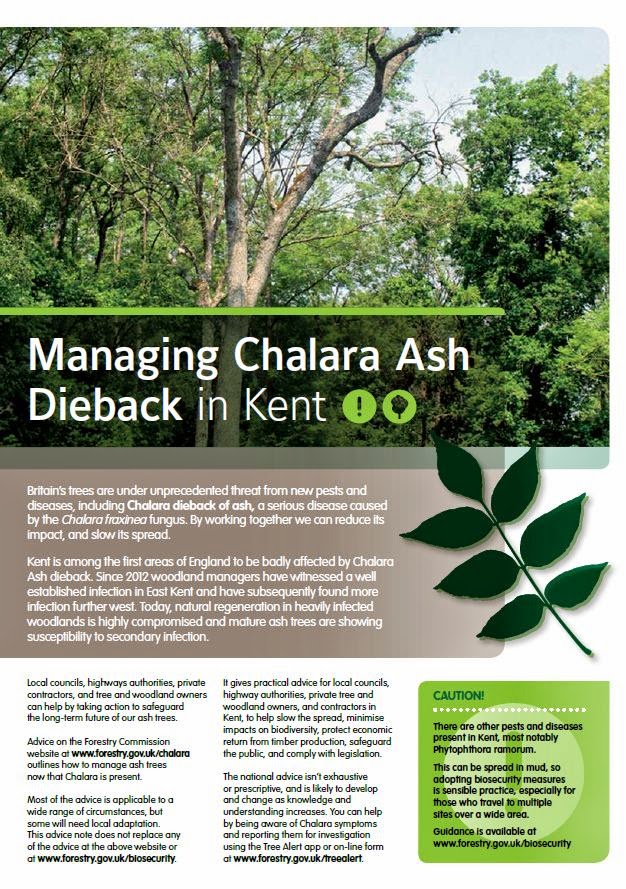
Kent’s tree experts lead on new guidance for Ash dieback

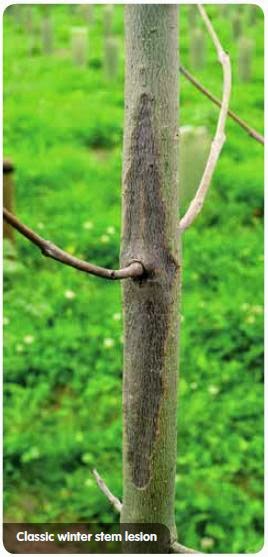
Britain’s trees are under unprecedented threat from new pests and diseases, including Chalara dieback of ash, a serious disease caused by the Chalara fraxinea fungus. 

Kent is among the first areas of England to be badly affected by Chalara Ash dieback. Since 2012 woodland managers have witnessed a well-established infection in East Kent and have subsequently found more infection further west. 

Today, natural regeneration in heavily infected woodlands is highly compromised and mature ash trees are showing susceptibility to secondary infection.

Ash is the most common tree in Kent (almost a fifth of all trees).  This, combined with the observed rate of spread and the high level of infection already present, make eradication of Chalara impossible.

The Kent Downs AONB Unit has worked closely with partners in the Arboriculture Association, Forestry Commission and Kent County Council to produce a guide which offers practical advice for local councils, highway authorities, private tree and woodland owners, and contractors in Kent. 

The main aim was to provide practical advice that might help slow the spread of Ash dieback, particularly from woods in high infection areas in the east of Kent to other locations in the west of Kent, and beyond, where infection rates are currently low.  

Other objectives were to provide advice that minimise impacts on biodiversity, protects economic return from timber production and safeguards the public.

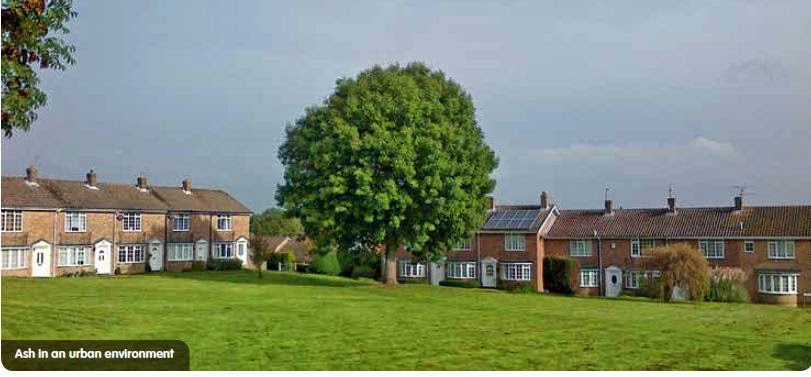
The guide provides a general overview of the disease and its current status before providing specific guidance for woodland managers and those managing tress in urban and sub-urban environments.  

It includes summary advice on how to manage infected ash trees in conservation areas and development sites, trees with preservation orders and ancient, veteran and heritage trees.  The guide also considers ash trees adjacent to highways, public open spaces and private property.


The guide was co-written by Jonathan Harding from the Forestry Commission, Dan Docker from Tunbridge Wells Borough Council, Mike Sankus from the Arboriculture Association and Tony Harwood from Kent County Council. 

The project was managed by the Kent Downs AONB Unit as part of the ADAFOR Interreg project, a cross-border forestry initiative that seeks to integrate knowledge and expertise to facilitate enhanced forest management and adaptation.

The guide is available to download for free our Google Docs folder.

For more information please contact:

Matthew Morris (Woodfuel Development Manager)
01303 815 171
Matthew.morris@kentdowns.org.uk


Friday, 28 March 2014

Pesticide seminar for forest managers

Confor is supporting a series of regional one-day updating crop protection seminars for forest managers and owners during April and May.


The seminars will be led by Confor crop protection adviser Colin Palmer and will include:

  • Implications of latest regulation
  • Avoiding environmental harm
  • Operator safety
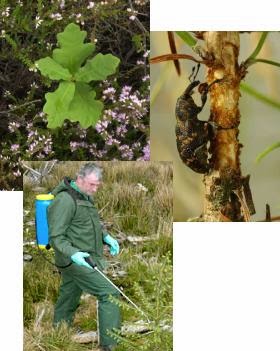
  • Control of Hylobius (tree weevil) and other insect pests
  • Best application practice
  • Advances in weed control
The seminar for the south east region will take place at Farnham in Surrey on Wednesday 23rd April.

Courses run from 10am to 4.30pm.  The cost is £65.00 (no VAT) per delegate. 
Each course will be limited to 25 attendees.

A booking form can be downloaded here.

Friday, 28 February 2014

Britain's forest area close to 3 million hectares


The Forestry Commission has published new maps and statistics showing that Great Britain has about two and a half times more forest and woodland than it had 100 years ago.

They show that Britain has almost 3 million hectares (7.5 million acres) of forest and woodland, representing 13 per cent of the total land area, and equivalent to almost 4 million football pitches. 


It is estimated that a century ago woodland cover was between only 4 and 6 per cent.

The new reports and maps form part of the National Forest Inventory (NFI), and show that, at 31 March 2011:
  • Great Britain had 2,979,354 hectares of woodland;
  • England had 1,292,372ha (10% of the land area);
  • Scotland had 1,383,410ha (18%);
  • Wales had 303,572ha (15%);
  • 42% of woodland comprised mostly conifer species
  • 37% mostly broadleaved species
  • remaining 21% comprised mostly mixed conifers and broadleaves; and
  • the Forestry Commission managed 807,288ha, or 27%, of Britain's woodland, with other owners managing the remaining 2,172,066 hectares, or 73%
The woodland area information comprises separate reports for Britain, England, Scotland and Wales. The England and Scotland reports include regional breakdowns. 

They, and other NFI products, can be downloaded free from the NFI area of the Forestry Commission website.


Britain's woodland cover had declined to an estimated 4-6% by the beginning of the 20th century after thousands of years of forest removal for fuel, timber, industry, farming and settlements. 

It has been expanding since the 1920s as successive governments have encouraged new forest planting. Reforestation programmes initially focused on re-establishing a strategic reserve of home-grown timber. However, policy has evolved to focus on creating a multi-purpose woodland resource also encompassing environmental protection (including climate change mitigation and adaptation), wildlife conservation, public recreation and health, and community development.

The NFI is based on measurement of all rural and urban woodland areas of 0.5ha or greater in size. Its predecessor, the National Inventory of Woodland & Trees (NIWT), compiled in the late 1990s, measured only the total area of woodlands of 2ha or greater, and estimated the total area of rural woodlands smaller than 2ha, based on a sample.

The current NFI is being compiled over the five years 2009 to 2014 from satellite imagery, aerial photography and field surveys; Forestry Commission, NRW and owners' records; and data analysis. 

The full suite of NFI outputs will include reports on woodland area, health and condition; timber, carbon, biomass and species content; various woodland uses and facilities; and forecasts of how some of these aspects could change over the coming decades under different scenarios.

It enables the Forestry Commission, Natural Resources Wales and other environmental, land and infrastructure authorities to track changes over time - crucially, in the health and condition of trees, woods and forests - and provides essential, up-to-date information on which to base advice, guidance, planning and management decisions.


Major update to the myForest service


The Sylva Foundation has announced two major updates to the myForest service.

For those who are unfamiliar with the service myForest is a free online tool for woodland owners, forestry businesses and wood users. The tools enable users to easily set-up a sustainable woodland management plan and also help with the marketing of home-grown forest products.


The recent updates to myForest include an enhanced management planning template that links with Forestry Commission England.  The mapping tool within myForest have also been improved and is now fully functional online GIS.

New Management Planning template

The myForest management plan template has been update to reflect the recent changes implemented by Forestry Commission England (FCE).  myForest  now enables the creation of management plans as part of the Woodland Planning Grant.  

These changes incorporate a number of benefits:

  • more user-friendly template
  • the template that allows the creation of a management plan that is compliant with the UK Forestry Standard
  • provides the woodland owner with felling permissions for 10 years as part of the management plan.
  • compliance with new regulations including EU Timber Regulations.

New Mapping Composer

The updated mapping composer within myForest is a simple Geographical Information System (GIS).  It allows the user to add layers and labels to a map which can be printed off or saved on your computer, and saved as in pdf format.

The maps generated can be used to provide felling permissions as part of a management plan or to support an application for a standalone felling licence.

Thursday, 27 February 2014

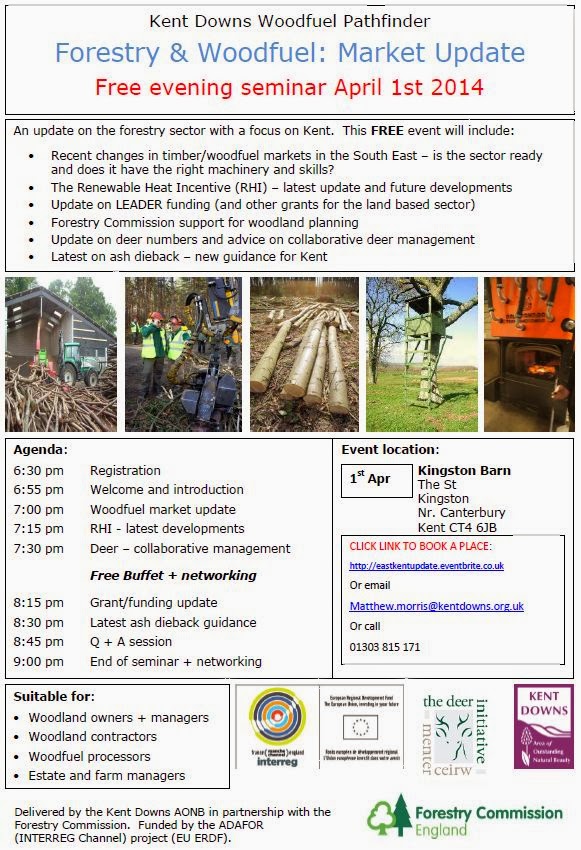
Forestry & Wood Fuel Update - April 2014 - Free Event

The Woodfuel Pathfinder will deliver its next event at Kingston Barn on the evening on April 1st.  Full details can be found below.

To register for the event please use this link.  

Alternatively please call the AONB Unit on 01303 815 171.


Monday, 3 February 2014

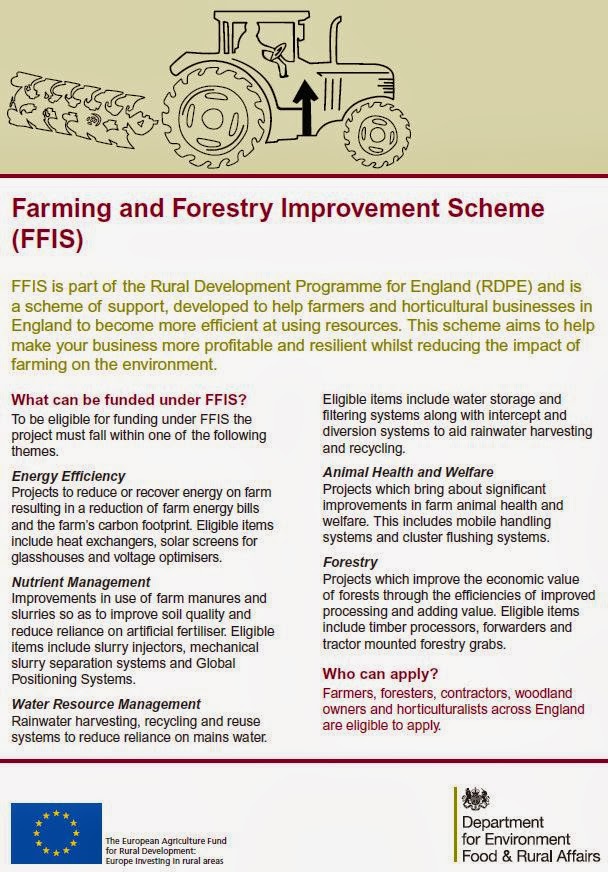
New grants for farming, forestry and low carbon businesses

We are pleased to see the arrival of two new grant schemes that are available to the forestry sector in Kent.

The FFIS and Low Carbon Plus grants can support existing businesses with machinery and other capital and business development costs.

It is possible that there is some overlap in these grants so applicant may need to decide which is best for their business.  As far as we can tell there is no restriction on applying to both.

The FFIS is a £10M 'pot' available in England.  The Low Carbon Plus pot is £1M and available to Kent-based businesses only.

FFIS

First up is the re-opening of the FFIS (Farming and Forestry Improvement  Scheme).  Round 3 of this scheme will provide grants of up to £35,000.  The grant rate in lowland areas is 40%.  Previous beneficiaries of FFIS can re-apply.

Eligible items for the forestry sector include timber processors, harvesters and tractor-mounted forestry grabs.  Deadline for applications is April 4th.  This scheme is funded by RDPE (Pillar 2 if the CAP).


Low Carbon Plus

The next grant is an entirely new grant that is being delivered by Kent County Council's Low Carbon Business Network.

The Low Carbon Plus scheme will provide £1M worth of grants to existing businesses that are involved in 'low carbon' goods and services.

Grants of up to £20,000 may be used for: 
  • Development finance: funding required to expand the business (for example, marketing costs)
  • Plant and machinery: costs of re-tooling and installation of machinery  and hardware and training required to operate it
  • Intangible assets: including costs of purchasing patents, IT, software and licences
  • Consultancy costs (e.g. marketing, business planning)
Applicants must be based in Kent. The grant rate is 50%.

The scheme is currently at the pre-launch stage.  Businesses are invited to complete an expression of interested which can be found here.  This scheme is funded by the EU-ERDF.


Friday, 31 January 2014

Tractor Based Harvesting - Free Demonstration Event

To book online click here.

Alternatively email Matthew or call 01303 815 171.


What buyers of firewood want

We were so pleased to read about the results of Certainly Wood's customer feedback exercise.  Finding data for the wood fuel sector is notoriously hard - and if you do find some the base from which the statistics are derived can be woefully small.

At around 2,300 Certainly Wood's survey seems fairly robust.  We've not seen the actual survey or looked at the analysis - but taken at face value the results should be of interest to anyone involved in woodfuel.

Right at the top of the list is moisture content - and more specifically moisture content below 20%.  As we know Certainly Wood specialise in kiln-dried wood so this sort of confirms their USP.  However, it does reinforce that fact that most consumers are pretty well informed when it comes to seasoning and moisture and they clearly look for these attributes when buying logs.

Next up are sustainability, supply chain and production.  Encouraging to see that such high emphasis is placed on where the fuel comes from.  We are not familiar with Certainly Wood's supply chain but clearly their customers like buying British and are at least aware of the need for sustainable sourcing.


Given the paucity of information from the woodfuel sector this survey makes interesting reading.  We are also fairly impressed with the marketing approach.  

We know that not all firewood businesses are this large, but good marketing can clearly help drive business.  Berties Woodfuel, based in Hadlow in Kent, is another example of where simple marketing and branding can really help differentiate a business.


Monday, 27 January 2014

National Coppice Federation - Issue 2 of newsletter

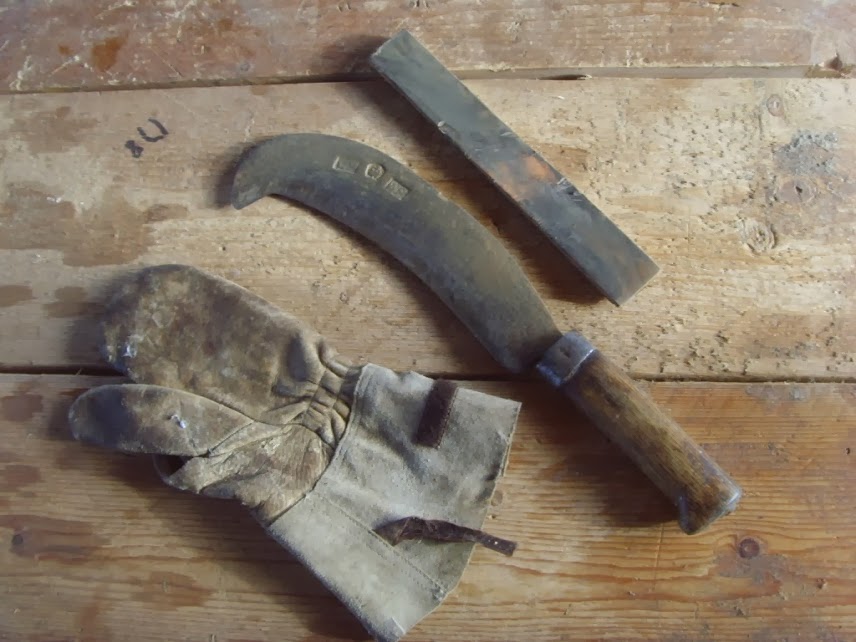
The second issue of The Cleft Stick, the newsletter of the National Coppice Federation or NCFED, is now available.

The newsletter provides an interesting and useful update of topics relating to coppice management.  

NCFED was only launched on October last year and it seems like this newsletter is one of the first bits of communication from this newly formed group.  The NCFED website is still taking shape and we assume that more information will begin to flow as 2014 progresses.

The newsletter includes a useful round up of events.  Of interest to those in the south east are the following:


  • Feb 1st (Saturday). Coppice Tool Bring-and-Buy Sale, nr Tunbridge Wells, Kent. See newsletter for more details.


  • Feb 25th, 26th and 27th. Three one-day deer management courses at Plumpton College, east Sussex. More info at Plumpton College website.


We have uploaded to the latest issue to help those not currently on the circulation list gain access to it.  Click the following link: The Cleft Stick - NCFED Issue 2.


If you would like to be added to the circulation list for The Cleft Stick please email brian.hurdles@virgin.net

Tuesday, 21 January 2014

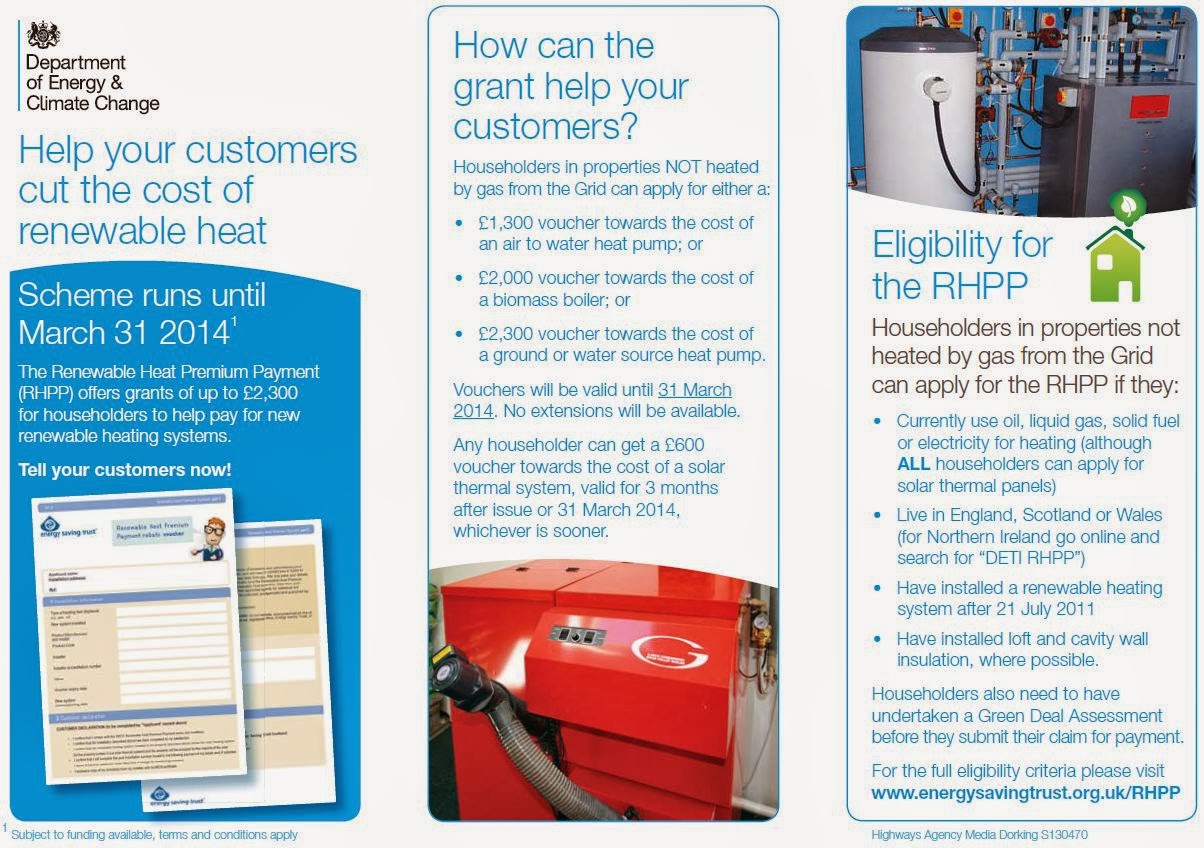
RHPP due to end soon - £2,000 grant towards the cost of a biomass boiler


Last chance for off-the-gas-grid households who want to make the most of the Government’s one-off grant designed to help meet the costs of installing renewable technologies in homes across the country.

The Renewable Heat Premium Payment Scheme will close on March 31st 2014 and householders are encouraged to apply now before it’s too late. 

Grants of up to £2,300 are available for households to help pay for new renewable heating systems including biomass boilers and ground, water source or air-to-water heat pumps.

The cut-in date for this scheme is 21st July 2011 and participating households must have undertaken a Green Deal assessment.

Vouchers will be valid until 31 March 2014  when all required paperwork will need to be submitted for payment  to the Energy Saving Trust. No extensions will be available to this deadline.

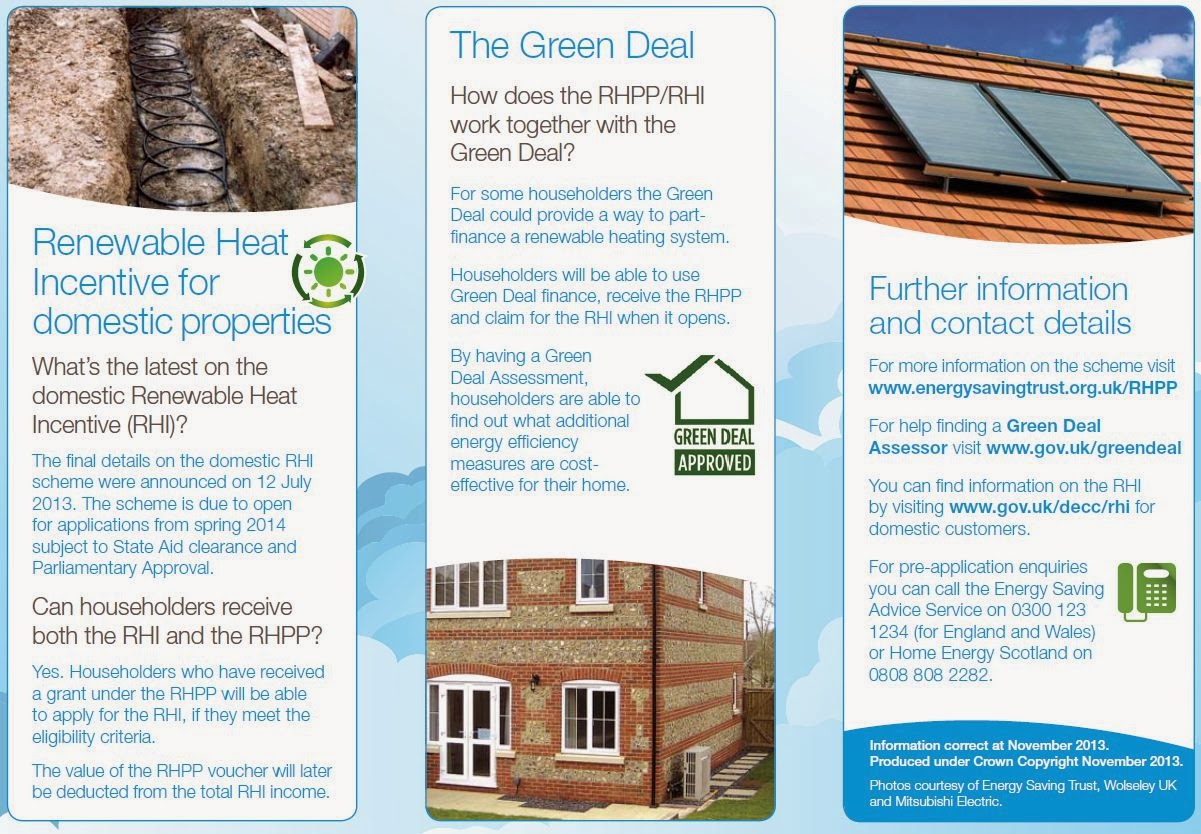
The following leaflet has now been developed to explain the benefit of applying in customer friendly language and where to go for more information.


Friday, 17 January 2014

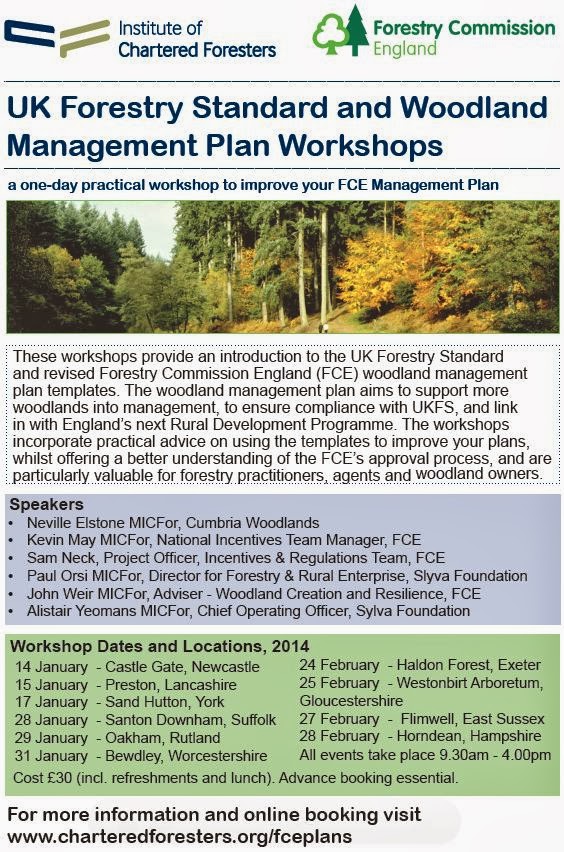
UK Forestry Standard and Woodland Management Plan Workshops


Thursday, 9 January 2014

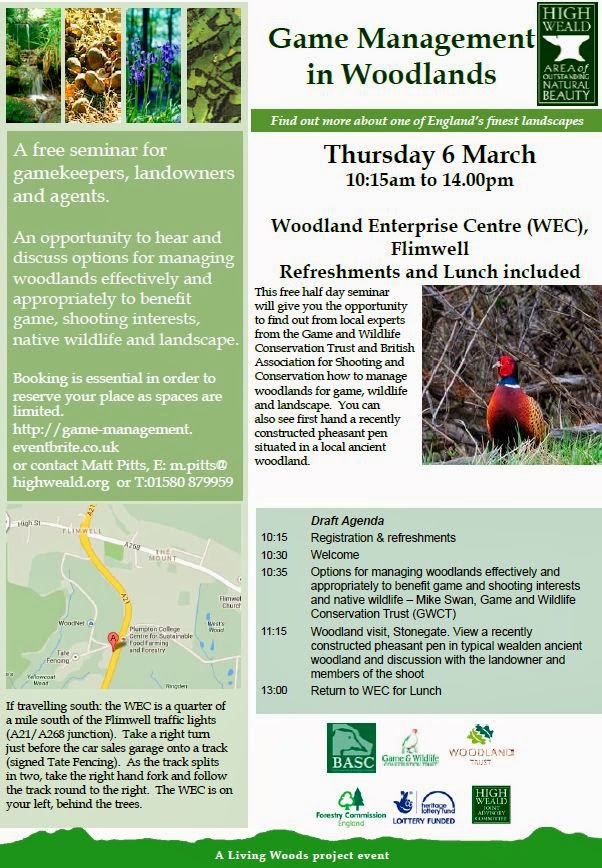
Free seminar - Game Management in Woodlands

High Weald AONB will deliver a free seminar on game management in woodlands on March 6th (see details below).


Game management can form part of a multi-functional approach to woodland management.  With good planning it can be compatible with management for conservation and wood fuels (such as wood chip for on-estate biomass boilers and firewood).

Traditionally small-scale felling and harvesting of timber tends to be fitted around the shooting calendar.  This is fine, but often the wider opportunity creating wood fuels for an estate is overlooked.

Given that the Renewable Heat Incentive continues to offer an excellent subsidy for heat generated by biomass boilers game managers should consider  other options for woodland management.

The Kent Downs Woodfuel Pathfinder can provide free support for those interested in woodland management for wood fuels, including free biomass heating feasibility studies.  Please contact matthew.morris@kentdowns.org.uk for more details.


Wednesday, 11 December 2013

Commercial RHI - summary of changes to tariffs and technologies


Are you sitting comfortably?

DECC has been busy releasing new and updated information about both the commercial and domestic RHI and renewable heat in general.

To my eyes the overall renewable heat situation looks extremely healthy at the moment, particularly if you are in the biomass sector.  However, it is also clear that biomass is dominating the commercial RHI.  Consequently DECC will introduce changes to the budgetary process to increase the degression trigger sensitivity for sub-1MW biomass.


We have read the latest update on the commercial RHI and have picked out the main points from the executive summary.  We would urge interested readers to look at the entire document in case we have missed anything.


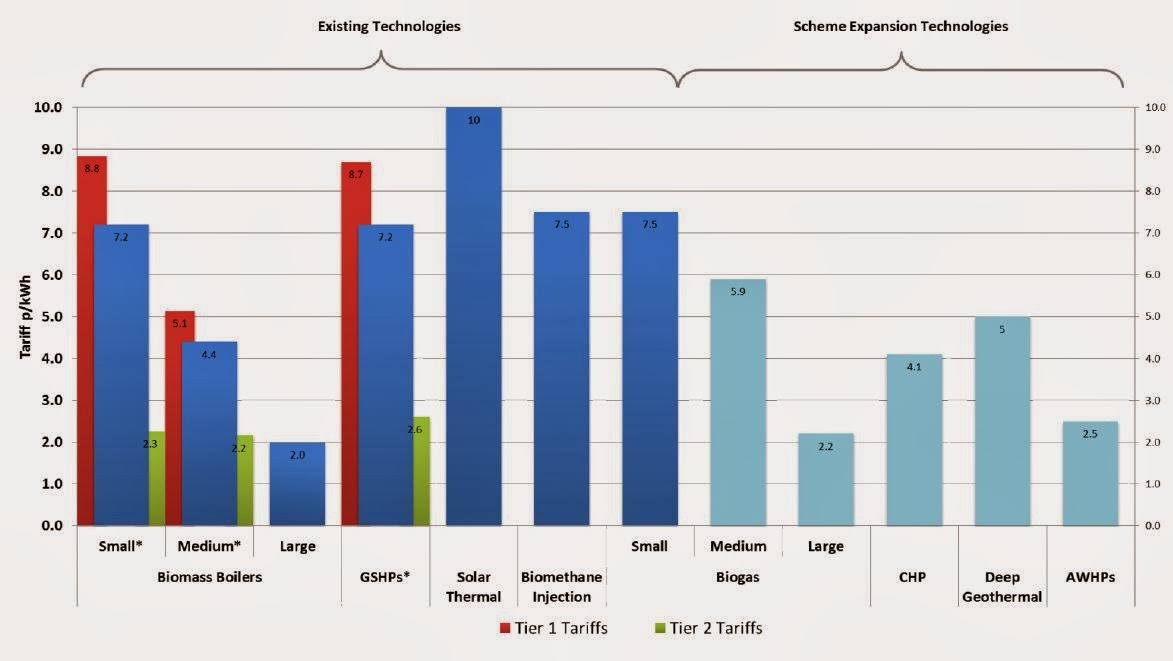
A key change is the capping of all tariffs at 10p/kWh.  This means that the RPI inflation of tariffs will stop at 10p/kWh.  For biomass it is the tier 1 small biomass tariff that is closest to this limit (n.b. the solar thermal tariff will be increased to 10p/kWh).

It is true that some renewable heat technologies are underperforming in the RHI, such as heat pumps and solar thermal.  However, DECC has recognised this and will beef up support - via increased tariffs and budgets - as well altering some requirements (such as energy efficiency).  The large biomass tariff, for example, will increase to 2.0p/kWh from 1.0p/kWh.


Eligibility

For new technologies and updated tariffs - 4 Dec 2013.  Any applications with a date of accreditation of 21 January 2013 or later will benefit from the tariff increases brought forward as a result of the Early Tariff Review consultation (this applies to ground source heat pumps (GSHP), solar thermal and biomass over 1MWth).


Energy Efficiency

DECC will not be introducing explicit energy efficiency criteria for non-domestic RHI applicants at this time. The mixed views from consultation respondents made it clear that more work needs to be done to establish a range of effective but not unduly burdensome energy efficiency measures that could be introduced into the scheme.


Biomass Sustainability Update

Based on feedback from stakeholders about industry readiness,  DECC  will postpone implementing mandatory compliance with GHG lifecycle emissions savings to Autumn 2014, so that industry and participants can monitor their processes in light of the sustainability criteria and build the audit trail necessary to demonstrate compliance.

DECC intend for the Biomass Suppliers List to be open for applications from suppliers of biomass in Spring 2014.

Subject to the availability of Parliamentary time,  DECC  intend to implement land-use sustainability criteria by 1 April 2015.


Biomass CHP

DECC will be introducing support for biomass CHP (4.1p/kWh), biogas >200kW (5.9 p/kWh and 2.2pkWh depending on size) and deep geothermal (5.0p/kWh). 

However, we do not intend to proceed at this time with support for heating only air-to-air heat pumps or biomass direct air as the consultation did not enable the development of appropriate deliverable policy.

Biogas combusion >200kWth

Subject to State Aid approval, tariffs will be set at 5.9p/kWh for installations with a thermal capacity of between 200 to 600kWth and 2.2p/kWh for those greater than 600kWth.

Deep geothermal

DECC will introduce a new tariff for deep geothermal heat at 5p/kWh. Deep geothermal heat will be defined as heat coming from a drilling depth of a minimum of 500m.

Heating only air-to-air heat pumps (AAHPs)

Although these technologies do produce renewable heat,  DECC  will not be introducing support for them at this time. This is primarily because of the risk of incentivising the installation of separate heating and cooling AAHPs in order to claim the RHI, rather than a reversible AAHP, which is likely to be more energy efficient.

Air to Water Heat Pumps and Energy from Waste

DECC will be introducing support set at 2.5p/kWh for AWHP (designed to achieve a minimum seasonal performance factor of at least 2.5) and 2.0p/kWh for the biogenic proportion of energy from waste (commercial and industrial).

Value for Money Cap and Tariff Rate of Return

From Spring 2014 tariffs across the RHI will be capped at 10.0p/kWh of renewable heat (and continue to be adjusted by RPI annually).

Biomass

To date deployment of large biomass has been below expectations and therefore  DECC  will go ahead with the proposed tariff increase to 2.0p/kWh.

Ground Source Heat Pump Tariffs

DECC will be replacing the current banded GSHP tariffs with a single tariff of 7.2p/kWh, which will be tiered.

The tier 1 tariff of 8.7p/kWh will be paid on the initial heat generated for an eligible purpose and the tier 2 tariff of 2.6p/kWh will be paid on the remaining eligible heat generated. This is equivalent to a tariff of 10.0p/kWh renewable heat assuming an SPF of 3.6.

Solar thermal

DECC will be raising the solar thermal tariff to 10.0p/kWh.

Budget management

Since implementation,  DECC  has made three quarterly degression assessments, one of which resulted in the medium biomass tariff being reduced by 5%. The outcome of the most recent assessment was published at the end of November.  DECC  will publish the fourth quarterly announcement by 1 March 2014.

In the May 2013 tariff review consultation we set out that the budget management policy would need to be developed in light of any tariff changes or scheme extensions and to reflect the outcome of the spending review for 2015/16, which has since confirmed an RHI budget in 2015/16 of up to £430m.


Having reviewed the budget management mechanism to ensure it remains fit for purpose,  DECC  will make some changes to the policy from Spring 2014 to:
  • base the deployment levels set out in the degression mechanism on refreshed market intelligence rather than the expectations that were modelled prior to the scheme’s introduction;
  • reduce the tolerance in the technology trigger for biomass under 1MWth and bio-methane injection by reducing the amount that these triggers are scaled above expected levels of deployment. They will change from being 150% of expected deployment to 120% of expected deployment. This will reduce the risk of unsustainable growth and dominance of the budget by a small number of technologies;
  • set the triggers for technologies  DECC  expects to deploy in relatively lower volumes (solar thermal, deep geothermal and all biogas) at 2.5% of the overall budget, rather than the current 5%.
Reducing uncertainty for projects with long-lead times

DECC intend to introduce a form of tariff guarantee for the largest installations (for example, those over 1MW), initially available for plant due to be commissioned by 31 March 2016. Subject to further policy development in 2014, State Aid and Parliamentary approval,  DECC  will aim for this measure to be in place from April 2015 to March 2016 and thereafter factored into the next spending review discussions on the RHI so that it can be available from Spring 2016 for plant due to commission by 31 March 2020.

Public Grants

After two years of the non-domestic RHI we think a more flexible approach to the interaction between public grants and the RHI could encourage more renewable heat installations to come forward. Pending further work alongside the 2014 review to look at the interaction between public grants and the non-domestic RHI,  DECC  intend to introduce some additional flexibility next year. We will take forward regulatory amendments to extend the eligibility window for repayment of grants and to allow some grant recipients who are unable to pay back their grants to access the RHI via reduced tariff payments.


Monday, 9 December 2013

Renewable Heat Incentive - safe from degression (for the time being)

Following the most recent check on uptake Ofgem has announced that the commercial RHI tariffs will remain unchanged.

This was the first serious 'degression test' for the commercial RHI. DECC's figures show that both the small and medium commercial biomass tariffs had exceeded their degression trigger points:
  • Small commercial biomass: Forecast spend over the next 12 months is £32.3m. This is £4.3m over its individual technology trigger.
  • Medium commercial biomass: Forecast spend over the next 12 months for is £26.5m. This is £0.2m over its individual technology trigger.
However, because spend for all other tariff categories were considerably below their individual tariff thresholds for this quarter, and overall spend was within budget, Ofgem has decided to leave all tariffs unchanged.

Commercial RHI - total spend (Nov 14 2013)
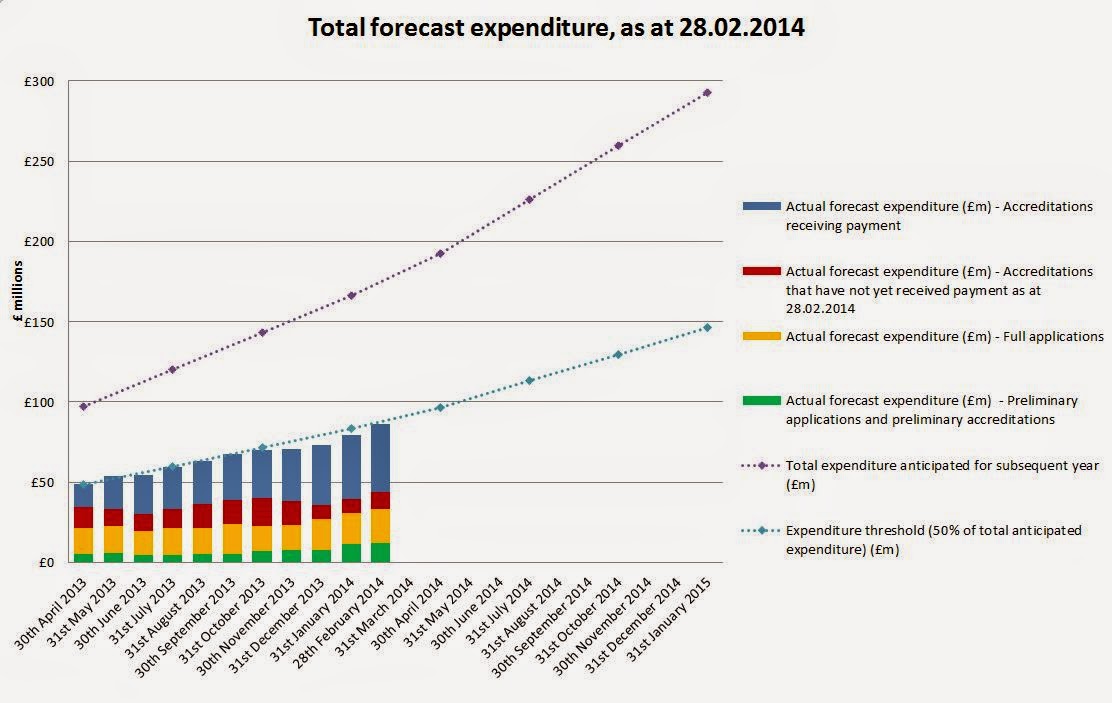
Total forecast expenditure for the scheme (as of October 31st) was £70.3 million. 

As the £70.3m figure does not exceed either threshold (see below) the scheme has been left unchanged:
  • The “50% trigger” for the scheme as a whole as at 31 October is £71.6m.
  • The “100% trigger" for the scheme as a whole as at 31 October is £143.3m.
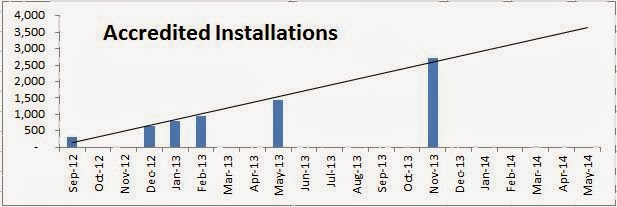
Biomass heating is clearly the biggest 'winner' from the commercial RHI. In contrast to the feed-in-tariff (FiT) for renewable electricity, which grew exponentially, RHI growth has been far more linear (and thus more predictable).


But as you can see the commercial RHI was very close to its degression trigger in October - for some tariffs - and we suspect that things may get even tighter in the near future.


Uptake of commercial RHI Source: KDAONB

The forecast spend for the small commercial biomass tariff means that it is already above its next quarters individual technology trigger (£30.9m on January 31st 2014).

This means that there is enhanced risk of degression in this tariff.  However, this would only occur if next quarter’s 50% trigger for overall expenditure of £83.2m was also exceeded.


RPI (%) Source: ONS
The good news is that the scheme overall is nearing its third 'inflation point' on April 1st 2014.  
The commercial RHI tariffs have already been increased by the Retail Prices Index (RPI) twice (4.8% in 2012, 3.1% in 2013) and the increase may help offset degression  if it happens.

However, the latest figures from the ONS show that the RPI is falling so the cushioning effect may not be so marked in April '14.

Tuesday, 3 December 2013

China bans import of Ash from Europe


AQSIQ Import ban notice
China has banned the import of ash (Fraxinus Excelsior) in log and sawn timber form from Europe.  This adds to the existing ban for the import of seeds and nursery stock.  

China has been a large importer of ash over the last few years this ban is significant for those involved in the trade.  

Whilst there are other important markets for ash, for example firewood, this immediate cessation of exports may have an impact on price for some parts of the supply chain.

Some commentators have suggested that woodland owners cease felling ash (for export) until the longevity of the ban is established.  

Other commentators, such as the Forestry Commission, have also suggested that woodland owners might consider delaying the felling of ash.  However, this is to prevent the loss of resistant trees rather than a temporary cessation of activity oriented towards export markets.


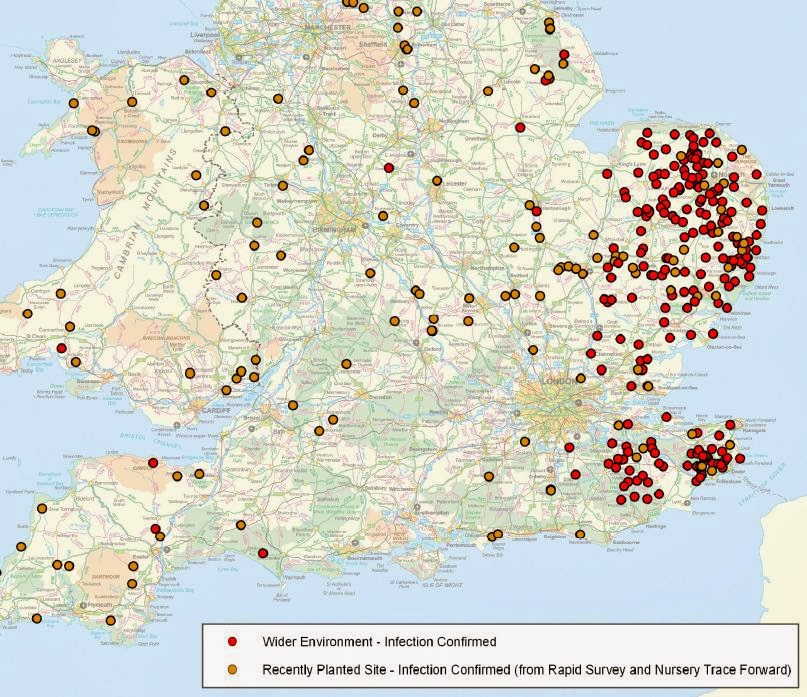
Ash dieback distribution (Source: Forestry Commission)
Interesting China recommends that local forestry administrations should reinforce surveillance of ash dieback and implement emergency response plans.  In Kent, where ash dieback is now widespread, local guidance is being prepared and County emergency planners have developed a response plan.

China's ban is immediate and will remain in place until the status of the epidemic allow the ban to be removed.  

Given that the impact of ash dieback is only beginning to be felt in the east of England and Kent it could be that China's plan stays in place for several years.

This could also be an opportunity for the UK.  If ash can no longer be exported easily from the UK this might be positive for those involved in indigenous supply and consumption.  This blog is not aware of the economics of timber for export to China but our guess is that ash firewood supplied locally is probably far more valuable (as is most firewood)!

Monday, 25 November 2013

Deer Management Courses


Plumpton College and The Deer Initiative will deliver a series of one day courses on deer management in December and February.

Each course will look at different aspects of deer management covering deer awareness, population dynamics and cull, deer impact assessment, landowner and deer stalker agreements, landscape scale management, risks and liabilities and deer economics.

The course dates are as follows:

  • Day 1: 17th December 2013
  • Day 2: 25th February 2014
  • Day 3: 26th February 2014
  • Day 4: 27th February 2014

The cost per say is £55.00 (RDPE) or £158.50 (full cost).

For more details contact Plumpton College at Flimwell (01580 879 547 gammonc@plumpton.ac.uk).

Wednesday, 13 November 2013

Forestry Commission - Surplus equipment for sale Nov 2013

The November 2013 Forestry Commission tender sale catalogue is now available.


The lots range from forwards and harvesters, to four-wheel-drive vehicles and chain saws.  There is also a selection of wood working machinery and workshop tools and equipment.

Bids for items must be received in writing by 11.00 am on the 28th November 2013.


The web page for the sale can be found here.  The catalogue for the sale can be found here.  For further information on sale items contact Tommy Groat on 01786 220250 or 07968 106613 (email tommy.groat@forestry.gsi.gov.uk).


Friday, 1 November 2013

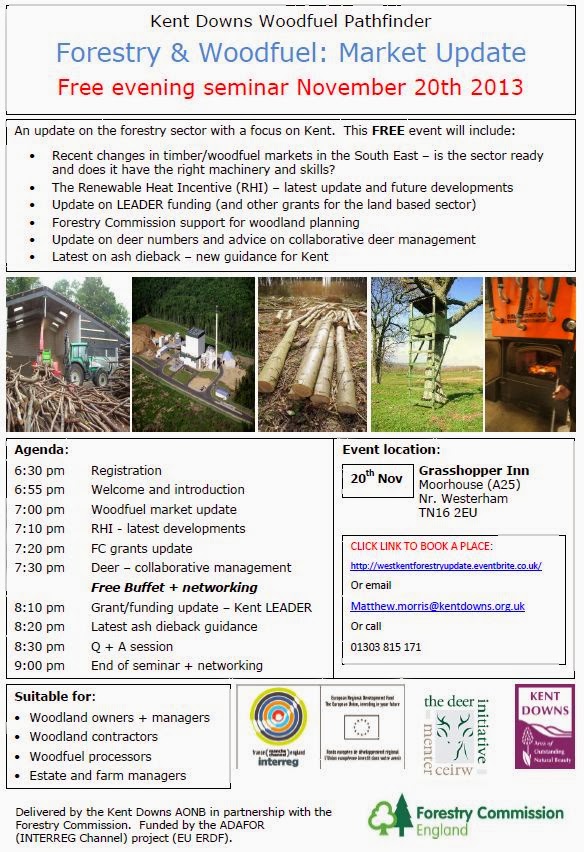
Forestry & Woodfuel - Market Update - FREE evening seminar

The Kent Downs Woodfuel Pathfinder, in partnership with the Forestry Commission and the Deer Initiative, will present an update on the forestry and woodfuel sectors in Kent on November 20th.

This free event will focus on the changes taking place in the forestry sector and provide insights into future opportunities.  

In particular the event will look at how improving markets for chip wood, in part stimulated by a new biomass power station in East Kent, may require  enhanced mechanisation and collaboration among forestry businesses.

The event will take place at the Grasshopper Inn at Moorhouse on the A25 near Westerham.  The event will open at 6:30 pm and will include a free buffet.

More details can be found below.

To book your free tickets please click here.


This event is funded by the EU ERDF Interreg IVa Channel project ADAFOR.