Showing posts with label energy tariff. Show all posts

Wednesday, 3 June 2015

RHI - tariff changes for biomass boilers announced

The Department of Energy and Climate Change has announced changes to the RHI tariffs for biomass in both the domestic and non-domestic schemes.

Domestic RHI

DECC announced on 29 May 2015 that the degression ‘super trigger’ for domestic biomass had been passed. 

This means that the current biomass tariff of 8.93p per kilowatt hour will be reduced by 20% to 7.14p per kilowatt hour for all new applications made from 1 July 2015.  The new tariff table is shown below.

To calculate the impact of this change simply multiply the tariff by the kWh total for space heating and hot water on your EPC (e.g. 15,000 kWh x 0.0893 = £1,339 per year for seven years).
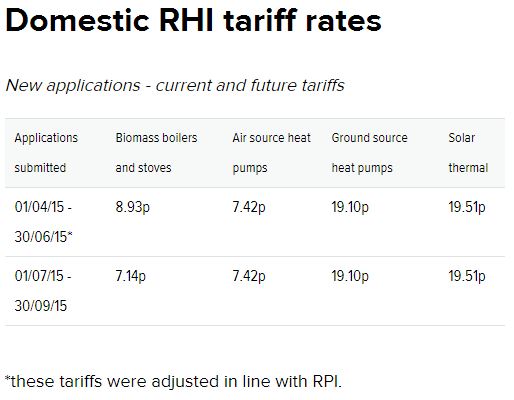


The tariffs for domestic air source heat pumps, ground source heat pumps and solar thermal are not affected by the 1 July 2015 degression.  Legacy applicants are not affected by degression.

Non-Domestic (Commercial) RHI

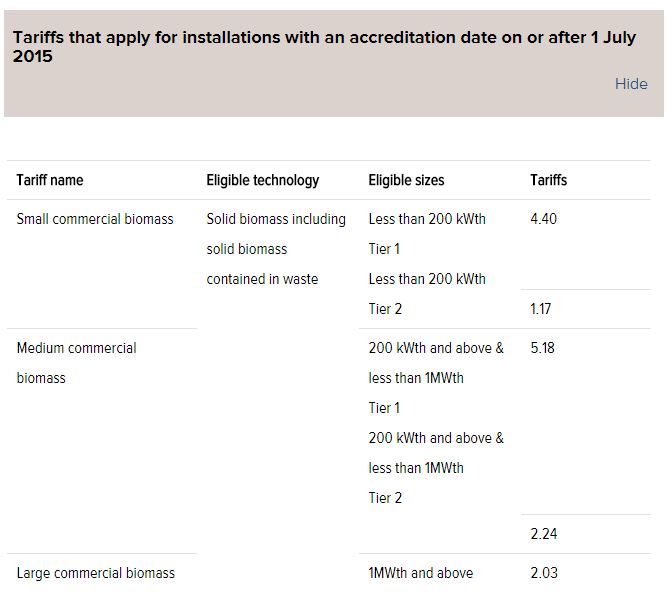
DECC has also announced a 25% reduction to the small commercial biomass tariff for the quarterly period starting on 1 July 2015.

This is a fairly significant reduction that will affect the economics of schemes up to 199 kW - particularly those involving wood pellets and the replacement (partial or full) of mains gas.

Nevertheless, a subsidy is still a subsidy and 4.4 p/kWh is still a positive contribution.

The risk with this degression is that larger boilers will be installed to gain the 'medium' tariff.  Whilst tempting this is likely to be a false economy as an over-sized boiler will be used less and is likely to have worse overall efficiency (it may well cost more as well).

Our advice would be to size correctly and be satisfied that a subsidy is still available.

If your sub-200 kW project is nearing completion then you have only a few weeks left to commission and apply in order to gain the current tariff (5.87 p/kWh).


More details can be found on the Ofgem website.

Monday, 9 December 2013

Renewable Heat Incentive - safe from degression (for the time being)

Following the most recent check on uptake Ofgem has announced that the commercial RHI tariffs will remain unchanged.

This was the first serious 'degression test' for the commercial RHI. DECC's figures show that both the small and medium commercial biomass tariffs had exceeded their degression trigger points:
  • Small commercial biomass: Forecast spend over the next 12 months is £32.3m. This is £4.3m over its individual technology trigger.
  • Medium commercial biomass: Forecast spend over the next 12 months for is £26.5m. This is £0.2m over its individual technology trigger.
However, because spend for all other tariff categories were considerably below their individual tariff thresholds for this quarter, and overall spend was within budget, Ofgem has decided to leave all tariffs unchanged.

Commercial RHI - total spend (Nov 14 2013)
Total forecast expenditure for the scheme (as of October 31st) was £70.3 million. 

As the £70.3m figure does not exceed either threshold (see below) the scheme has been left unchanged:
  • The “50% trigger” for the scheme as a whole as at 31 October is £71.6m.
  • The “100% trigger" for the scheme as a whole as at 31 October is £143.3m.
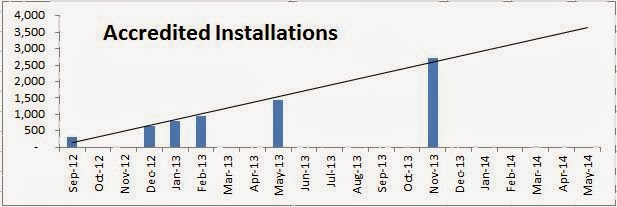
Biomass heating is clearly the biggest 'winner' from the commercial RHI. In contrast to the feed-in-tariff (FiT) for renewable electricity, which grew exponentially, RHI growth has been far more linear (and thus more predictable).


But as you can see the commercial RHI was very close to its degression trigger in October - for some tariffs - and we suspect that things may get even tighter in the near future.


Uptake of commercial RHI Source: KDAONB

The forecast spend for the small commercial biomass tariff means that it is already above its next quarters individual technology trigger (£30.9m on January 31st 2014).

This means that there is enhanced risk of degression in this tariff.  However, this would only occur if next quarter’s 50% trigger for overall expenditure of £83.2m was also exceeded.


RPI (%) Source: ONS
The good news is that the scheme overall is nearing its third 'inflation point' on April 1st 2014.  

The commercial RHI tariffs have already been increased by the Retail Prices Index (RPI) twice (4.8% in 2012, 3.1% in 2013) and the increase may help offset degression  if it happens.

However, the latest figures from the ONS show that the RPI is falling so the cushioning effect may not be so marked in April '14.