Showing posts with label degression. Show all posts

Wednesday, 3 June 2015

RHI - tariff changes for biomass boilers announced

The Department of Energy and Climate Change has announced changes to the RHI tariffs for biomass in both the domestic and non-domestic schemes.

Domestic RHI

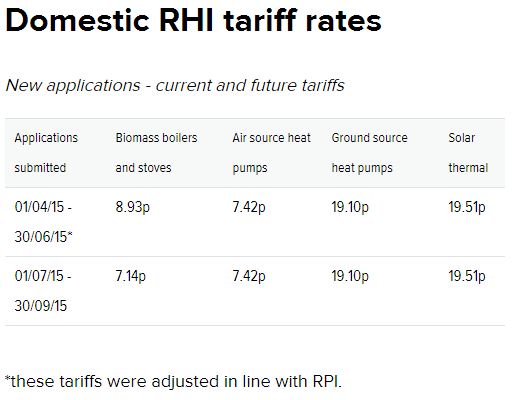
DECC announced on 29 May 2015 that the degression ‘super trigger’ for domestic biomass had been passed. 

This means that the current biomass tariff of 8.93p per kilowatt hour will be reduced by 20% to 7.14p per kilowatt hour for all new applications made from 1 July 2015.  The new tariff table is shown below.

To calculate the impact of this change simply multiply the tariff by the kWh total for space heating and hot water on your EPC (e.g. 15,000 kWh x 0.0893 = £1,339 per year for seven years).


The tariffs for domestic air source heat pumps, ground source heat pumps and solar thermal are not affected by the 1 July 2015 degression.  Legacy applicants are not affected by degression.

Non-Domestic (Commercial) RHI

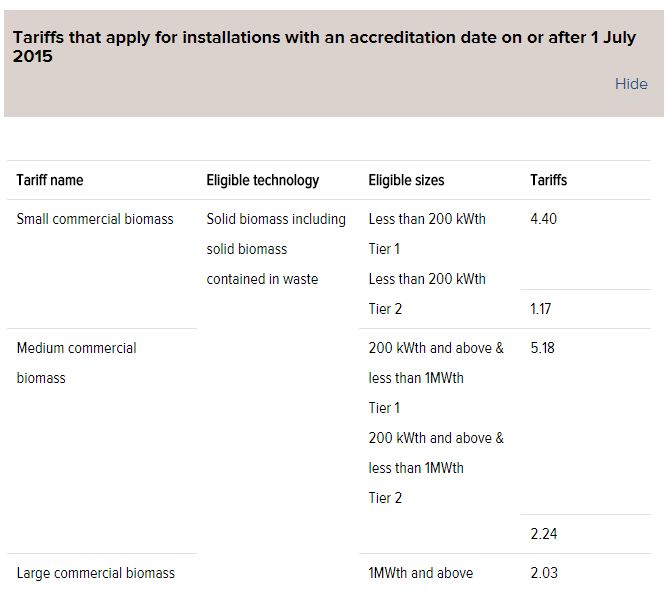
DECC has also announced a 25% reduction to the small commercial biomass tariff for the quarterly period starting on 1 July 2015.

This is a fairly significant reduction that will affect the economics of schemes up to 199 kW - particularly those involving wood pellets and the replacement (partial or full) of mains gas.

Nevertheless, a subsidy is still a subsidy and 4.4 p/kWh is still a positive contribution.

The risk with this degression is that larger boilers will be installed to gain the 'medium' tariff.  Whilst tempting this is likely to be a false economy as an over-sized boiler will be used less and is likely to have worse overall efficiency (it may well cost more as well).

Our advice would be to size correctly and be satisfied that a subsidy is still available.

If your sub-200 kW project is nearing completion then you have only a few weeks left to commission and apply in order to gain the current tariff (5.87 p/kWh).


More details can be found on the Ofgem website.

Monday, 9 December 2013

Renewable Heat Incentive - safe from degression (for the time being)

Following the most recent check on uptake Ofgem has announced that the commercial RHI tariffs will remain unchanged.

This was the first serious 'degression test' for the commercial RHI. DECC's figures show that both the small and medium commercial biomass tariffs had exceeded their degression trigger points:
  • Small commercial biomass: Forecast spend over the next 12 months is £32.3m. This is £4.3m over its individual technology trigger.
  • Medium commercial biomass: Forecast spend over the next 12 months for is £26.5m. This is £0.2m over its individual technology trigger.
However, because spend for all other tariff categories were considerably below their individual tariff thresholds for this quarter, and overall spend was within budget, Ofgem has decided to leave all tariffs unchanged.

Commercial RHI - total spend (Nov 14 2013)
Total forecast expenditure for the scheme (as of October 31st) was £70.3 million. 

As the £70.3m figure does not exceed either threshold (see below) the scheme has been left unchanged:
  • The “50% trigger” for the scheme as a whole as at 31 October is £71.6m.
  • The “100% trigger" for the scheme as a whole as at 31 October is £143.3m.
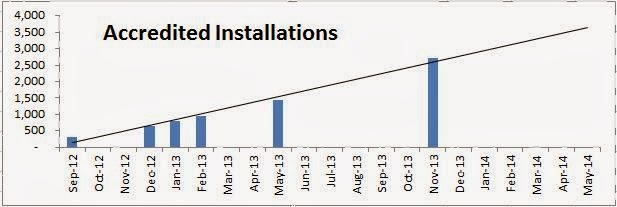
Biomass heating is clearly the biggest 'winner' from the commercial RHI. In contrast to the feed-in-tariff (FiT) for renewable electricity, which grew exponentially, RHI growth has been far more linear (and thus more predictable).


But as you can see the commercial RHI was very close to its degression trigger in October - for some tariffs - and we suspect that things may get even tighter in the near future.


Uptake of commercial RHI Source: KDAONB

The forecast spend for the small commercial biomass tariff means that it is already above its next quarters individual technology trigger (£30.9m on January 31st 2014).

This means that there is enhanced risk of degression in this tariff.  However, this would only occur if next quarter’s 50% trigger for overall expenditure of £83.2m was also exceeded.


RPI (%) Source: ONS
The good news is that the scheme overall is nearing its third 'inflation point' on April 1st 2014.  

The commercial RHI tariffs have already been increased by the Retail Prices Index (RPI) twice (4.8% in 2012, 3.1% in 2013) and the increase may help offset degression  if it happens.

However, the latest figures from the ONS show that the RPI is falling so the cushioning effect may not be so marked in April '14.

Monday, 8 July 2013

Latest results from Renewable Heat Incentive (RHI) show steady uptake

Ofgem's latest set of results for the Renewable Heat Incentive (RHI) paint a positive picture about the uptake of the World's first renewable heat incentive.  

Whilst the numbers overall are still small uptake accelerated during the first 15 months of the scheme and installed capacity approximately doubled every quarter.

At the end of March '13 there were 1,238 approved installations and a further 649 being processed.  Only eight applications had been rejected. Total installed capacity was 266 MW and these installations had generated 168 million kWhth.  Cumulative payments were £7.62m.


The technology split is still dominated by biomass (92%) with solar thermal and ground source heat pumps making up the majority of the remainder (3.9% and 3.4%, respectively).

The emergence of solar thermal as the second most installed technology under the RHI is interesting. It is not clear what the split is between stand-alone systems and those integrated with biomass systems. As Jamie Oliver would say biomass boilers and solar panels are "best friends" and the latter can make a useful contribution to the overall efficiency (and no doubt payback) of a biomass system.


The message overall, therefore, appears positive. We of course know that the RHI has already had to return some of its funds due to under-performance, but given the long lead-in time for biomass and its relative high capital cost it is perhaps not surprising that the situation is 'steady'.

In Kent installation activity for biomass boilers is again steady. Of the projects we know about around 2 MW of biomass heating capacity has come on-stream since December '12. These project at a range of scales but most are in the sub-200 kW range at the moment. Most are chip systems with local fuel supply.

RHI Developments

Whilst the policy overall is very much intact there have been one or two changes that are of interest:


  • Medium tariff (200-999 kW): This tariff was inflated on April 1st 2013 and then promptly deflated by 5% (which effectively brought the tariff back to its pre-April 1st level). This only has a minor impact on the attractiveness of the tariff which, in our opinion, remains very good.
  • Large tariff (1 MW+): This was doubled to 2.0p.
These tariff adjustments are fairly straightforward and only to represent some fine-tuning rather than a radical re-think or withdrawal of support.  The small tariff has remained unchanged to date.  The current tariff is shown below and can be found here. 

The Ofgem website indicates that the next tariff table will be published on September 15th. It is not known at this stage whether more changes are planned...we will keep an eye out.


Other developments include:

Degression

On 30 April 2013 the Renewable Heat Incentive Scheme (Amendment) Regulations 2013 came into effect. These regulations introduced:

  • A long term cost control mechanism, otherwise referred to as the degression mechanism.
  • removal of the provisions relating to the scheme suspension mechanism (Stand-by Budget Mechanism) introduced in the Renewable Heat Incentive Scheme (Amendment) Regulations 2012.
The degression mechanism enables reductions to be made to an individual tariff, or all tariffs, if certain requirements set out in the RHI (Amendment) Regulations are met. It aims to ensure that the non-domestic RHI does not exceed its fixed annual budgets by lowering tariffs to bring deployment down
in line with affordable levels.

Simplification of metering requirements

DECC is addressing issues raised by stakeholders about the complexity of metering requirements and the proportion of complex systems. DECC is addressing this by requiring that the installation only installs meters necessary for the RHI payment formula. This will allow heat loss from external
pipework to be disregarded in specific circumstances (ie if properly insulated). If it is either physically or financially problematic to install a heat meter, we will allow applicants to instead submit a heat loss calculation.

A number of industry associations are taking steps to develop RHI specific training and assessment programmes for those that wish to provide Independent Reports on Metering Arrangements (IRMA). In the interim the Building and Engineering Services Association has published a Guide to Good Practice for Heat Metering in the RHI.

Air quality (AQ) compliance

DECC is introducing requirements for all biomass burning installations to submit a valid certificate or an environmental permit with their application. This will need to show that the boiler complies with the required AQ limits. All applicants with biomass burning installations will now need to submit an RHI emission certificate or a valid environmental permit with their application. If an applicant is submitting an RHI emission certificate it will need to show that the boiler complies with the specified air quality limits.


Wednesday, 1 August 2012

Renewable Heat Incentive: Providing certainty, improving performance

Here at Woodfuel Pathfinder Towers we have been trying to decipher the recent slew of information on the Renewable Heat Incentive and related matters.  


Just as we got our collective heads around the review of the Clean Air Act, new Ofgem guidance on heat metering and scheme administration and announcement of DECC’s budget management mechanism yet another consultation on the RHI has been issued.


The “Renewable Heat Incentive: Providing certainty,improving performance” sets out a series of proposals for the non-domestic RHI (Phase I) relating to longer-term budget management and scheme improvements, including biomass sustainability, air quality and changes to the metering requirements.


Needless to say the document is long and technical so we have attempted to extract the salient points from the executive summary.  


The proposals are important and anyone considering investing should set aside a some to read the document and familiarise themselves with the proposed changes, particularly as we may have missed something.


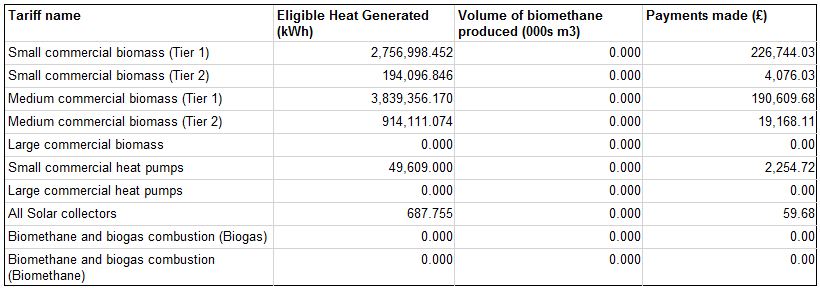
Before we get going we thought we would highlight the following tables that show the latest position on RHI uptake and payments (England only, see Ofgem web site for full report).


Renewable Heat Incentive: Providing certainty, improving performance

Executive summary – key points:

  • Controlling spend while providing certainty and transparency is a far greater challenge than simply keeping within a pre-determined budget.
  • The consultation sets out proposals for longer-term budget management and how DECC will aim to provide market certainty alongside budgetary control.
  • These proposals would only apply to new applications and only to the RHI scheme as it currently stands (i.e. non-domestic). Proposals would be extended to other technologies brought into the non-domestic scheme, which will be consulted on from September 2012.
  • Budget management proposal is to use a flexible degression-based system. Under this system tariff reductions for new applications would occur if deployment was approaching pre-determined triggers, at which point a small tariff reduction would occur automatically.
  • Proposed triggers for each technology and for the RHI overall will be based on the level of deployment required to keep us on a trajectory to deliver the 2020 renewables target.
  • Degression announcements would be made quarterly, with one month’s notice being given for any reductions.
  • Triggers for tariff reductions will be set out in advance and progress towards those triggers will be monitored and made available monthly on the DECC website.


  • The size of possible reductions would also be set out in advance, with a small reduction if deployment is slightly above that needed, and a larger reduction if deployment is significantly higher than that needed for the 2020 renewables targets.
  • In addition, DECC is proposing to carry out periodic reviews of the RHI, starting in 2014, to take stock of the evidence on the operation of the scheme and consider ways of improving it further. These reviews will provide an opportunity to recalibrate tariffs and if necessary, make changes to the tariff structure.
  • DECC has set out a potential option, enhanced preliminary accreditation. This would allow applicants to develop and accredit an installation that, when built, would receive a tariff guaranteed at the point of application for enhanced preliminary accreditation. Applications would be subject to time and size limits according to each technology.
  • It is equally important that the RHI is sustainable in the wider sense, so DECC will put forward proposals for biomass sustainability criteria.
  • The proposals are that biomass used for heat will have to achieve a lifecycle greenhouse gas (GHG) saving of 60% against an EU fossil heat average. The lifecycle assessment would take account of emissions from cultivation, processing and transport of the biomass, and reflect the conversion efficiency of the boiler plant. This would ensure a significant GHG saving relative to the use of coal, oil or fossil gas for heating.
  • Furthermore, for wood-fuel, we propose that the land criteria correspond to meeting the UK public procurement policy on wood and wood products. This approach requires that suppliers should have available documentary evidence demonstrating the wood supplied is from legal and sustainable sources or is from a licensed Forest Law Enforcement, Governance and Trade (FLEGT) partner.
  • For installations below 1MWth capacity, DECC proposes that, from April 2014, they have to purchase their biomass from an approved supplier list. For larger installations DECC proposes that RHI participants would provide reports on the sustainability of their fuel to Ofgem.
  • In the March 2011 RHI policy document DECC committed to introducing limits on the emissions of particulate matter (PM) and oxides of nitrogen (NOx) from biomass installations up to 20MWth capacity. This consultation proposes what the compliance regime should be for those emissions limits.
  • The consultation sets out proposals for simplifying the metering arrangements. DECC proposes that, in most cases, heat transported in external pipes insulated to a specified standard will be eligible heat use and will not be deducted from RHI payments. Therefore, where all heat uses are eligible, only the metering of eligible renewable heat generation would be required.


Other improvements:
  • clarifying the eligibility around ground source heat pumps
  • allowing renewable heat plants to be moved under the RHI
  • clarifying eligible heat use
  • simplifying the rules for biogas metering
  • ensuring biomass boilers are not oversized specifically to claim the tier 1 tariff
  • dealing with how the Retail Price Index (RPI) applies to low tariffs, such as large biomass


With regard to boiler sizing Biomass DECC has anecdotal evidence that there may be installations of biomass boilers which are inappropriate for the heat demand they are intended to serve but have been sized in order to claim the tier 1 tariff only. DECC considers this to be poor practice and is likely to have a detrimental long-term financial impact on the owner of the installation. DECC intends to introduce an eligibility requirement to prevent such installations from benefitting from the RHI.

For all the proposed changes, apart from those on sustainability, within this consultation grandfathering will apply; only applications which are accredited after these changes come into force will be affected. All those installations accredited currently or before these changes, will have to meet current eligibility requirements.