Showing posts with label ground source heat pump. Show all posts

Thursday, 8 August 2013

Domestic RHI - summary of scheme proposals

DECC has published its response to the consultation on the domestic version of the Renewable Heat Incentive (RHI).  The response includes a lot of detail on the types of technology that will be supported, their 'performance' and the type of properties and tenure that will be eligible.

To assist readers we have produced a summary of the proposals as they stand.  This can be found here.

The proposals for biomass heating are of particular interest to this blog.  The main points of interest include:


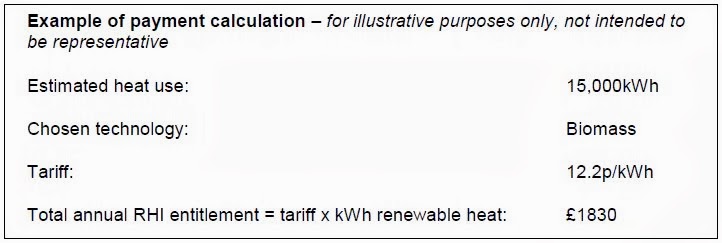
  • The tariff for biomass has increased from 8.7 p/kWh (initially proposed in 2012) to 12.2 p/kWh.  Whilst this is slightly below the 13-15 p/kWh we would have liked to see it is clearly an improvement.  The final tariff is yet to be announced but presumably it will be well before the proposed scheme opening date of April 1st 2014.

  • The tariff will be paid over seven years according to deemed heat.  This is the heat load as determined by the EPC that is created during a Green Deal assessment which is a mandatory requirement.
  • Legacy systems installed since 15th July 2009 will also be eligible providing they were installed by an MCS accredited company.  
  • Biomass equipment will need to meet meet air quality standards in relation to particulate matter (PM) and oxides of nitrogen (NOx). Legacy installations, installed between 15th July 2009 and the launch of the scheme, will not need to meet this requirement.
  • A new requirement around fuel sustainability will be introduced for  biomass installations.  To be eligible for and continue to receive RHI support for a biomass system, fuel needs to be sourced from a supplier registered on an approved supplier list. Such a list will be set up ahead of the launch of the scheme and will be the same one that is being established for the non-domestic RHI scheme.
The final point on sustainability is interesting and has important implications for wood fuel suppliers. To be included on the list, DECC intends that fuel suppliers will have to meet two criteria from April 2014:

  • Supply fuel which complies with the greenhouse gas (GHG) lifecycle emissions target of achieving 60% GHG savings against the EU fossil fuel heat average, assuming a boiler efficiency of 70%.
  • Report their performance against the relevant land criteria from the following list (although compliance with the criteria will not initially be required):

Evidence of legality and sustainability can come in two forms:

  • Category A evidence is independent certification of the timber/ timber products by any of the forest certification schemes that meet the policy requirements (such as FSC and PEFC).
  • Category B evidence is alternative documentary evidence that provides assurance that the source is legal and sustainable.
Category A evidence is the 'belt and braces' approach and undoubtedly involves the procurement of external expertise from Forest Stewardship Council and the accredited certification bodies are authorised to issue FSC certificates.

The alternative is Category B evidence and you will be glad to hear that this includes use of the Forestry Commission's Woodland Planning Grant (WPG) that falls under the English Woodland Grant Scheme (EWGS).  

However, the WPG Category B option is open to owners with less than 100 hectares of woodland, and more than 3 hectares, and whose woodlands are not certified.  As such it is envisaged that owners with more than 100 hectares will pursue the Category A, full certification option.

As ever we would recommend a good read of the full DECC document to make sure you pick up all of the salient points.


Monday, 8 July 2013

Latest results from Renewable Heat Incentive (RHI) show steady uptake

Ofgem's latest set of results for the Renewable Heat Incentive (RHI) paint a positive picture about the uptake of the World's first renewable heat incentive.  

Whilst the numbers overall are still small uptake accelerated during the first 15 months of the scheme and installed capacity approximately doubled every quarter.

At the end of March '13 there were 1,238 approved installations and a further 649 being processed.  Only eight applications had been rejected. Total installed capacity was 266 MW and these installations had generated 168 million kWhth.  Cumulative payments were £7.62m.


The technology split is still dominated by biomass (92%) with solar thermal and ground source heat pumps making up the majority of the remainder (3.9% and 3.4%, respectively).

The emergence of solar thermal as the second most installed technology under the RHI is interesting. It is not clear what the split is between stand-alone systems and those integrated with biomass systems. As Jamie Oliver would say biomass boilers and solar panels are "best friends" and the latter can make a useful contribution to the overall efficiency (and no doubt payback) of a biomass system.


The message overall, therefore, appears positive. We of course know that the RHI has already had to return some of its funds due to under-performance, but given the long lead-in time for biomass and its relative high capital cost it is perhaps not surprising that the situation is 'steady'.

In Kent installation activity for biomass boilers is again steady. Of the projects we know about around 2 MW of biomass heating capacity has come on-stream since December '12. These project at a range of scales but most are in the sub-200 kW range at the moment. Most are chip systems with local fuel supply.

RHI Developments

Whilst the policy overall is very much intact there have been one or two changes that are of interest:


  • Medium tariff (200-999 kW): This tariff was inflated on April 1st 2013 and then promptly deflated by 5% (which effectively brought the tariff back to its pre-April 1st level). This only has a minor impact on the attractiveness of the tariff which, in our opinion, remains very good.
  • Large tariff (1 MW+): This was doubled to 2.0p.
These tariff adjustments are fairly straightforward and only to represent some fine-tuning rather than a radical re-think or withdrawal of support.  The small tariff has remained unchanged to date.  The current tariff is shown below and can be found here

The Ofgem website indicates that the next tariff table will be published on September 15th. It is not known at this stage whether more changes are planned...we will keep an eye out.


Other developments include:

Degression

On 30 April 2013 the Renewable Heat Incentive Scheme (Amendment) Regulations 2013 came into effect. These regulations introduced:

  • A long term cost control mechanism, otherwise referred to as the degression mechanism.
  • removal of the provisions relating to the scheme suspension mechanism (Stand-by Budget Mechanism) introduced in the Renewable Heat Incentive Scheme (Amendment) Regulations 2012.
The degression mechanism enables reductions to be made to an individual tariff, or all tariffs, if certain requirements set out in the RHI (Amendment) Regulations are met. It aims to ensure that the non-domestic RHI does not exceed its fixed annual budgets by lowering tariffs to bring deployment down
in line with affordable levels.

Simplification of metering requirements

DECC is addressing issues raised by stakeholders about the complexity of metering requirements and the proportion of complex systems. DECC is addressing this by requiring that the installation only installs meters necessary for the RHI payment formula. This will allow heat loss from external
pipework to be disregarded in specific circumstances (ie if properly insulated). If it is either physically or financially problematic to install a heat meter, we will allow applicants to instead submit a heat loss calculation.

A number of industry associations are taking steps to develop RHI specific training and assessment programmes for those that wish to provide Independent Reports on Metering Arrangements (IRMA). In the interim the Building and Engineering Services Association has published a Guide to Good Practice for Heat Metering in the RHI.

Air quality (AQ) compliance

DECC is introducing requirements for all biomass burning installations to submit a valid certificate or an environmental permit with their application. This will need to show that the boiler complies with the required AQ limits. All applicants with biomass burning installations will now need to submit an RHI emission certificate or a valid environmental permit with their application. If an applicant is submitting an RHI emission certificate it will need to show that the boiler complies with the specified air quality limits.