Showing posts with label renewable heat incentive. Show all posts

Tuesday, 22 September 2015

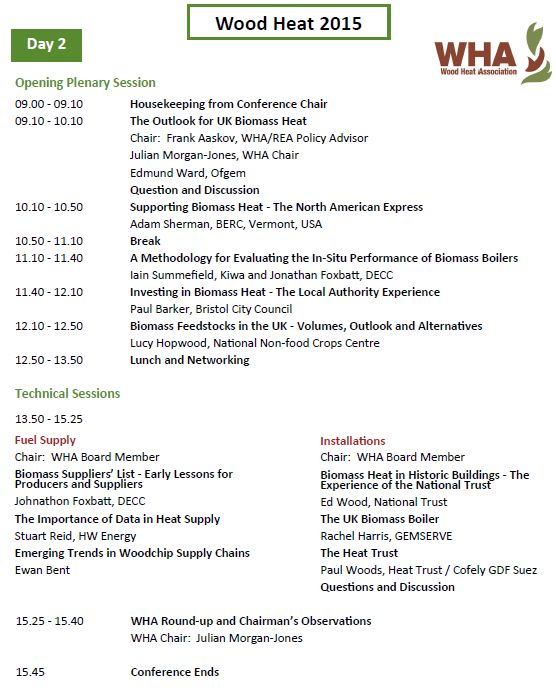
Wood Heat Conference 2015 - Now open for bookings


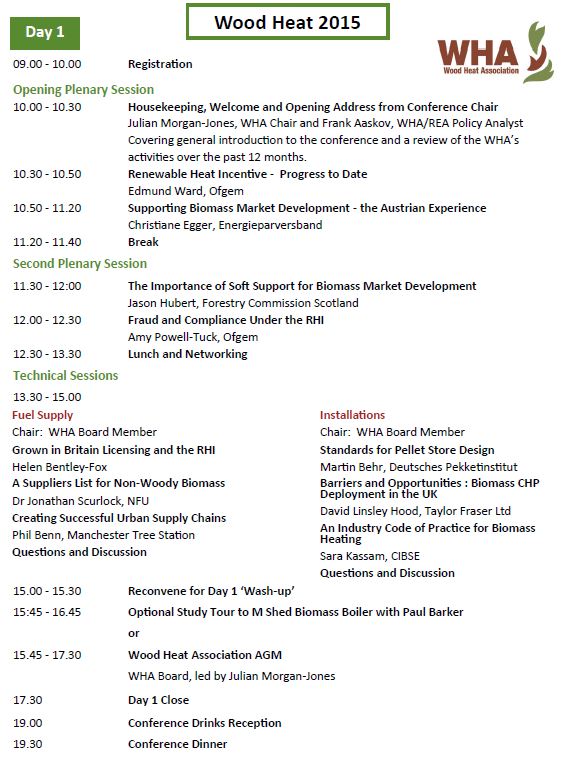
The 2015 Wood Heat conference is now open for bookings.

Despite degression, the UK renewable heat industry continues to grow thanks to effective support from the Renewable Heat Incentive.

Of all the renewable heat technologies, wood and biomass heat is still outperforming all others.

The UK's dedicated biomass and wood heat industry conference will run three weeks prior to the Government's Comprehensive Spending Review, offering the opportunity to learn from the experiences of UK businesses and those overseas.

The conference has the sub-title “Raising Our Standard”, and speakers will cover subjects including:

  • Fraud and compliance under the RHI
  • Soft support for the biomass heat sector in Scotland, Austria and the USA
  • Biomass CHP deployment in the UK
  • Evaluating the in-situ performance of biomass boilers - results from DECC research
  • The UK biomass boiler market


The conference will include a host of other subjects for all parts of the wood heat supply chain - installers and fuel producers/suppliers.

The conference will also include speakers from government, the Wood Heat Association and the Renewable Energy Association, enabling delegates to gain a thorough understanding of the opportunities available in the UK's modern wood heat and biomass industry.

The conference will take place on Wednesday 4th and Thursday 5th November 2015 in Bristol.

Full details can be found here.

Wednesday, 3 June 2015

RHI - tariff changes for biomass boilers announced

The Department of Energy and Climate Change has announced changes to the RHI tariffs for biomass in both the domestic and non-domestic schemes.

Domestic RHI

DECC announced on 29 May 2015 that the degression ‘super trigger’ for domestic biomass had been passed. 

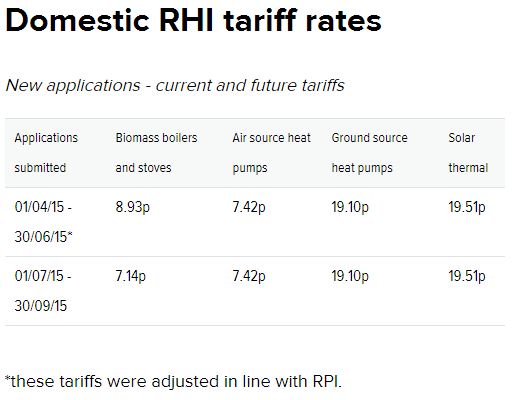
This means that the current biomass tariff of 8.93p per kilowatt hour will be reduced by 20% to 7.14p per kilowatt hour for all new applications made from 1 July 2015.  The new tariff table is shown below.

To calculate the impact of this change simply multiply the tariff by the kWh total for space heating and hot water on your EPC (e.g. 15,000 kWh x 0.0893 = £1,339 per year for seven years).


The tariffs for domestic air source heat pumps, ground source heat pumps and solar thermal are not affected by the 1 July 2015 degression.  Legacy applicants are not affected by degression.

Non-Domestic (Commercial) RHI

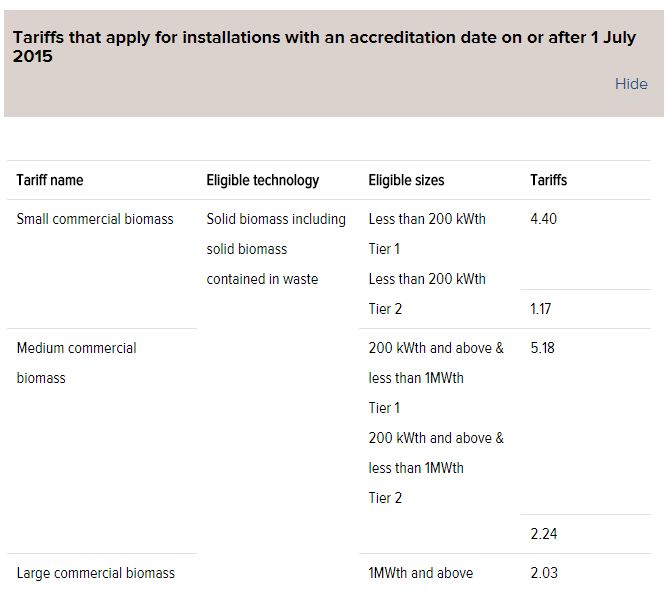
DECC has also announced a 25% reduction to the small commercial biomass tariff for the quarterly period starting on 1 July 2015.

This is a fairly significant reduction that will affect the economics of schemes up to 199 kW - particularly those involving wood pellets and the replacement (partial or full) of mains gas.

Nevertheless, a subsidy is still a subsidy and 4.4 p/kWh is still a positive contribution.

The risk with this degression is that larger boilers will be installed to gain the 'medium' tariff.  Whilst tempting this is likely to be a false economy as an over-sized boiler will be used less and is likely to have worse overall efficiency (it may well cost more as well).

Our advice would be to size correctly and be satisfied that a subsidy is still available.

If your sub-200 kW project is nearing completion then you have only a few weeks left to commission and apply in order to gain the current tariff (5.87 p/kWh).


More details can be found on the Ofgem website.

Friday, 23 January 2015

Forestry Commission - FREE forestry contractors events

Join the Forestry Commission for a free "pie and drink" at one of the southeast forestry contractor workshops being held this February/March. 

  • Hear about new markets in your county - who is out there.
  • Learn about the new grant options and how they could help grow your business.
  • Share your ideas and concerns with like minded colleagues.
  • Tell us how we could help and meet your local Forestry Commission team.

We are seeing signs of market recovery - woodfuel, new boiler installations with the Renewable Heat Incentive, estates switching to woodfuel to heat houses, the BSW purchase of the Giddings sawmill, and a revival in markets for chestnut.  

 How can forestry businesses make the most from this recovery?  

Come and share your thoughts and hear from others.

Did you know that woods in the southeast:

  • account for about a quarter of all England 's woods  - 326,000 ha covering 15.6% of land area (England average is 9.9% )
  • contain more than 30 million m3 of "overdue" wood as current harvesting removes less than a third (300,000 m3) of the total volume that grows each year
  • grow at a rate of more than 1,000,000 m3 a year but less than a 3rd of this is being harvested
  • are at risk of collapse through lack of management
Tell us if you are coming and how many, as places are limited, by clicking on the relevant link below and following the instructions. 

We look forward to meeting you. 

Wednesday 18th February - West Sussex and East Hampshire

Thursday 19th February - Kent (Lenham)

Monday 23rd February - South Hampshire

Tuesday 24th February – Oxfordshire and Buckinghamshire


Thursday 26th February - East Sussex

Friday 26th February - Isle of Wight

Wednesday 4th March - North Hampshire and West Berkshire

Friday, 9 January 2015

Working with wood chip at Hever Castle - FREE CLA event

You may have heard a bit about Hever Castle's wood fuel and biomass heating project already.  

If you want to learn more then Douch Biomass and South East Wood Fuels will host a talk and site visit at Hever on March 24th.

Full details can be found on the CLA website.  Details can also be found below.


Thursday, 23 October 2014

Development of Forestry Businesses - FREE Demonstration Workshops


The Forestry Commission will deliver three demonstration events in November.  
These are designed to illustrate how three forestry businesses located in the South East have grown over the last seven years and how Rural Development Programme England (RDPE) support has helped facilitate this growth.

The events are described below.  Contact and booking details can be found at the end of the article.

Friday 7th November – Balcombe Estate nr Crawley

Balcombe Estate has a long history of integrated woodland management maintaining their estate sawmill and pursuing new markets for wood products. 

RDPE support has helped them build their woodfuel supply business, including supporting the purchase of a 360 mounted harvester in partnership with a nearby estate. They are currently exploring how they can grasp the growing interest in locally grown timber by upgrading their sawmill and marketing. 

As they grow their business they are also exploring how they can work collaboratively with complimentary businesses and neighbours.

This event will include:
  • First hand experience of a previous grant recipient
  • A walking tour and demonstration of harvesting/firewood processing
  • Lunch and refreshments

This event will illustrate how entrepreneurial management and enthusiasm can grow forestry business in lowland England and how RDPE support and collaboration can help accelerate this process. 

This event will be of particular interest to anyone exploring how they can grow their forestry business in SE England. 

Registration from 9.45am for a 10am start. Lunch will be provided.

Tuesday 18th November - H G Matthews Brickworks nr Chesham

H G Matthews illustrates how a local business with high energy needs has developed the use of locally sourced wood as a fuel along with the supply chain to meet their needs. 

This event will be of particular interest to local businesses considering use of locally grown wood, contractors who are looking to expand or establish woodfuel supply chains and owners exploring options for woodfuel supply. 

This event will include:

First hand experience of a previous grant recipient
  • Walking tour of the brickworks
  • Lunch and refreshments at a nearby public house. 

Space is restricted and so we can only accommodate 20 individuals at this event. Only one person per company/organisation please. 

Registration from 9.45am for a 10am start. Lunch will be provided.

Thursday 27th November - Brockwood Park Farm nr Petersfield

Brockwood Park Farm illustrates how woodlands on farms and estates can be managed cost effectively to deliver woodfuel to heat the owner’s, neighbours’ and/or local business properties. 

Heating oil is becoming ever more expensive and few people realise that a tonne of seasoned wood can deliver as much heat as 350 litres of heating oil and you may be eligible for support from the Government’s Renewable Heat Incentive.

Alex Morton at Brockwood Park has carefully considered his options and brought together a package of equipment, infrastructure and skills to help him manage his woods extremely well and supply woodfuel to the adjacent school as well as heat his home. He is now exploring opportunities to extend his forestry management with neighbours.

This event will include:
  • First hand experience of a previous grant recipient
  • A walking tour of woodfuel processing site

Registration from 9.45am for a 10am start. 

As these are ‘on site’ visits spaces are limited and hence early registration is encouraged. To book please click here.

Thursday, 21 August 2014

RHI - biomass sustainability and Biomass Suppliers List (BSL)

Over the last few weeks we have received several emails from DECC regarding their policy for biomass sustainability that it applies to renewable energy subsidy schemes including the Renewable Heat Incentive (RHI) and Renewables Obligation (RO).

Given the volume of reading required to keep up with all of the recent announcements we have attempted a summary to enable readers to locate some of the important documents.

First up is the Biomass sustainability policy Q&A that was released following the consultation workshops that took place in London.  This is well worth a read as it neatly summarises some key questions as well as confirming the following:
  • Introduction of the greenhouse gas and land criteria in the RHI/RO biomass sustainability policy will now be introduced from Spring 2015.
  • Non-domestic RHI participants will have two methods of demonstrating compliance with the forthcoming sustainability criteria:
These 'criteria' are:

  • GHG criteria: Biomass fuel used by RHI participants must meet a lifecycle greenhouse gas (GHG) emissions target of 34.8g CO2 equivalent per MJ of heat, or 60% GHG savings against the EU fossil fuel average.
  • Land Criteria: For woodfuel the criteria are outlined in the UK Timber Standard for Heat and Electricity.
Woodfuel meets the Timber Standard for Heat & Electricity if it "...originates from an independently verifiable legal and sustainable source and appropriate documentation is provided to prove it."

Currently this documentation is obtained via one of two routes:
  • Category A: Evidence that the woodfuel originates from a legal and sustainable source can be provided through the use of independent certification of the wood by a recognised forest certification scheme (e.g. FSC, PEFC).
  • Category B: Evidence that the woodfuel originates from a legal and sustainable source can also be provided in the form of alternative/bespoke documentary evidence that provides sufficient assurance that the source of the wood is legal and sustainable (e.g. via a supplier registered on the BSL or via self-reporting - for more details click here).

Summary of post consultation decisions

Some changes have been introduce following the consultation and feedback received during workshops.  These changes are as follows:

  • New requirements to report on the proportion of ‘hardwood’ and ‘softwood’. There will be an additional requirement to report on whether any of the wood used was likely to have come from threatened or protected species.
  • Arboricultural residues will be deemed sustainable under the Timber Standard for the RO and RHI.
  • Not to exempt wood from diseased trees from the Timber Standard.   
  • To “deem sustainable” under the Timber Standard, trees removed from non-forest land for ecological reasons.
  • Not to exempt wind blow from the Timber Standard at this stage but to keep the evidence under review.
  • Not to exempt non-waste residues from sawmills from the Timber Standard.
  • To add ‘highly biodiverse grasslands’ to the list of protected land types in the land criteria for non-wood solid and gaseous biomass.
Copies of the original consultation document and Government Response can be can be viewed on the DECC website.

Further reading:


BSL guidance and Q & A 

UK Timber Standard for Heat and Electricity

DECC February 2013 Government Response document, announcing RHI sustainability criteria 

DECC December 2013 Government Response document, providing an update on RHI sustainability criteria

Ofgem Renewables Obligation sustainability guidance

EU 2010 Report on biomass sustainability

Monday, 11 August 2014

Renewable Heat Incentive - latest uptake figures from DECC

The latest RHI figures continue to demonstrate how successful the scheme has been at increasing the rate of renewable heat generation in Great Britain.

Biomass heating remains the clear 'winner' of the RHI and account for 94% of all installations, 99% of the installed capacity and 85% of the payments made under the scheme.  

Whilst the number of biomethane installations is small (just 3) they are starting to account for around 5.6% of the total payments made (which is great than the 'large biomass' category).  As I stated before this seems to demonstrate the enormous potential of biomethane production from anaerobic digestion.


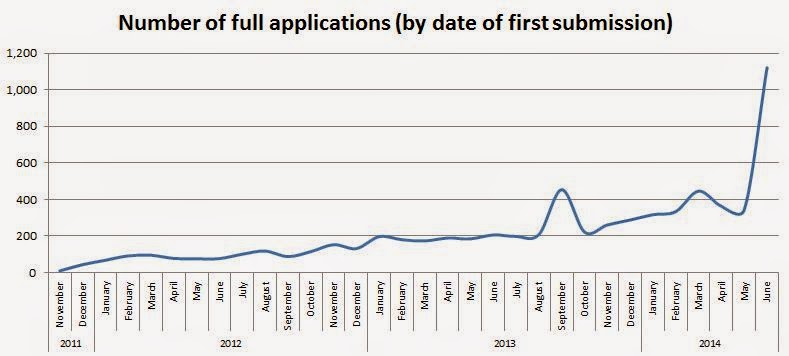
Of note, particularly to those considering installing a biomass system, is the recent acceleration in applications seen in June.


Whilst the precise reasons for this dramatic increase are not clear (backlog?) it is possible that it might lead to additional tariff adjustments later in the year (on top of the 5% reduction for small biomass implemented on July 1st).

In terms of geography the South West region continues to lead the way with 19% of all installations. 


In the South East, where this blog lives, Kent has the most accredited installations.


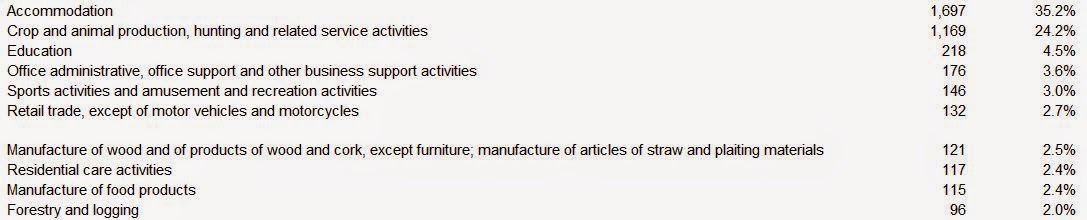
The top 10 business types benefiting from the RHI are shown in the table.


Will there be more tariff adjustments in 2014?

In simple terms - yes, quite likely.

The results of the next tariff review will be  the announcement on 31 August 2014 (with any changes commencing on 1 October 2014).

The data suggests the expenditure thresholds for the overall RHI budget are starting to be exceeded.  The cause of this is 'small biomass' tariff which is now well over its  expenditure threshold. 

This situation has been tolerated for a while because uptake of the non-biomass tariffs was, and still is, well below forecast and the overall budget was within its limits.  The difference now is that uptake of the 'small biomass' tariff has accelerated so fast that it has now impacted the finances of the overall scheme.

Given the scale of the current overspend it is possible that a 10% reduction in the 'small biomass' tariff might take place on October 1st.  This would reduce the tariff from 8.4 p/kWh (tier 1) and 2.2 p/kWh (tier 2) to 7.6 pence and 2.0 pence, respectively.

The impact of this reduction for a 199 kW biomass boiler is around £2,000 a year (although this depends heavily on the heat load and of course the actual meter readings).

Summary

There has been a large 'spike' in applications in June - whether this develops into a 'trend' is yet to be seen.  Regardless of this the scheme overall is starting to overspend and as such the rules for degression are clear.

Any decision to reduce tariffs (in October) will most likely affect the 'small biomass' tariff.

Any sub-200 kW installations that are currently in progress now have a clear signal to complete as soon as possible.  New projects, with an expected commissioning date post-October 1st, should probably factor-in a lower tariff for feasibility and business planning purposes.


Thursday, 26 June 2014

Non-domestic RHI - small biomass tariff reduced

Ofgem has announced that the small biomass tariff will be reduced by 5% from July 1st 2014.

This is in response to increasing uptake in the sub 200 kW category as well as higher than anticipated levels of eligible heat being submitted in meter readings.

This degression of the small biomass category follows the annual inflation increase that took place on April 1st.  This saw the tariff increase from 8.6 p/kWh (Tier 1) and 2.2 p/kWh (Tier 2) to 8.8 and 2.3 p/kWh, respectively.

The 5% reduction from July 1st will mean that the tariff falls again to 8.4 and 2.2 p/kWh (which is similar to the levels seen in 2012).


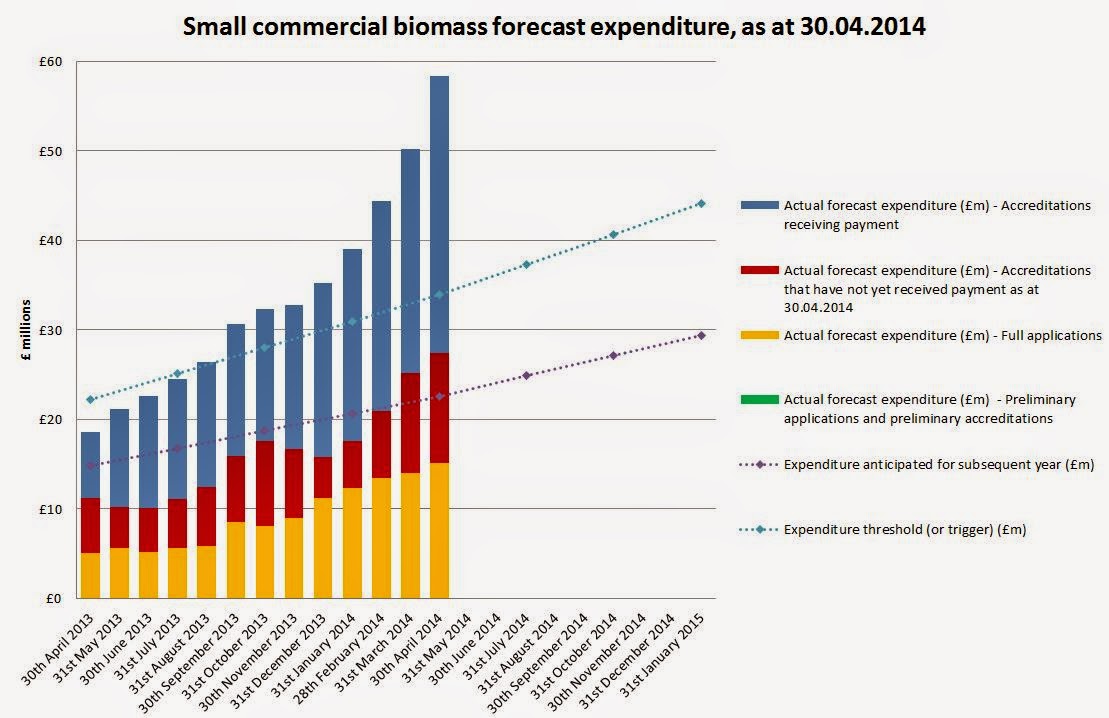
The latest uptake figures clearly indicate that whilst the RHI overall is operating within it budgets, uptake of the small biomass category has accelerated.


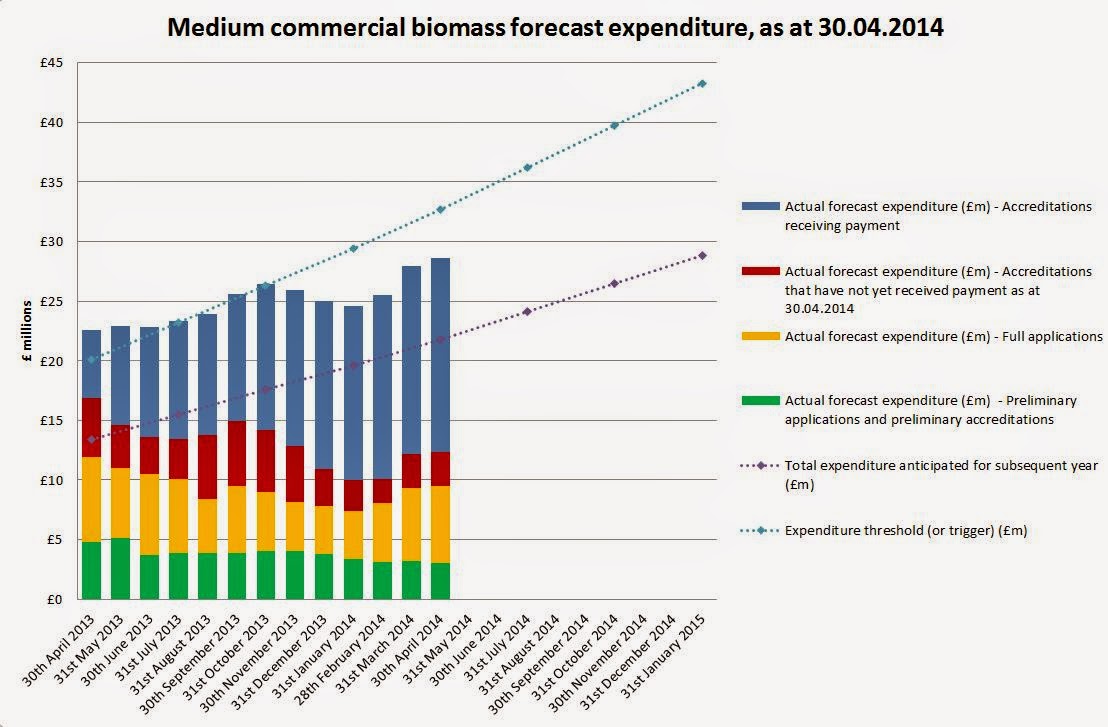
Meanwhile, uptake of the medium tariff remains strong but is currently operating below budget forecasts.


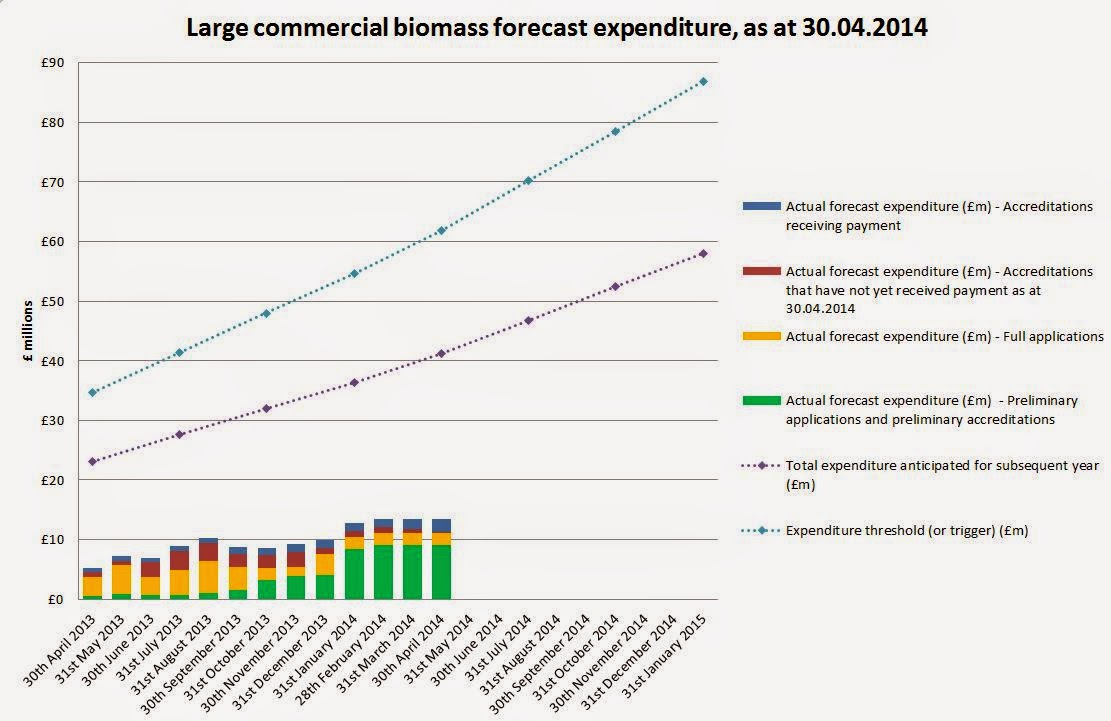
Activity in the large biomass tariff category is far lower than the other categories.  However, there are clearly a number of schemes at pre-application stage (green column) and these may start to have greater impact on budgets over the next 24 months.


Overall biomass heating remains the clear 'winner' in the non-domestic RHI.  The majority of the available budget (and installed capacity) is currently allocated to biomass technologies and activity in the other RHI-eligible technologies remains relatively modest. 

Monday, 2 June 2014

Training voucher scheme to help cross-skill heating engineers to renewable heating systems

The Department for Energy and Climate Change (DECC) has announced a £650,000 fund aimed at expanding the skill set of domestic heating engineers to include the installation and maintenance of renewable heating systems. 

Many of the people installing renewable heat technologies today come from the heating and plumbing sectors and most of the experience is related to oil, gas and LPG systems.


Whilst most conventional renewable technologies are based on familiar electrical, mechanical and hydraulic principles, renewable technologies bring with them a range of additional technical considerations that may not have been encountered during conventional oil, gas or LPG projects.  

Biomass heating, for example, is a proven and reliable technology, but a lack of installation experience can lead to technical difficulties, additional costs and sub-optimal performance.  For example, poorly designed fuel stores can lead to fuel degradation and high fuel delivery costs.

Giving consumers and installers reliable information is an important part of helping them make decisions about their heating system. With the launch of the domestic Renewable Heat Incentive it is important to ensure that consumers have a range of installers to consult, and that these installers are trained to the very latest standards.

The two main areas of support are as follows:

Short course vouchers for existing heating installers

  • The short course vouchers are aimed at existing plumbing and heating engineers in order to encourage them to undertake training in renewable heating technologies.
  • This part of the scheme will deliver vouchers worth 75% of the cost of the training and assessment, up to a maximum of £500 per voucher (including VAT).
  • A maximum of ten vouchers per company will be available. To be eligible the company must be a small to medium-sized enterprise (SME).

Vouchers will be available for:

  • Solar thermal
  • Heat pumps (both air source and ground source)
  • Biomass
  • For solar thermal and heat pump training courses to be eligible, the training must include a QCF assessment that leads to a qualification that is accredited by an awarding organisation. 

Apprenticeship support vouchers

  • The apprenticeship support scheme will support those nearing the end of their plumbing/heating apprenticeship to become skilled with one or more renewable technologies.
  • The apprenticeship support vouchers are worth up to £2,500(including VAT).
  • A maximum of ten vouchers per company will be available. To be eligible the company must be a small to medium-sized enterprise (SME).
  • If an apprentice has already chosen to take the “renewable technology” pathway, they can apply to extend the number of technologies within that pathway and use the funding to support that training.
  • If an apprentice has already selected a non-renewable pathway such as oil or gas, they can still apply and use the funding to take one or more of the QCF units in the renewable technology pathway.

Eligible training includes:

  • Understand the fundamental principles and requirements of environmental technology systems
  • Solar thermal (installation & service and maintenance)
  • Heat pump (installation & service and maintenance)
  • Biomass [solid fuel] (installation & service and maintenance)
  • In addition applications can be made from apprentices to support them in other ways, such as the provision of learning materials and, if required, assistance to enable them to access work types that they may require to complete their apprenticeship programme.

Full details can be found here.

Green heat technologies more affordable with RHI upgrade

The Department for Energy and Climate Change (DECC) has announced changes to the non-domestic (commercial) Renewable Heat Incentive (RHI).

The main changes are as follows:
  • Increased financial support for:
    • renewable CHP
    • large biomass boilers (over 1MW)
    • deep geothermal
    • ground source heat pumps
    • solar-thermal
    • biogas combustion
  • New technologies added:
    • air-water heat pumps
    • commercial and industrial energy from waste

  • An evolved approach to budget management:
    • Improved market intelligence has been used to inform growth rates across the range of renewable heating technologies supported
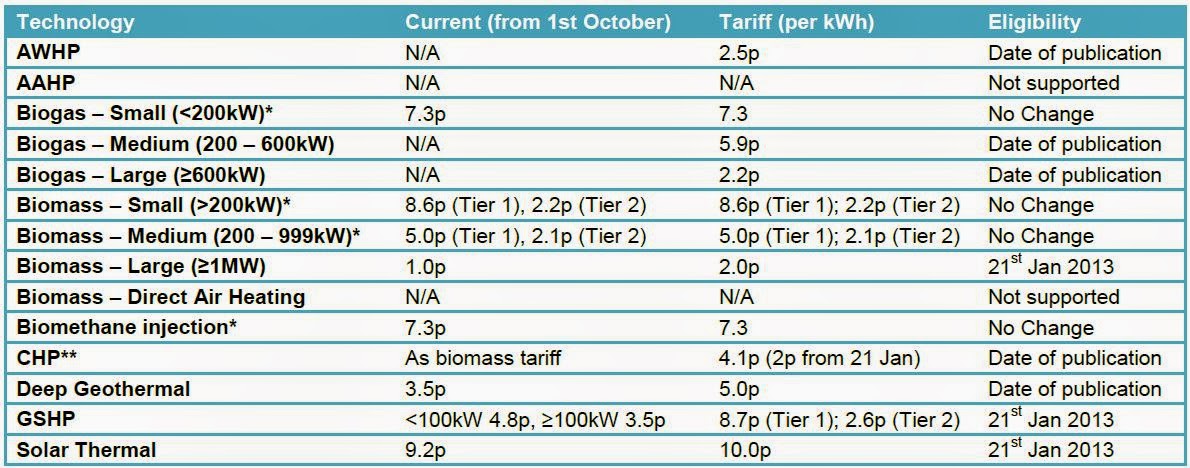
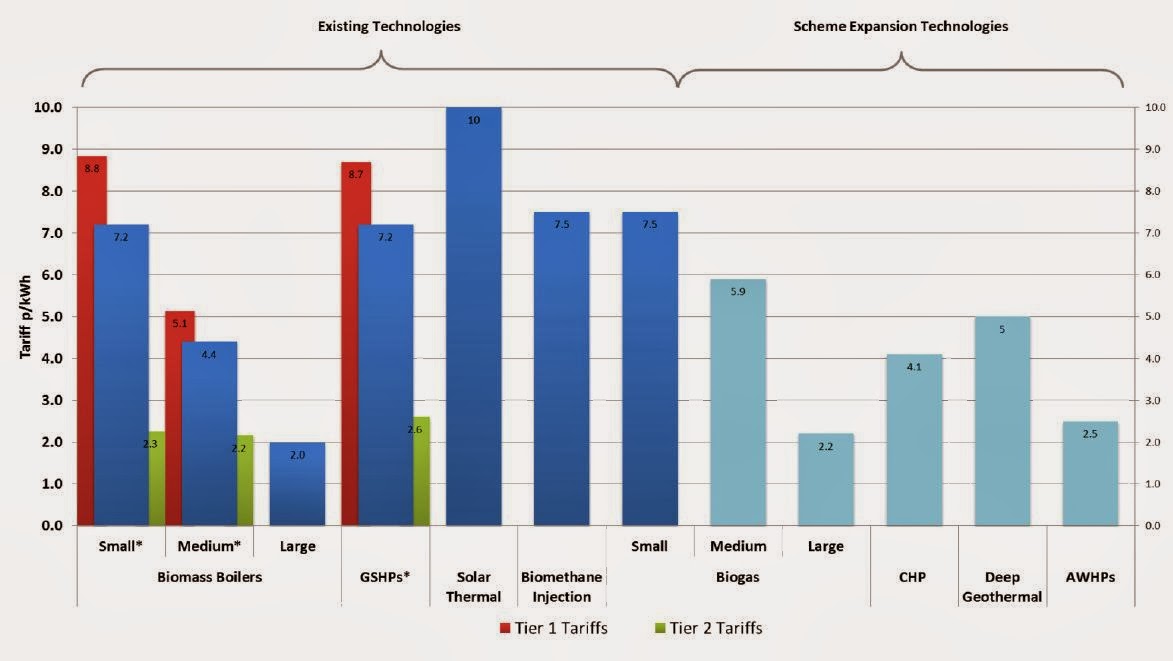
The updated tariff table is shown below.


These changes are the result of co-operation between industry and Government, and have been welcomed by the Renewable Energy Association (REA) and affiliated trade bodies.

"The RHI is now a truly world-leading renewable energy policy," said the REA's chief executive Dr Nina Skorupska. "Almost all renewable heat applications are now supported under the scheme, offering businesses greater choice than ever before on how to sustainably meet their heating needs.”

The Solar Trades Association provided evidence to Government in support of increasing the 'value for money cap' for renewable energy support programmes, which has enabled support for solar water heating to increase to 10p/kWh (from 9.2 pence/kWh).

Stuart Elmes, chair of the STA Solar Thermal Working Group, said: 

"The extra support for solar heating means that the economics will now stack up for more projects. More swimming pools, sports centres, food factories and hospitals will now be able to afford year-round heating from the sun."

We have also proposed that future improvements should include front-loading RHI payments for solar into the first seven years, as with the domestic scheme, to help businesses get over payback hurdles."

Support for large biomass heat has doubled (to 2p/kWh), but this technology sub-sector still draws the lowest fixed level of subsidy of any low carbon technology.

The newly formed Wood Heat Association (WHA) announced its affiliation to the REA last week. Speaking of these changes to the RHI, the WHA's interim chairman Julian Morgan-Jones said: 

"Under the previous cost-control mechanisms, wood heat was being unnecessarily constrained in order to preserve head room in the budget for heat pumps that was clearly not going to be used. The revised cost control mechanisms more closely match real world deployment and will ensure that wood heat can maximise its contribution to cost-effective emissions savings and renewable energy targets."

The RHI counts towards the UK's 2020 renewable energy target and helps reduce the UK's dependence on polluting fossil fuels. The above changes came into effect on May 28th 2014.

Full details can be found here.

Wednesday, 30 April 2014

New biomass sustainability requirements for the Renewable Heat Incentive

Ofgem has revealed more detail on how it intends to roll out and implement sustainability requirements for biomass fuels.

This is particularly important as it not only affects the owners and operators of RHI accredited biomass boilers but also producers and traders of biomass fuels.

The guidance applies to both the non-domestic (commercial) and domestic RHI and participants will need to comply with requirements from date they come into force (although the precise dates are not stated).

All participants are strongly encouraged to start sourcing from a supplier on the forthcoming Biomass Suppliers List (BSL) supplier in advance of the criteria coming into force later this year.

The new requirements also take into account participants who self-supply, for example an estate that processes wood chip from its own woodland.  Details on this can be found below.

From Autumn 2014 (no earlier than 1st October 2014)

Biomass fuel used by RHI participants must meet a lifecycle greenhouse gas (GHG) emissions target of 34.8g CO2 equivalent per MJ of heat.

Don't panic!  All this means is that the fuel (chip, logs, pellets) must achieve a 60% GHG saving against the EU fossil fuel average.  And it is the supplier of the fuel that has to demonstrate the GHG saving and not the end user (although the end user will have new reporting responsibilities if they are participating in the RHI).

From Spring 2015 (subject to the Parliamentary process)

Ofgem plans for biomass fuel to meet land criteria, which will differ for different types of biomass:
For woodfuel the criteria are outlined in the UK Timber Standard for Heat and Electricity.
How do non-domestic RHI participants comply?

This is rather simple actually.  A new Biomass Suppliers List (BSL) is currently being set up.  This is being managed by the good people at Woodsure who have been appointed by Ofgem to manage the BSL.  The alternative option is to self-report directly to Ofgem.

Participants can switch between these methods.  Of the two the BSL route sounds more straightforward to us.
  • Sourcing woodfuel from the Biomass Suppliers List (BSL)
    • Participants may still need to also provide Ofgem with a quarterly declaration that the biomass fuel they have used was sourced from a supplier registered on the BSL and marked as sustainable.
  • Self-reporting to Ofgem on the sustainability of their fuel
    • This will involve making a quarterly declaration to Ofgem of the lifecycle GHG emissions associated with each consignment of fuel used in that quarter, and provide an annual independent audit of the lifecycle GHG emissions associated with biomass used in that reporting year.
For the domestic RHI all fuel used from the date the criteria come into force must be sourced from a supplier registered on the BSL at the time the fuel was purchased. Participants are required to make an annual declaration to Ofgem that the biomass fuel used meets this requirement.

Self-suppliers (domestic and non-domestic) < 1 MW

Participants self-supplying woodfuel from the same estate as the installation will be able to register on the BSL as a self-supplier without undertaking an assessment against the sustainability criteria if the boiler is less than 1MW capacity. 

Ofgem recommendeds:
  • Self-suppliers provide some evidence of their ability to self-supply, such as a Forestry Commission approved management plan. 
  • Self-suppliers should register on the BSL before the sustainability criteria come into force in Autumn 2014.
Self-supplying participants who cannot meet all of their needs from their own woodland will be able to top up with fuel purchased from a BSL supplier.

Tuesday, 22 April 2014

Updated commercial RHI tariffs announced

Ofgem has recently released the updated tariffs for the commercial RHI scheme.  These changes have taken place primarily due to the annual inflation of the RHI, the third increase since the scheme was launched.  However, changes have also taken place in response to increasing uptake of the scheme, particularly in the small and medium biomass projects.

The inflation of the tariff, this year by 2.7%, affects those already in receipt of payments from Ofgem as well as installations that will become accredited after April 1st 2014.

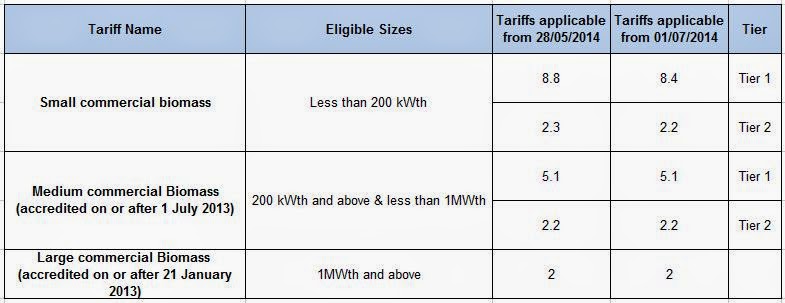
The following table focuses on the biomass tariff.  For example, for boilers sized up to 199 kW the Tier 1 tariff has increased from 8.6 p/kWh to 8.8 kWh (the Tier 2 tariff from 2.2 to 2.3 p/kWh).  The last column in the following table shows the updated tariff (from 01/04/2014).


Whilst these changes are not earth shattering the increases help to further enhance the economics of RHI accredited biomass boilers.  For example, the annual RHI payment for a 199 kW boiler serving a 280,000 kWh heat load would increase by around £500 per year.
The only downside to these changes is the reduction in the tariff for medium-scale biomass boilers that were accredited after July 1st 2013 (Tier 1 down to 5.1 p/kWh and Tier 2 remains at 2.2 p/kWh).  This change indicates that degression has taken place in the medium category due to rising uptake of the RHI in this category.

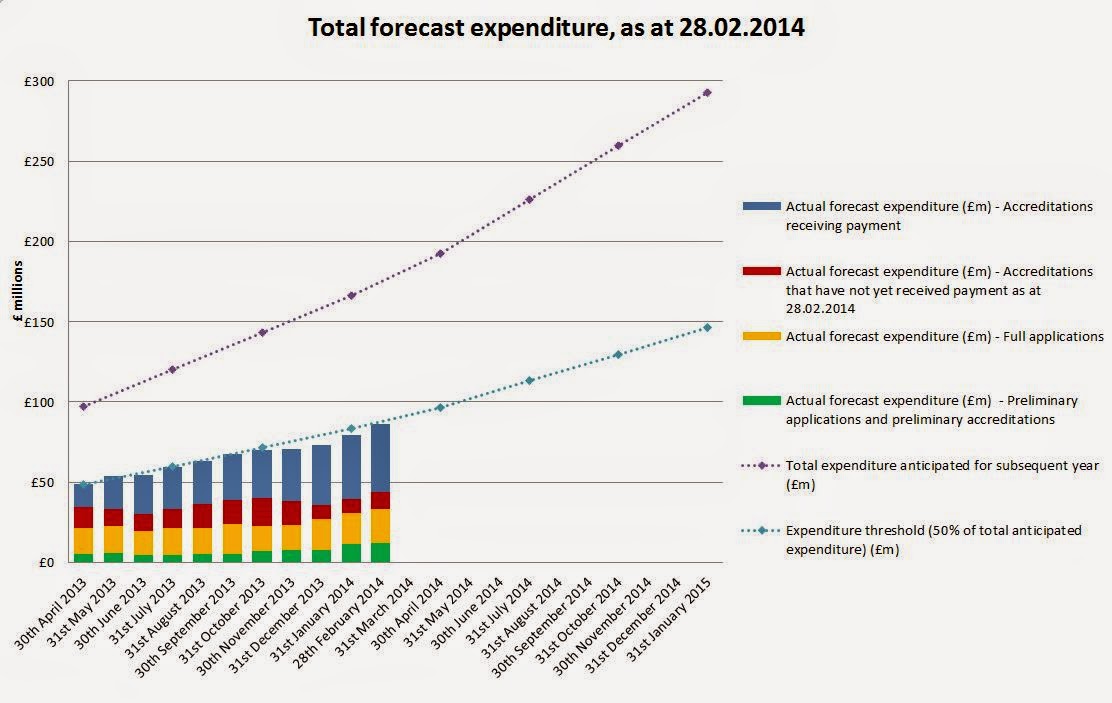
Whilst the overall expenditure for the RHI is proceeding according to forecast it is clear that the small biomass category has seen the largest increase in expenditure.


Ofgem states that:

"Forecast spend over the next 12 months for small commercial biomass is £44.4m. This means that estimated spend for this technology is already £10.4m above its 30 April 2014 individual technology trigger point of £34.0m. This increases the possibility of a reduction to this tariff in the next quarter. However, this would only occur if next quarter’s 50% trigger for the scheme as a whole of £96.4m was also exceeded, which would require a £10.1m increase in total expenditure over March and April."

Other developments include:

  • Forecast spend over the next 12 months for medium & large commercial biomass has increased by 4% and 6% respectively.
  • Forecast spend for small heat pumps has seen a significant increase of 25% in the last month.
  • Forecast spend for all other tariff categories have seen little to no activity this month and remain considerably below their individual tariff triggers for the next quarter.

The future risk of degression is summarised by Ofgem as follows:

"Whether any reductions occur next quarter depends on how well the scheme overall, and each technology tariff, performs during March and April and whether total scheme spend grows by £10.1 million in that time. An increase of this size would occur if the scheme was to continue to grow at the rate we have seen this month which would cause the 50% total scheme trigger of £96.4m to be hit. DECC will receive the data needed to make this forecast in May, and will publish the next quarterly degression announcement by 1 June 2014, following which, any reduced tariffs would come into effect from 1 July 2014."
Tuesday, 21 January 2014

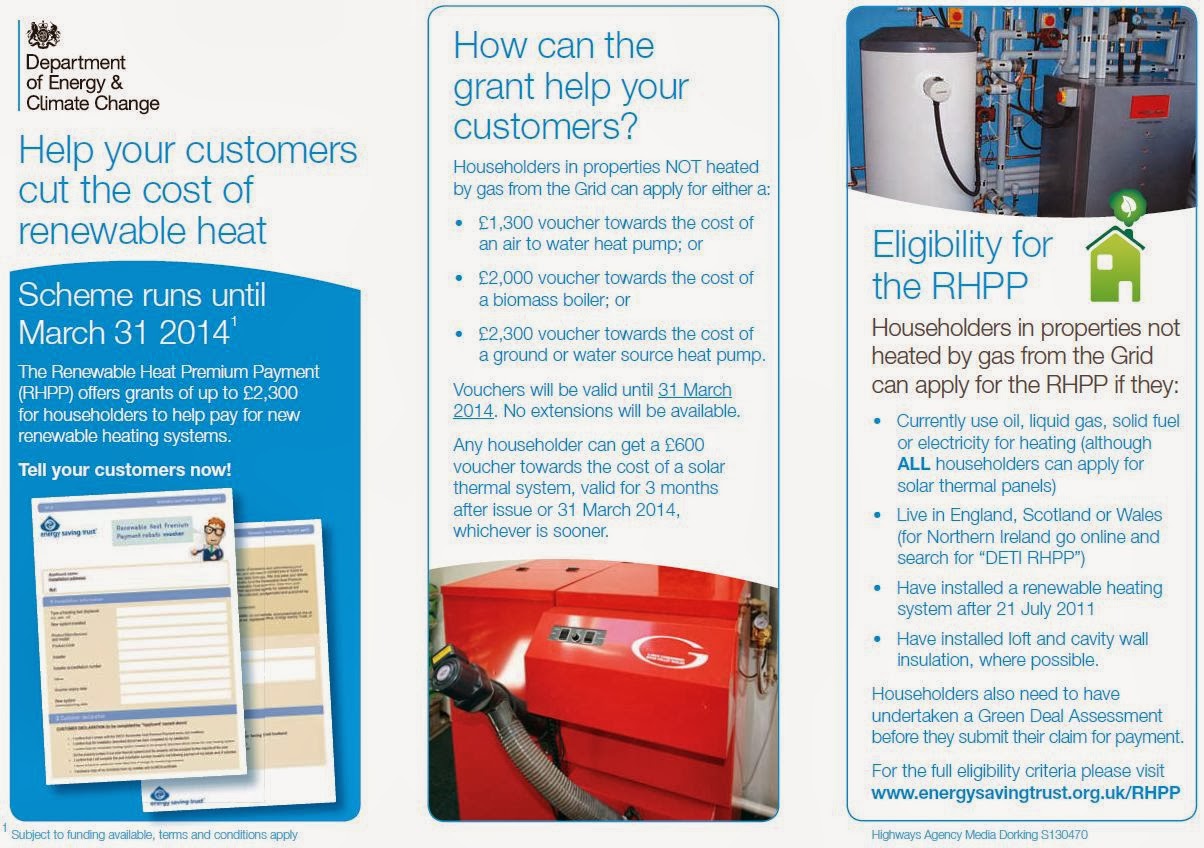
RHPP due to end soon - £2,000 grant towards the cost of a biomass boiler


Last chance for off-the-gas-grid households who want to make the most of the Government’s one-off grant designed to help meet the costs of installing renewable technologies in homes across the country.

The Renewable Heat Premium Payment Scheme will close on March 31st 2014 and householders are encouraged to apply now before it’s too late. 

Grants of up to £2,300 are available for households to help pay for new renewable heating systems including biomass boilers and ground, water source or air-to-water heat pumps.

The cut-in date for this scheme is 21st July 2011 and participating households must have undertaken a Green Deal assessment.

Vouchers will be valid until 31 March 2014  when all required paperwork will need to be submitted for payment  to the Energy Saving Trust. No extensions will be available to this deadline.

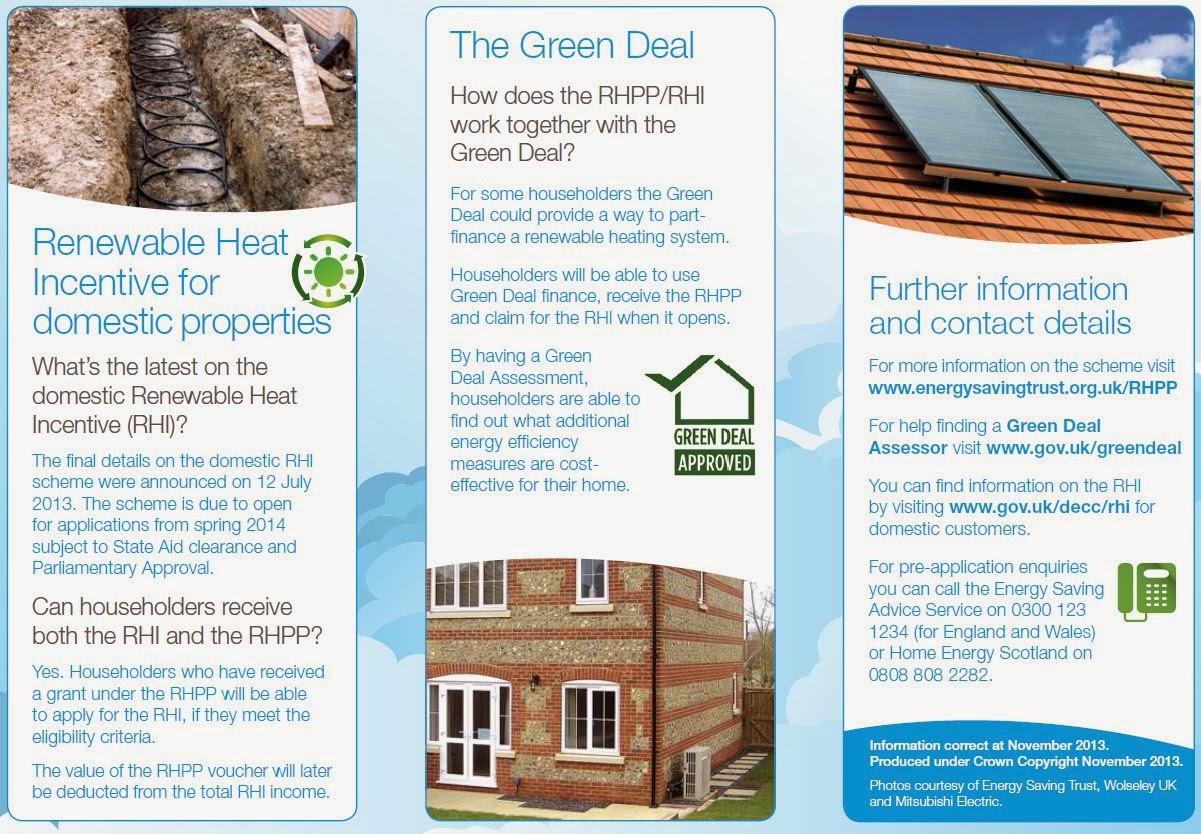
The following leaflet has now been developed to explain the benefit of applying in customer friendly language and where to go for more information.


Thursday, 9 January 2014

Free seminar - Game Management in Woodlands

High Weald AONB will deliver a free seminar on game management in woodlands on March 6th (see details below).


Game management can form part of a multi-functional approach to woodland management.  With good planning it can be compatible with management for conservation and wood fuels (such as wood chip for on-estate biomass boilers and firewood).

Traditionally small-scale felling and harvesting of timber tends to be fitted around the shooting calendar.  This is fine, but often the wider opportunity creating wood fuels for an estate is overlooked.

Given that the Renewable Heat Incentive continues to offer an excellent subsidy for heat generated by biomass boilers game managers should consider  other options for woodland management.

The Kent Downs Woodfuel Pathfinder can provide free support for those interested in woodland management for wood fuels, including free biomass heating feasibility studies.  Please contact matthew.morris@kentdowns.org.uk for more details.


Wednesday, 11 December 2013

Commercial RHI - summary of changes to tariffs and technologies


Are you sitting comfortably?

DECC has been busy releasing new and updated information about both the commercial and domestic RHI and renewable heat in general.

To my eyes the overall renewable heat situation looks extremely healthy at the moment, particularly if you are in the biomass sector.  However, it is also clear that biomass is dominating the commercial RHI.  Consequently DECC will introduce changes to the budgetary process to increase the degression trigger sensitivity for sub-1MW biomass.


We have read the latest update on the commercial RHI and have picked out the main points from the executive summary.  We would urge interested readers to look at the entire document in case we have missed anything.


A key change is the capping of all tariffs at 10p/kWh.  This means that the RPI inflation of tariffs will stop at 10p/kWh.  For biomass it is the tier 1 small biomass tariff that is closest to this limit (n.b. the solar thermal tariff will be increased to 10p/kWh).

It is true that some renewable heat technologies are underperforming in the RHI, such as heat pumps and solar thermal.  However, DECC has recognised this and will beef up support - via increased tariffs and budgets - as well altering some requirements (such as energy efficiency).  The large biomass tariff, for example, will increase to 2.0p/kWh from 1.0p/kWh.


Eligibility

For new technologies and updated tariffs - 4 Dec 2013.  Any applications with a date of accreditation of 21 January 2013 or later will benefit from the tariff increases brought forward as a result of the Early Tariff Review consultation (this applies to ground source heat pumps (GSHP), solar thermal and biomass over 1MWth).


Energy Efficiency

DECC will not be introducing explicit energy efficiency criteria for non-domestic RHI applicants at this time. The mixed views from consultation respondents made it clear that more work needs to be done to establish a range of effective but not unduly burdensome energy efficiency measures that could be introduced into the scheme.


Biomass Sustainability Update

Based on feedback from stakeholders about industry readiness,  DECC  will postpone implementing mandatory compliance with GHG lifecycle emissions savings to Autumn 2014, so that industry and participants can monitor their processes in light of the sustainability criteria and build the audit trail necessary to demonstrate compliance.

DECC intend for the Biomass Suppliers List to be open for applications from suppliers of biomass in Spring 2014.

Subject to the availability of Parliamentary time,  DECC  intend to implement land-use sustainability criteria by 1 April 2015.


Biomass CHP

DECC will be introducing support for biomass CHP (4.1p/kWh), biogas >200kW (5.9 p/kWh and 2.2pkWh depending on size) and deep geothermal (5.0p/kWh). 

However, we do not intend to proceed at this time with support for heating only air-to-air heat pumps or biomass direct air as the consultation did not enable the development of appropriate deliverable policy.

Biogas combusion >200kWth

Subject to State Aid approval, tariffs will be set at 5.9p/kWh for installations with a thermal capacity of between 200 to 600kWth and 2.2p/kWh for those greater than 600kWth.

Deep geothermal

DECC will introduce a new tariff for deep geothermal heat at 5p/kWh. Deep geothermal heat will be defined as heat coming from a drilling depth of a minimum of 500m.

Heating only air-to-air heat pumps (AAHPs)

Although these technologies do produce renewable heat,  DECC  will not be introducing support for them at this time. This is primarily because of the risk of incentivising the installation of separate heating and cooling AAHPs in order to claim the RHI, rather than a reversible AAHP, which is likely to be more energy efficient.

Air to Water Heat Pumps and Energy from Waste

DECC will be introducing support set at 2.5p/kWh for AWHP (designed to achieve a minimum seasonal performance factor of at least 2.5) and 2.0p/kWh for the biogenic proportion of energy from waste (commercial and industrial).

Value for Money Cap and Tariff Rate of Return

From Spring 2014 tariffs across the RHI will be capped at 10.0p/kWh of renewable heat (and continue to be adjusted by RPI annually).

Biomass

To date deployment of large biomass has been below expectations and therefore  DECC  will go ahead with the proposed tariff increase to 2.0p/kWh.

Ground Source Heat Pump Tariffs

DECC will be replacing the current banded GSHP tariffs with a single tariff of 7.2p/kWh, which will be tiered.

The tier 1 tariff of 8.7p/kWh will be paid on the initial heat generated for an eligible purpose and the tier 2 tariff of 2.6p/kWh will be paid on the remaining eligible heat generated. This is equivalent to a tariff of 10.0p/kWh renewable heat assuming an SPF of 3.6.

Solar thermal

DECC will be raising the solar thermal tariff to 10.0p/kWh.

Budget management

Since implementation,  DECC  has made three quarterly degression assessments, one of which resulted in the medium biomass tariff being reduced by 5%. The outcome of the most recent assessment was published at the end of November.  DECC  will publish the fourth quarterly announcement by 1 March 2014.

In the May 2013 tariff review consultation we set out that the budget management policy would need to be developed in light of any tariff changes or scheme extensions and to reflect the outcome of the spending review for 2015/16, which has since confirmed an RHI budget in 2015/16 of up to £430m.


Having reviewed the budget management mechanism to ensure it remains fit for purpose,  DECC  will make some changes to the policy from Spring 2014 to:
  • base the deployment levels set out in the degression mechanism on refreshed market intelligence rather than the expectations that were modelled prior to the scheme’s introduction;
  • reduce the tolerance in the technology trigger for biomass under 1MWth and bio-methane injection by reducing the amount that these triggers are scaled above expected levels of deployment. They will change from being 150% of expected deployment to 120% of expected deployment. This will reduce the risk of unsustainable growth and dominance of the budget by a small number of technologies;
  • set the triggers for technologies  DECC  expects to deploy in relatively lower volumes (solar thermal, deep geothermal and all biogas) at 2.5% of the overall budget, rather than the current 5%.
Reducing uncertainty for projects with long-lead times

DECC intend to introduce a form of tariff guarantee for the largest installations (for example, those over 1MW), initially available for plant due to be commissioned by 31 March 2016. Subject to further policy development in 2014, State Aid and Parliamentary approval,  DECC  will aim for this measure to be in place from April 2015 to March 2016 and thereafter factored into the next spending review discussions on the RHI so that it can be available from Spring 2016 for plant due to commission by 31 March 2020.

Public Grants

After two years of the non-domestic RHI we think a more flexible approach to the interaction between public grants and the RHI could encourage more renewable heat installations to come forward. Pending further work alongside the 2014 review to look at the interaction between public grants and the non-domestic RHI,  DECC  intend to introduce some additional flexibility next year. We will take forward regulatory amendments to extend the eligibility window for repayment of grants and to allow some grant recipients who are unable to pay back their grants to access the RHI via reduced tariff payments.


Friday, 1 November 2013

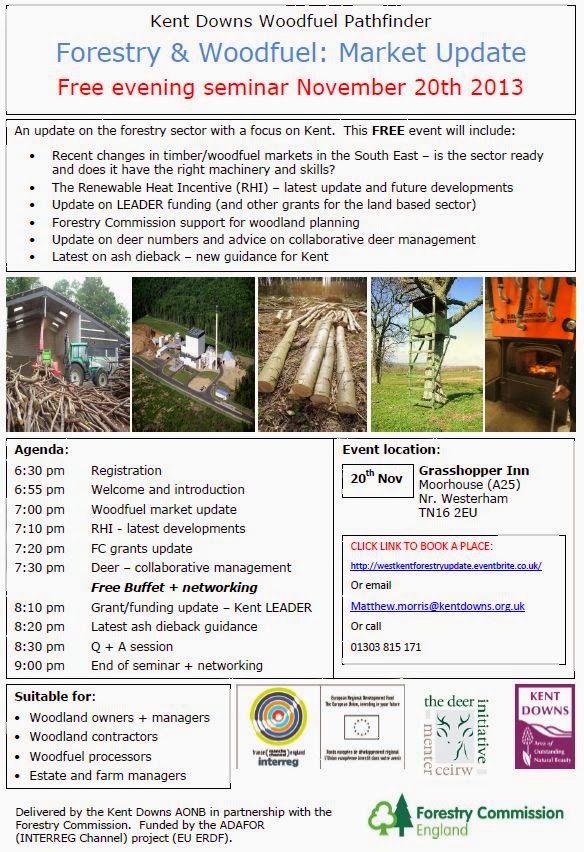
Forestry & Woodfuel - Market Update - FREE evening seminar

The Kent Downs Woodfuel Pathfinder, in partnership with the Forestry Commission and the Deer Initiative, will present an update on the forestry and woodfuel sectors in Kent on November 20th.

This free event will focus on the changes taking place in the forestry sector and provide insights into future opportunities.  

In particular the event will look at how improving markets for chip wood, in part stimulated by a new biomass power station in East Kent, may require  enhanced mechanisation and collaboration among forestry businesses.

The event will take place at the Grasshopper Inn at Moorhouse on the A25 near Westerham.  The event will open at 6:30 pm and will include a free buffet.

More details can be found below.

To book your free tickets please click here.


This event is funded by the EU ERDF Interreg IVa Channel project ADAFOR.