Given the volume of reading required to keep up with all of the recent announcements we have attempted a summary to enable readers to locate some of the important documents.
First up is the Biomass sustainability policy Q&A that was released following the consultation workshops that took place in London. This is well worth a read as it neatly summarises some key questions as well as confirming the following:
- Introduction of the greenhouse gas and land criteria in the RHI/RO biomass sustainability policy will now be introduced from Spring 2015.
- Non-domestic RHI participants will have two methods of demonstrating compliance with the forthcoming sustainability criteria:
- Self-reporting directly to Ofgem against the criteria
- Sourcing fuel from the Biomass Suppliers List (BSL).
- GHG criteria: Biomass fuel used by RHI participants must meet a lifecycle greenhouse gas (GHG) emissions target of 34.8g CO2 equivalent per MJ of heat, or 60% GHG savings against the EU fossil fuel average.
- Land Criteria: For woodfuel the criteria are outlined in the UK Timber Standard for Heat and Electricity.
Woodfuel meets the Timber Standard for Heat & Electricity if it "...originates from an independently verifiable legal and sustainable source and appropriate documentation is provided to prove it."
Currently this documentation is obtained via one of two routes:
- Category A: Evidence that the woodfuel originates from a legal and sustainable source can be provided through the use of independent certification of the wood by a recognised forest certification scheme (e.g. FSC, PEFC).
- Category B: Evidence that the woodfuel originates from a legal and sustainable source can also be provided in the form of alternative/bespoke documentary evidence that provides sufficient assurance that the source of the wood is legal and sustainable (e.g. via a supplier registered on the BSL or via self-reporting - for more details click here).
Summary of post consultation decisions
Some changes have been introduce following the consultation and feedback received during workshops. These changes are as follows:
- The definition of ‘saw logs’ was changed so that it now reflects local sawmill specifications. Where local specifications are not available, suppliers should use the UK specifications set out in Table 1 of the Forestry Commission Field Book 9 (second edition). See following table.
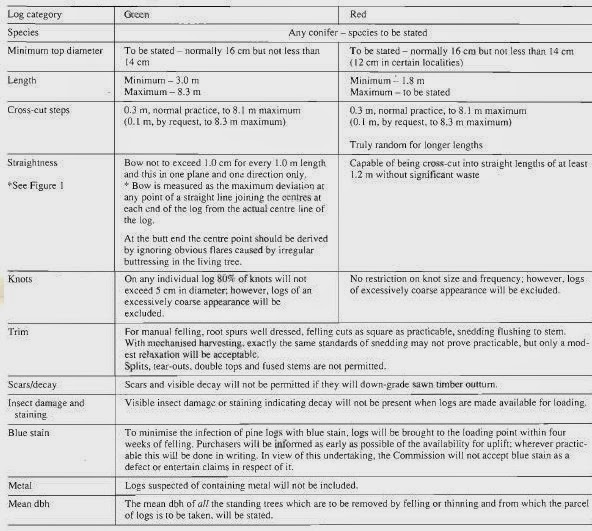
- New requirements to report on the proportion of ‘hardwood’ and ‘softwood’. There will be an additional requirement to report on whether any of the wood used was likely to have come from threatened or protected species.
- Arboricultural residues will be deemed sustainable under the Timber Standard for the RO and RHI.
- Not to exempt wood from diseased trees from the Timber Standard.
- To “deem sustainable” under the Timber Standard, trees removed from non-forest land for ecological reasons.
- Not to exempt wind blow from the Timber Standard at this stage but to keep the evidence under review.
- Not to exempt non-waste residues from sawmills from the Timber Standard.
- To add ‘highly biodiverse grasslands’ to the list of protected land types in the land criteria for non-wood solid and gaseous biomass.
Copies of the original consultation document and Government Response can be can be viewed on the DECC website.
Further reading:
BSL guidance and Q & A
UK Timber Standard for Heat and Electricity
DECC February 2013 Government Response document, announcing RHI sustainability criteria
DECC December 2013 Government Response document, providing an update on RHI sustainability criteria
Ofgem Renewables Obligation sustainability guidance
EU 2010 Report on biomass sustainability