Showing posts with label biomass. Show all posts

Friday, 27 November 2015

Training Opportunity: Woodfuel Quality Standards

Can you afford not to be up to date with BSL compliance and sustainability criteria?

Keep up to speed on the latest developments in woody biomass standards and specifications.

Why attend?

The Ignite Woodfuel Quality Standards course is essential training for anyone involved in the production of woodfuel.  

It includes the latest information on how to maintain compliance with the Biomass Suppliers List (BSL) and RHI land use and sustainability criteria, it provides a commercial insight into quality assurance and third party schemes such as Woodsure and ENPlus and provides a technical introduction to specifications and standards in use for woody biomass fuels including ONORM, BS-EN and BS-EN-ISO.

This one day course covers the key legislation and sustainability criteria which need to be considered during the production and specification of woodfuel. 

The day is divided into four sessions, including an outdoor based practical and demonstration:
  • BS EN and BS EN ISO Standards
  • Specifying Woodfuel 
  • Chipping & Sampling
  • Fuel Quality Assurance including meeting BSL requirements

The full course content can be accessed here.

The course is delivered by our qualified and experienced trainers with over 10 years of experience in delivering Ignite woodfuel training courses. 

Cost

This one day course costs £150+VAT* which includes the LANTRA Awards certification fee, course materials, lunch and refreshments.

* Members of Woodsure, the Wood Heat Association and the Confor Woodfuel Suppliers Group can take advantage of a 10% discount on course fees - just let us know at time of booking.

Ignite courses are accredited with LANTRA Awards and course fee includes certificate of attendance.

If you would like further information on any of our courses, please contact:

Erica at erica.spencer@ruraldevelopment.org.uk

or on 01765 609355.

For further information on events and courses being run by RDI, please click here.


Tuesday, 22 September 2015

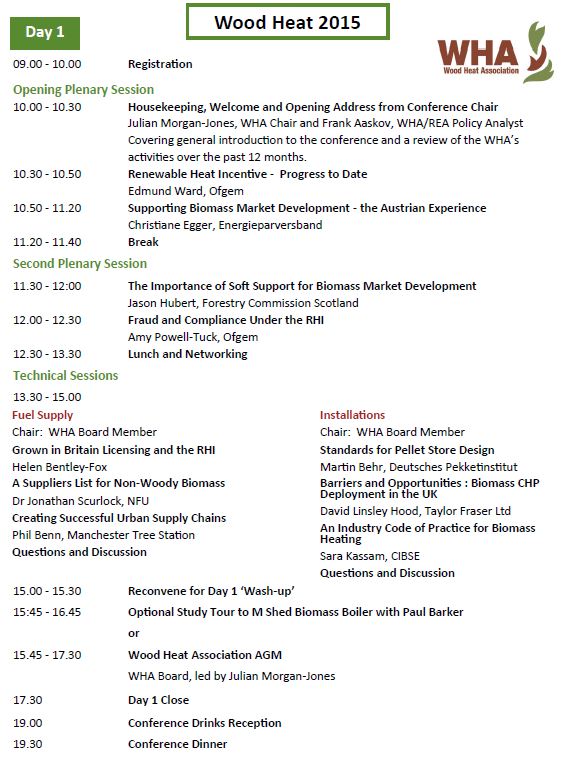
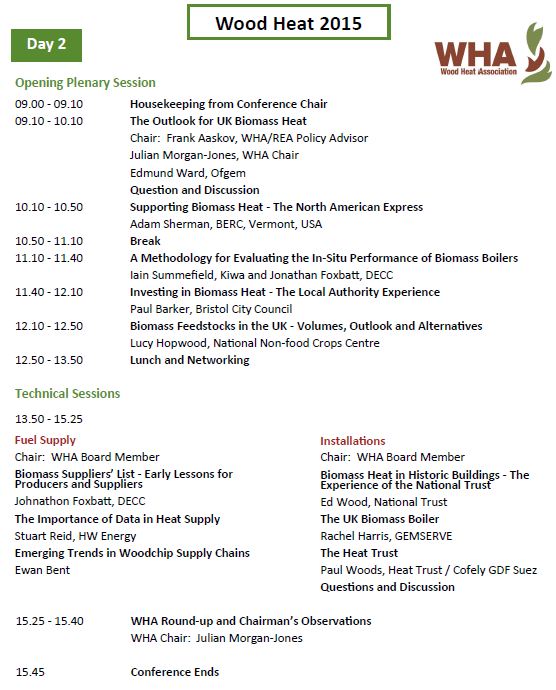
Wood Heat Conference 2015 - Now open for bookings


The 2015 Wood Heat conference is now open for bookings.

Despite degression, the UK renewable heat industry continues to grow thanks to effective support from the Renewable Heat Incentive.

Of all the renewable heat technologies, wood and biomass heat is still outperforming all others.

The UK's dedicated biomass and wood heat industry conference will run three weeks prior to the Government's Comprehensive Spending Review, offering the opportunity to learn from the experiences of UK businesses and those overseas.

The conference has the sub-title “Raising Our Standard”, and speakers will cover subjects including:

  • Fraud and compliance under the RHI
  • Soft support for the biomass heat sector in Scotland, Austria and the USA
  • Biomass CHP deployment in the UK
  • Evaluating the in-situ performance of biomass boilers - results from DECC research
  • The UK biomass boiler market


The conference will include a host of other subjects for all parts of the wood heat supply chain - installers and fuel producers/suppliers.

The conference will also include speakers from government, the Wood Heat Association and the Renewable Energy Association, enabling delegates to gain a thorough understanding of the opportunities available in the UK's modern wood heat and biomass industry.

The conference will take place on Wednesday 4th and Thursday 5th November 2015 in Bristol.

Full details can be found here.

Tuesday, 8 September 2015

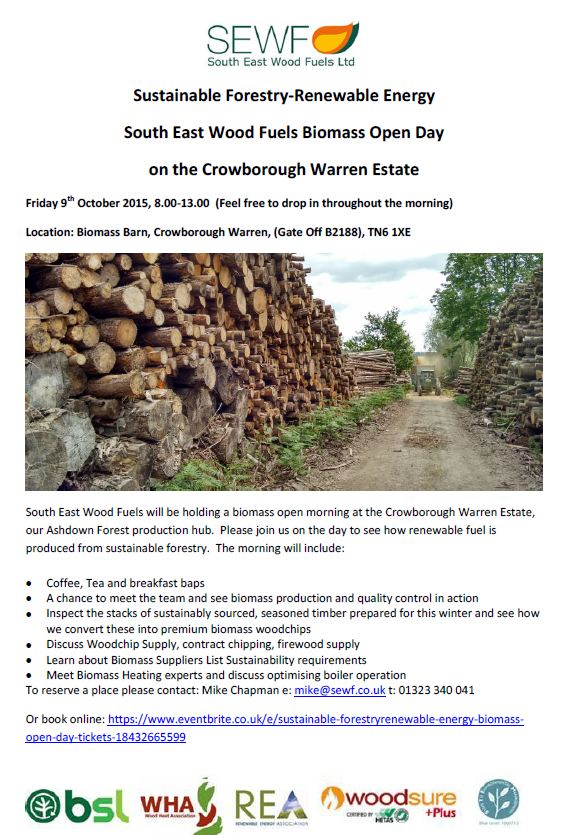
South East Wood Fuels - Biomass open day


Thursday, 26 March 2015

Restoring Kent's Ancient Woodlands

During the last few years we have worked in partnership with the KWES - the Kent Woodland Employment Scheme.

KWES has achieved some impressive progress over the last 18 months and now employs 16 people who are undertaking a three-year woodland management apprenticeship.

KWES has kindly provided an introduction to their project which we have published verbatim below.  

If you have any questions please contact Susannah Ferguson at KWES directly (contact details below).

///

KWES Kent Woodland Employment Scheme is able to assist owners of ancient woodlands, particularly those which are not currently managed, by bringing them back into sustainable production, and profitability.   

Increases in demand for, and prices of, timber and woodfuel (logwood, chips and pellets) have made profits possible – but the pinch-point is the shortage of skilled workers able to restore the woodlands, and cut and extract the timber. 

KWES Kent Woodland Employment Scheme is a charity (and training company) set up to provide training and employment for ex-Service personnel, young people and ex-offenders  in Kent’s ancient woodlands. 

KWES now has 16 trainees whose apprenticeships last for three years, during which they are given theoretical training and practical experience in all aspects of woodland operations and management. 

These qualifications will ensure they are able to get worthwhile employment in woodland and forestry industries throughout the UK.  Particularly so as all our practical training will be carried out in ancient woodlands which need highly skilled operators.

KWES mainly works with woodland owners who recognise that the increasing demand for timber and wood for fuel provides an opportunity to restore their unmanaged woods back to economic sustainability.  KWES agrees to bring their woods back into production over a period of time using a rotational coppicing system in accordance with a Forestry Commission management plan.  

In return KWES can either be allowed to extract and sell the wood its apprentices cut or alternatively we can work on a contract basis for woodland owners whose woods are in need of restoration.

All our apprentices work to the highest possible standards and are supervised and work with our fully qualified team leaders.   Our workforce come equipped with their personal protective equipment, chain saws and other equipment as well as insurance.   When necessary we even provide specialised equipment for use in ancient woodlands such as a low impact forwarding trailer.

Do you own a woodland in need of restoration and if so would you like to make contact with KWES to see if we can help?

Please contact KWES’s administrator for more information:

Susannah Ferguson
Susannah@kwes.org.uk
07860 942900

Monday, 9 March 2015

Heathlands and Biomass workshop - Friday March 13th

We have just learnt about a heathland biomass workshop this Friday (March 13th).

This event has been prepared by the South Downs National Park and will take place at Liphook.

The event includes two field trips - Stanley Common and Highfield School (to see the biomass heating system).

If you are interested in attending please contact:

Jonathan Mycock
SDNPA Heathland Project Manager
01730 819241
jonathan.mycock@southdowns.gov.uk.


Thursday, 23 October 2014

Development of Forestry Businesses - FREE Demonstration Workshops


The Forestry Commission will deliver three demonstration events in November.  
These are designed to illustrate how three forestry businesses located in the South East have grown over the last seven years and how Rural Development Programme England (RDPE) support has helped facilitate this growth.

The events are described below.  Contact and booking details can be found at the end of the article.

Friday 7th November – Balcombe Estate nr Crawley

Balcombe Estate has a long history of integrated woodland management maintaining their estate sawmill and pursuing new markets for wood products. 

RDPE support has helped them build their woodfuel supply business, including supporting the purchase of a 360 mounted harvester in partnership with a nearby estate. They are currently exploring how they can grasp the growing interest in locally grown timber by upgrading their sawmill and marketing. 

As they grow their business they are also exploring how they can work collaboratively with complimentary businesses and neighbours.

This event will include:
  • First hand experience of a previous grant recipient
  • A walking tour and demonstration of harvesting/firewood processing
  • Lunch and refreshments

This event will illustrate how entrepreneurial management and enthusiasm can grow forestry business in lowland England and how RDPE support and collaboration can help accelerate this process. 

This event will be of particular interest to anyone exploring how they can grow their forestry business in SE England. 

Registration from 9.45am for a 10am start. Lunch will be provided.

Tuesday 18th November - H G Matthews Brickworks nr Chesham

H G Matthews illustrates how a local business with high energy needs has developed the use of locally sourced wood as a fuel along with the supply chain to meet their needs. 

This event will be of particular interest to local businesses considering use of locally grown wood, contractors who are looking to expand or establish woodfuel supply chains and owners exploring options for woodfuel supply. 

This event will include:

First hand experience of a previous grant recipient
  • Walking tour of the brickworks
  • Lunch and refreshments at a nearby public house. 

Space is restricted and so we can only accommodate 20 individuals at this event. Only one person per company/organisation please. 

Registration from 9.45am for a 10am start. Lunch will be provided.

Thursday 27th November - Brockwood Park Farm nr Petersfield

Brockwood Park Farm illustrates how woodlands on farms and estates can be managed cost effectively to deliver woodfuel to heat the owner’s, neighbours’ and/or local business properties

Heating oil is becoming ever more expensive and few people realise that a tonne of seasoned wood can deliver as much heat as 350 litres of heating oil and you may be eligible for support from the Government’s Renewable Heat Incentive.

Alex Morton at Brockwood Park has carefully considered his options and brought together a package of equipment, infrastructure and skills to help him manage his woods extremely well and supply woodfuel to the adjacent school as well as heat his home. He is now exploring opportunities to extend his forestry management with neighbours.

This event will include:
  • First hand experience of a previous grant recipient
  • A walking tour of woodfuel processing site

Registration from 9.45am for a 10am start. 

As these are ‘on site’ visits spaces are limited and hence early registration is encouraged. To book please click here.
Friday, 10 October 2014

Business support for forestry businesses

The Forestry Commission has recently appointed a consortium of organisations to provide business support to forestry businesses across England.  

The objective of this support is to support forestry businesses in advance of the new grants within the new Rural Development Programme (RDP), set to start in 2015.


Mike and Max knew there must be an easier way!
A recent survey undertaken by the Kent Downs Woodfuel Pathfinder showed that the average age of forestry machinery currently in use in Kent is around 20 years. 

Survey respondents identified 32 items of forestry machinery required to either maintain or enhance business performance.  


The cost of this machinery was just under £1 million:

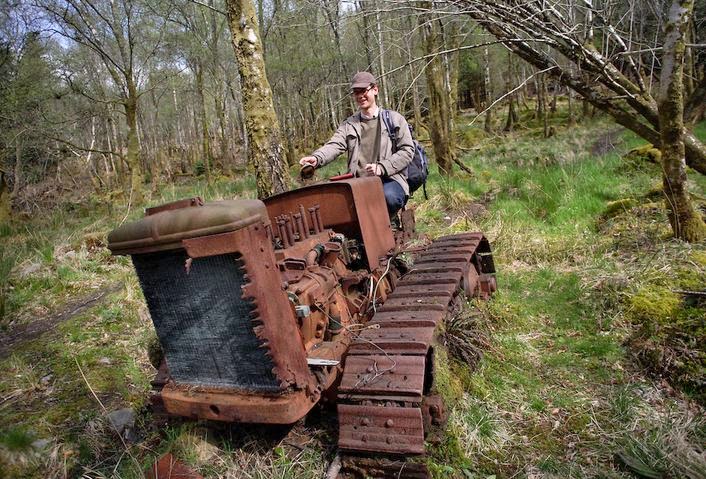
Kelvin's tractor had
seen better days
  • The average cost ranged from £7,250 (firewood processor) to £70,000 (harvester/processor).
  • The majority of the equipment was allocated for purchase within the next two to three years (and no later than 2020).
  • Forwarders and firewood processors were the most frequently cited items.
  • Most investment is required in forwarding machinery (£315,000).

Mark's great great great Grandfather's
chainsaw was a bit smoky
These results indicate that substantial investment in forestry machinery is still needed in Kent in order to maintain or develop businesses performance.


The consortium, known as FACE (Forestry Advisory Consortium England), will provide free one-to-one business support.

Details of future schemes under RDP are still taking shape.  

However, based on the previous programme grant support may be available for (but not limited) projects involving machinery, training, business support, venison processing and initiatives involving collaboration.
Guy's harvester was not helped by the foam leftover
from the last woodland rave

Experience from previous rounds of these European Rural Development Grants shows that it will be important for forestry businesses to have good quality “oven ready” applications in time for the official opening.

FCE are encouraging businesses to register their interest in the support as soon as possible. 

Please choose from the appropriate regional contact below:

  • East England: Corinne Meakins corinne.meakins@forestry.gsi.gov.uk 01842 819089
  • East Midlands: David Bole david.bole@forestry.gsi.gov.uk 07712 750549
  • South East: Matthew Woodcock matthew.woodcock@forestry.gsi.gov.uk 01483 326210
  • South West: Mark Prior mark.prior@forestry.gsi.gov.uk 01392 834260
  • West Midlands: Simon West simon.west@forestry.gsi.gov.uk 01905 532212
  • North West: Penny Oliver penny.oliver@forestry.gsi.gov.uk 01524 565805
  • Yorkshire & the North East richard.pow@forestry.gsi.gov.uk 07831 216024


Further details can be found here.

Rick's two horsepower log extractor was very thirsty
In parallel to business support the Forestry Commission is also delivering a series of workshops between September 2014 and January 2015.

To register for these events please contact Amy or Jude on 07502 985 921 or email events@lantern.uk.com.  More details can be found here.


Thursday, 21 August 2014

RHI - biomass sustainability and Biomass Suppliers List (BSL)

Over the last few weeks we have received several emails from DECC regarding their policy for biomass sustainability that it applies to renewable energy subsidy schemes including the Renewable Heat Incentive (RHI) and Renewables Obligation (RO).

Given the volume of reading required to keep up with all of the recent announcements we have attempted a summary to enable readers to locate some of the important documents.

First up is the Biomass sustainability policy Q&A that was released following the consultation workshops that took place in London.  This is well worth a read as it neatly summarises some key questions as well as confirming the following:
  • Introduction of the greenhouse gas and land criteria in the RHI/RO biomass sustainability policy will now be introduced from Spring 2015.
  • Non-domestic RHI participants will have two methods of demonstrating compliance with the forthcoming sustainability criteria:
These 'criteria' are:

  • GHG criteria: Biomass fuel used by RHI participants must meet a lifecycle greenhouse gas (GHG) emissions target of 34.8g CO2 equivalent per MJ of heat, or 60% GHG savings against the EU fossil fuel average.
  • Land Criteria: For woodfuel the criteria are outlined in the UK Timber Standard for Heat and Electricity.
Woodfuel meets the Timber Standard for Heat & Electricity if it "...originates from an independently verifiable legal and sustainable source and appropriate documentation is provided to prove it."

Currently this documentation is obtained via one of two routes:
  • Category A: Evidence that the woodfuel originates from a legal and sustainable source can be provided through the use of independent certification of the wood by a recognised forest certification scheme (e.g. FSC, PEFC).
  • Category B: Evidence that the woodfuel originates from a legal and sustainable source can also be provided in the form of alternative/bespoke documentary evidence that provides sufficient assurance that the source of the wood is legal and sustainable (e.g. via a supplier registered on the BSL or via self-reporting - for more details click here).

Summary of post consultation decisions

Some changes have been introduce following the consultation and feedback received during workshops.  These changes are as follows:

  • New requirements to report on the proportion of ‘hardwood’ and ‘softwood’. There will be an additional requirement to report on whether any of the wood used was likely to have come from threatened or protected species.
  • Arboricultural residues will be deemed sustainable under the Timber Standard for the RO and RHI.
  • Not to exempt wood from diseased trees from the Timber Standard.   
  • To “deem sustainable” under the Timber Standard, trees removed from non-forest land for ecological reasons.
  • Not to exempt wind blow from the Timber Standard at this stage but to keep the evidence under review.
  • Not to exempt non-waste residues from sawmills from the Timber Standard.
  • To add ‘highly biodiverse grasslands’ to the list of protected land types in the land criteria for non-wood solid and gaseous biomass.
Copies of the original consultation document and Government Response can be can be viewed on the DECC website.

Further reading:


BSL guidance and Q & A 

UK Timber Standard for Heat and Electricity

DECC February 2013 Government Response document, announcing RHI sustainability criteria 

DECC December 2013 Government Response document, providing an update on RHI sustainability criteria

Ofgem Renewables Obligation sustainability guidance

EU 2010 Report on biomass sustainability

Monday, 19 May 2014

Business development grants available from Low Carbon Plus


The markets for waste wood, biomass fuel, firewood and fencing are continuing to improve in Kent and we are aware of several new projects and initiatives that should impact right across the supply chain. 

We also know that the sector has struggled with investment in machinery in recent years.  This is partially due to poor markets, but also because grants programmes such as LEADER are not currently active.

Help is at hand!  

The Low Carbon Plus project offers grants to businesses to fund 45% of the cost of qualifying projects. The minimum grant that can be awarded is £1,000 and the maximum grant amount is £20,000.

We are aware that several Kent-based woodland management/wood fuel businesses that have already successfully applied to Low Carbon Plus.  One firewood supplier will use the grant to help improve storage facilities whilst a woodland contractor will use the grant for a new forwarder.

More details can be found below.

Projects must lead to business growth and/or job creation.  Grant funding can be used to cover the following types of expenditure:

  • Development finance: funding required to expand the business such as marketing costs
  • Plant and machinery: costs of re-tooling and installation of machinery and hardware, as well as training required to operate it
  • Intangible assets: including costs of purchasing patents, IT, software and licences  
  • Consultancy costs: including marketing and business planning

Funding cannot be allocated retrospectively, and only applications where no activity has yet taken place will be considered.

The initial application form can be found here.  Participants are encouraged to join the Low Carbon Kent business network.

Thursday, 27 February 2014

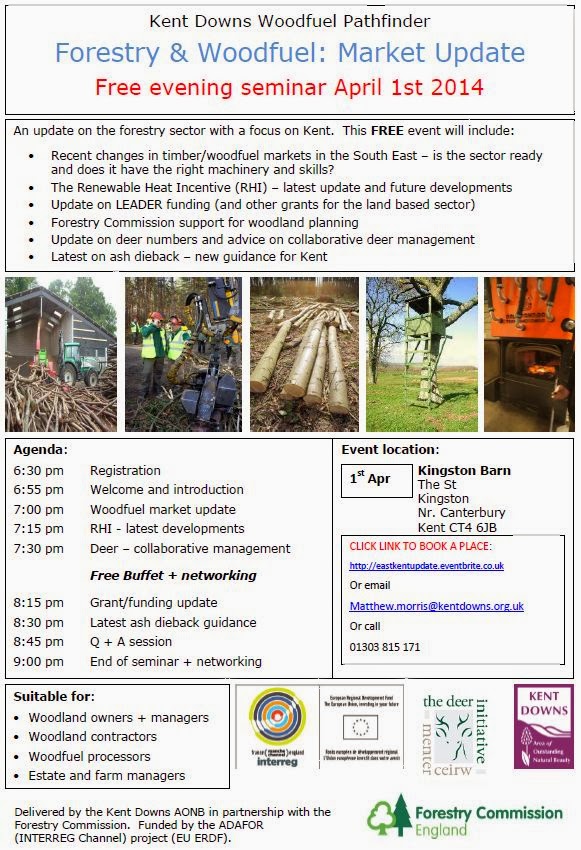
Forestry & Wood Fuel Update - April 2014 - Free Event

The Woodfuel Pathfinder will deliver its next event at Kingston Barn on the evening on April 1st.  Full details can be found below.

To register for the event please use this link.  

Alternatively please call the AONB Unit on 01303 815 171.


Tuesday, 3 December 2013

China bans import of Ash from Europe


AQSIQ Import ban notice
China has banned the import of ash (Fraxinus Excelsior) in log and sawn timber form from Europe.  This adds to the existing ban for the import of seeds and nursery stock.  

China has been a large importer of ash over the last few years this ban is significant for those involved in the trade.  

Whilst there are other important markets for ash, for example firewood, this immediate cessation of exports may have an impact on price for some parts of the supply chain.

Some commentators have suggested that woodland owners cease felling ash (for export) until the longevity of the ban is established.  

Other commentators, such as the Forestry Commission, have also suggested that woodland owners might consider delaying the felling of ash.  However, this is to prevent the loss of resistant trees rather than a temporary cessation of activity oriented towards export markets.


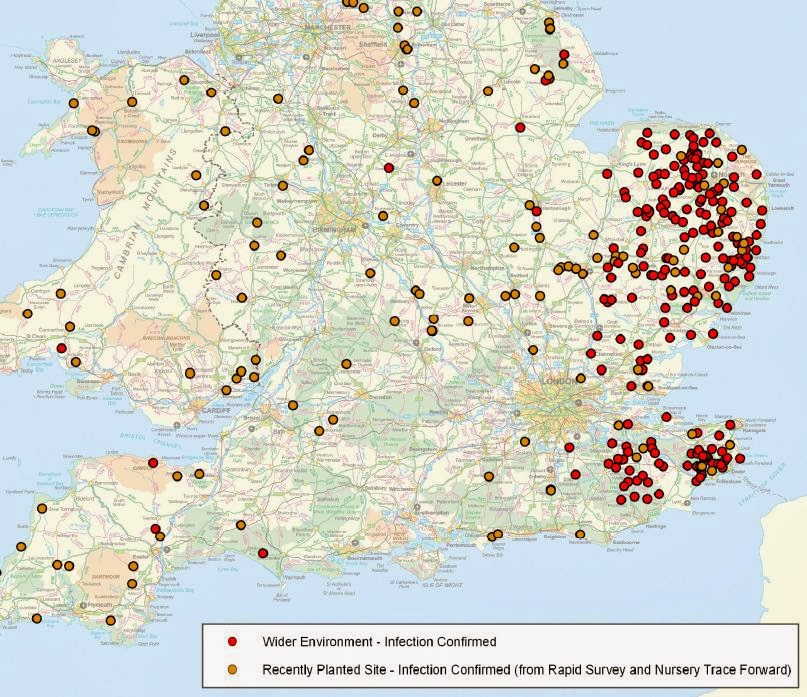
Ash dieback distribution (Source: Forestry Commission)
Interesting China recommends that local forestry administrations should reinforce surveillance of ash dieback and implement emergency response plans.  In Kent, where ash dieback is now widespread, local guidance is being prepared and County emergency planners have developed a response plan.

China's ban is immediate and will remain in place until the status of the epidemic allow the ban to be removed.  

Given that the impact of ash dieback is only beginning to be felt in the east of England and Kent it could be that China's plan stays in place for several years.

This could also be an opportunity for the UK.  If ash can no longer be exported easily from the UK this might be positive for those involved in indigenous supply and consumption.  This blog is not aware of the economics of timber for export to China but our guess is that ash firewood supplied locally is probably far more valuable (as is most firewood)!

Thursday, 3 October 2013

Events in Sussex will highlight progress in wood fuel and biomass heating sectors

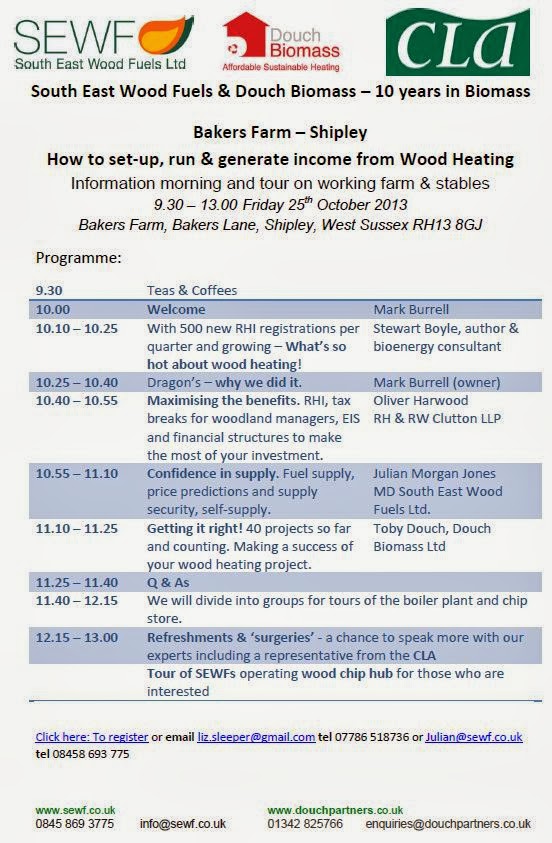
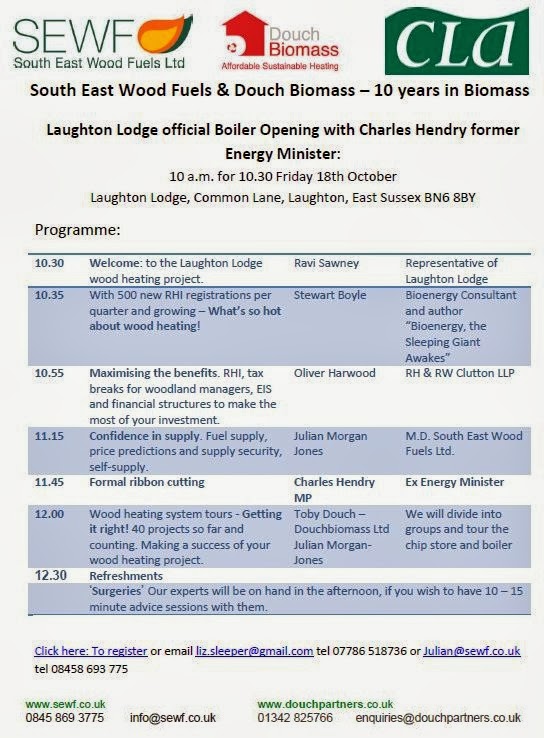
South East Wood Fuels, Douch Biomass and the CLA have announced two events to showcase new biomass heating installations in Sussex and to provide an update on the woodfuel and biomass heating sectors.

The first will take place on Friday October 18th at Laughton Lodge in East Sussex.  The district heating system at this site has recently been upgraded and a new boiler installed.  

On hand will be a range of RHI, woodfuel and biomass heating experts who will highlight recent developments in the sector.  The event also offers free 'surgeries' for those interested in undertaking a woodfuel or biomass heating project.


The second event takes place at Bakers Farm in West Sussex on Friday October 25th.  Both events are free.  To register please visit the following sites to book your place:

  1. Laughton Lodge - Oct 18th: Click here
  2. Bakers Farm - Oct 25th: Click here


Friday, 15 March 2013

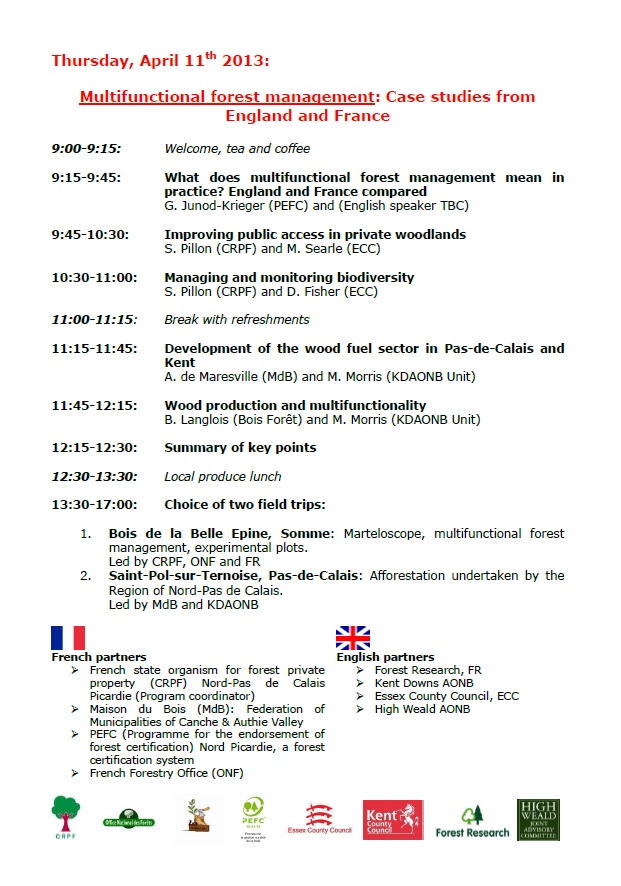
MULTIFOR woodfuel conference - free places available for selected delegates

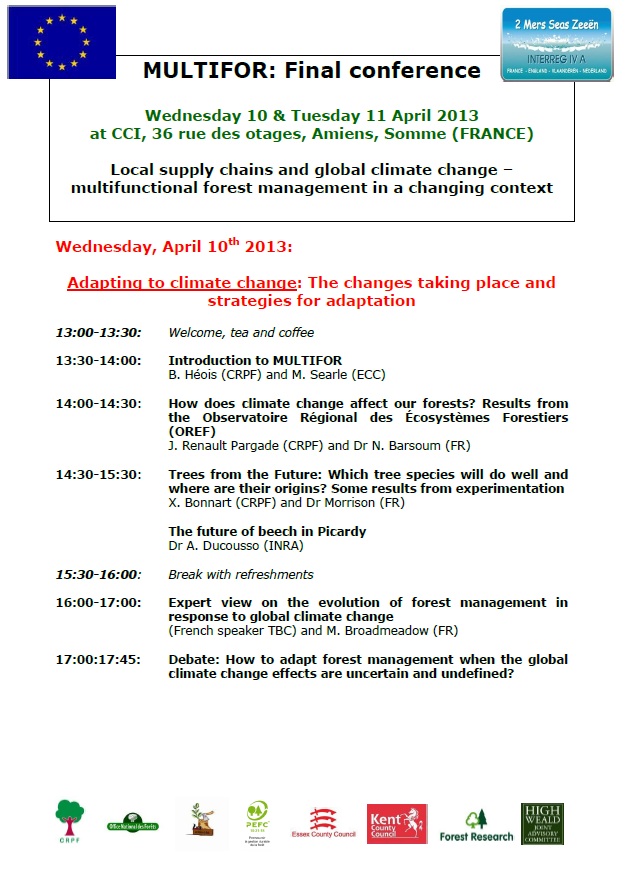
The final conference for the MULTIFOR (Multi-Functional Forestry) project will take place in Amiens in France on April 10th and 11th.

This EU ERDF funded project has been active since 2010 and has explored a range of topics ranging from woodfuel (hence the Kent Downs Woodfuel Pathfinder), adaptation of forestry management in a changing climate and  improving public access in private woodlands.

The conference will include speakers from a range French and English organisations involved in both research and the practical application of new approaches that promote multi-functional woodland management.


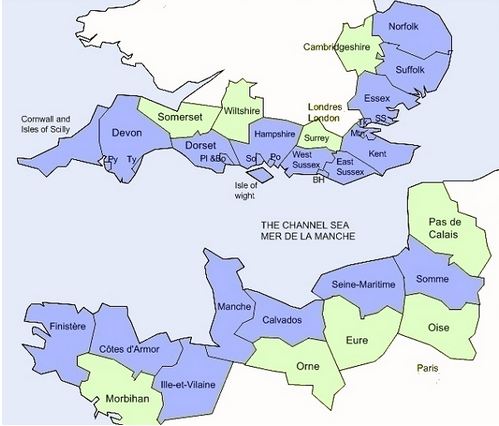
Interreg IV A Eligible Area
The Pathfinder project can fund a limited number of delegates (maximum 15).  

This includes travel (by coach) to and from Amiens and overnight accommodation and breakfast (lunches will be provided by the conference organiser).

If you are interested in attending please call Matthew Morris on 01303 815 171 as soon as possible to discuss.


To qualify for a funded place it is preferable that you:

  • Have a demonstrable connection with woodland management, woodfuel, climate change in forest ecosystems, public access in woodland or multi-functional woodland management in general.
  • Work in the eligible area for the Interreg IV A 'two seas' programme (see map above)
  • Can commit to attending the conference on April 10th and 11th.

Full details of the conference are below.  Please do note hesitate to call to discuss attending the conference (01303 815 171).


Friday, 1 February 2013

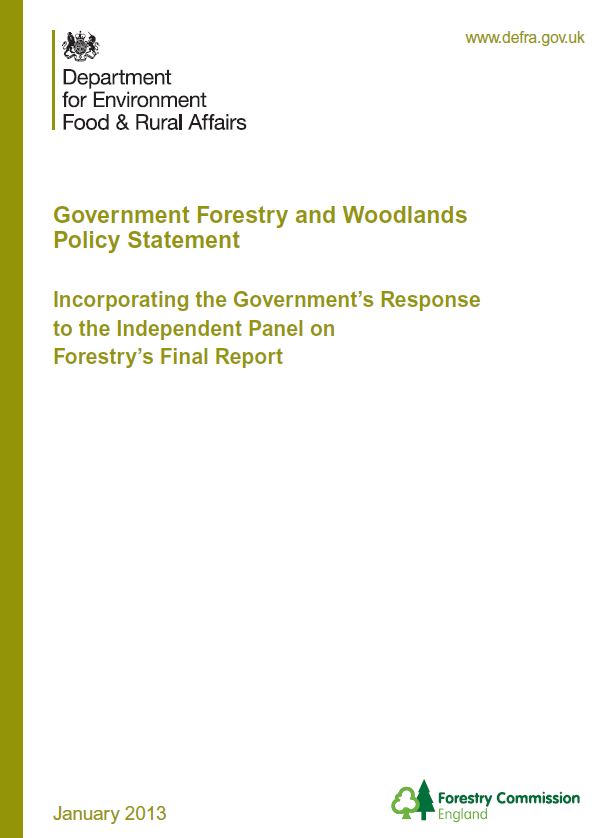
Government Forestry and Woodlands Policy Statement

Defra's response to the Independent Panel on Forestry's report has been released and it makes interesting reading.

The Panel’s report has essentially led to a refreshed Government forestry policy. It will be based around a set of priorities: protecting, improving and expanding public and private woodland assets. It also reflects key Government principles, such as economic growth, localism, deregulation, targeted government intervention and value for money.

Of great interest to this blog is the announcement of an 'action plan' led by the wood industry that will consider, among other things, the important future role played by the biomass and woodfuel markets in the management of our woodland resource.


The main headlines from the response are as follows:


  • The need to develop a new woodland culture and a resilient forestry and woodland sector,
  • The value of the Public Forest Estate, which will continue to benefit from public ownership, be held in trust for the nation and be managed by a new, operationally-independent body,
  • The importance of protecting our woodland assets,
  • The need to bring more woodland into active management and increase the extent of woodland cover in England,
  • The need to help the sector to find its voice and improve its economic performance,
  • The importance of preserving and maximising the social and environmental benefits provided by trees and woodlands, particularly in and around our towns and cities,
  • The scope for developing new markets based around a better understanding of the value and potential of our trees, woods and forests,
  • The value of retaining a skilled cadre of forestry experts within the public sector.
Exploring New Opportunities: The role of woodfuel

Defra's response recognises that local renewable heat projects have the potential to provide an economic return to owners of even small areas of woodland and can benefit many businesses involved in the wider forestry sector:
  • There are currently around 600 woodfuel supply outlets across Britain selling to local markets and there is potential to do more, provided this market is not developed at the expense of other wood processing industries and does not create unfair competition for our home grown products.
  • Undermanaged broadleaved woodland in particular could supply significant quantities of fuel without interrupting current supply chains. More effective management of our woodlands will also make a long-term contribution to our challenging climate change targets, through reducing reliance on fossil fuels and energy intensive materials.
  • With the introduction of the Renewable Heat Incentive the scope for developing new initiatives around woodfuel is growing.
To facilitate these objectives, the industry has invited Dr Peter Bonfield, OBE, Chief Executive of the Building Research Establishment (BRE), to lead the creation of a 'roadmap' (in autumn 2013) to a new and successful future for England’s forest-based supply chains. 

This will be developed in partnership with woodland owners, managers, buyers, processors, researchers, retailers, contractors, woodfuel suppliers, community groups and Government. 

Details of the organisations currently involved are on the Confor website.


A summary of the other main points are provided in the sections below.

Improving our Valuable Woodland Assets

This section of the response probably contains the most radical changes and clearly sets the policy towards economic growth:
  • Work with landowners and others to increase the amount of actively-managed woodland and review progress in five years,
  • Further reduce unnecessary regulation and red tape affecting the sector,
  • Support the sector as it develops its new industry-led Action Plan,
  • Work with the sector to explore the scope for exploiting economic opportunities, such as woodfuel markets and rural tourism,
  • Encourage, where appropriate, local government and Local Enterprise Partnerships to take advantage of the opportunities provided by Government policies to realise the potential of local woodland assets.
Specific activities around people and communities and wildlife and the natural environment will continue.

Expanding our Woodland Resource

Increase England’s woodland cover significantly to achieve greater economic, social and environmental benefits:
  • Deliver 12% woodland cover by 2060:
  • Work with the sector to find new ways of encouraging landowners to plant more trees where it best suits them and their local conditions,
  • Develop further the voluntary woodland carbon market and other sources of investment that reflect forestry’s low carbon credentials and wider public benefits to deliver a more wooded landscape,
  • Pilot an initiative to reduce burdens on landowners who want to plant woodland by clarifying where a full Environmental Statement is unlikely to be required.
Protecting our Trees, Woods and Forests

Defra will give greater priority to tree and plant health.  For example, the Living With Environmental Change (LWEC) Partnership will use £4 million of Defra funding, £0.5 million of additional Forestry Commission funding and up to £4 million additional funding from Research Councils to do in-depth research into tree diseases to inform the way outbreaks are handled in the future.

Governance and Structures

Defra plans to simplify current structures and step back from unnecessary day-to-day involvement:
  • Retaining a core of forestry expertise within Government with the capacity to deliver a range of functions, duties and powers,
  • Reviewing the Government’s forestry functions alongside the Triennial Review of the Environment Agency and Natural England,
  • Working with the devolved nations to ensure that vital cross-border functions in areas such as research, standards and tree health can continue to be delivered centrally, where this is appropriate,
  • Establishing via legislation a new, operationally-independent Public Forest Estate management body to hold the Estate in trust for the nation. It will be charged with generating a greater proportion of its income through appropriate commercial activity and with maximising the social, environmental and economic value of the assets under its care.
Realising More of our Woodlands’ Value

Defra acknowledges the social and environmental benefits of woodlands and to developing new market opportunities to realise these. Work already undertaken by the National Ecosystem Assessment, the Natural Capital Committee and the Ecosystem Markets will continue via:
  • Working with the Natural Capital Committee and the Office of National Statistics to develop a set of natural capital accounts for UK forestry assets and use this to inform the development of a set of natural capital accounts for the Public Forest Estate,
  • Developing a woodland ecosystem market roadmap to bring together actions by Government and our partners over the next 5 years to (a) build knowledge (b) develop wider networks of collaboration and expertise and (c) implement mechanisms and projects to demonstrate good practice,
  • Working with others to support the further development of markets in forest carbon and other ecosystem services such as water and biodiversity.

Wednesday, 1 August 2012

Renewable Heat Incentive: Providing certainty, improving performance

Here at Woodfuel Pathfinder Towers we have been trying to decipher the recent slew of information on the Renewable Heat Incentive and related matters.  


Just as we got our collective heads around the review of the Clean Air Act, new Ofgem guidance on heat metering and scheme administration and announcement of DECC’s budget management mechanism yet another consultation on the RHI has been issued.


The “Renewable Heat Incentive: Providing certainty,improving performance” sets out a series of proposals for the non-domestic RHI (Phase I) relating to longer-term budget management and scheme improvements, including biomass sustainability, air quality and changes to the metering requirements.


Needless to say the document is long and technical so we have attempted to extract the salient points from the executive summary.  


The proposals are important and anyone considering investing should set aside a some to read the document and familiarise themselves with the proposed changes, particularly as we may have missed something.


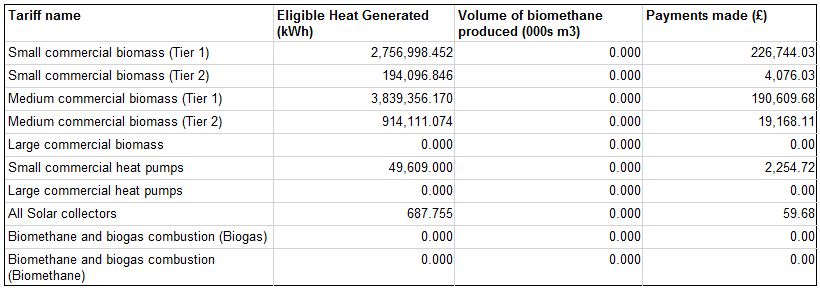
Before we get going we thought we would highlight the following tables that show the latest position on RHI uptake and payments (England only, see Ofgem web site for full report).


Renewable Heat Incentive: Providing certainty, improving performance

Executive summary – key points:

  • Controlling spend while providing certainty and transparency is a far greater challenge than simply keeping within a pre-determined budget.
  • The consultation sets out proposals for longer-term budget management and how DECC will aim to provide market certainty alongside budgetary control.
  • These proposals would only apply to new applications and only to the RHI scheme as it currently stands (i.e. non-domestic). Proposals would be extended to other technologies brought into the non-domestic scheme, which will be consulted on from September 2012.
  • Budget management proposal is to use a flexible degression-based system. Under this system tariff reductions for new applications would occur if deployment was approaching pre-determined triggers, at which point a small tariff reduction would occur automatically.
  • Proposed triggers for each technology and for the RHI overall will be based on the level of deployment required to keep us on a trajectory to deliver the 2020 renewables target.
  • Degression announcements would be made quarterly, with one month’s notice being given for any reductions.
  • Triggers for tariff reductions will be set out in advance and progress towards those triggers will be monitored and made available monthly on the DECC website.


  • The size of possible reductions would also be set out in advance, with a small reduction if deployment is slightly above that needed, and a larger reduction if deployment is significantly higher than that needed for the 2020 renewables targets.
  • In addition, DECC is proposing to carry out periodic reviews of the RHI, starting in 2014, to take stock of the evidence on the operation of the scheme and consider ways of improving it further. These reviews will provide an opportunity to recalibrate tariffs and if necessary, make changes to the tariff structure.
  • DECC has set out a potential option, enhanced preliminary accreditation. This would allow applicants to develop and accredit an installation that, when built, would receive a tariff guaranteed at the point of application for enhanced preliminary accreditation. Applications would be subject to time and size limits according to each technology.
  • It is equally important that the RHI is sustainable in the wider sense, so DECC will put forward proposals for biomass sustainability criteria.
  • The proposals are that biomass used for heat will have to achieve a lifecycle greenhouse gas (GHG) saving of 60% against an EU fossil heat average. The lifecycle assessment would take account of emissions from cultivation, processing and transport of the biomass, and reflect the conversion efficiency of the boiler plant. This would ensure a significant GHG saving relative to the use of coal, oil or fossil gas for heating.
  • Furthermore, for wood-fuel, we propose that the land criteria correspond to meeting the UK public procurement policy on wood and wood products. This approach requires that suppliers should have available documentary evidence demonstrating the wood supplied is from legal and sustainable sources or is from a licensed Forest Law Enforcement, Governance and Trade (FLEGT) partner.
  • For installations below 1MWth capacity, DECC proposes that, from April 2014, they have to purchase their biomass from an approved supplier list. For larger installations DECC proposes that RHI participants would provide reports on the sustainability of their fuel to Ofgem.
  • In the March 2011 RHI policy document DECC committed to introducing limits on the emissions of particulate matter (PM) and oxides of nitrogen (NOx) from biomass installations up to 20MWth capacity. This consultation proposes what the compliance regime should be for those emissions limits.
  • The consultation sets out proposals for simplifying the metering arrangements. DECC proposes that, in most cases, heat transported in external pipes insulated to a specified standard will be eligible heat use and will not be deducted from RHI payments. Therefore, where all heat uses are eligible, only the metering of eligible renewable heat generation would be required.


Other improvements:
  • clarifying the eligibility around ground source heat pumps
  • allowing renewable heat plants to be moved under the RHI
  • clarifying eligible heat use
  • simplifying the rules for biogas metering
  • ensuring biomass boilers are not oversized specifically to claim the tier 1 tariff
  • dealing with how the Retail Price Index (RPI) applies to low tariffs, such as large biomass


With regard to boiler sizing Biomass DECC has anecdotal evidence that there may be installations of biomass boilers which are inappropriate for the heat demand they are intended to serve but have been sized in order to claim the tier 1 tariff only. DECC considers this to be poor practice and is likely to have a detrimental long-term financial impact on the owner of the installation. DECC intends to introduce an eligibility requirement to prevent such installations from benefitting from the RHI.

For all the proposed changes, apart from those on sustainability, within this consultation grandfathering will apply; only applications which are accredited after these changes come into force will be affected. All those installations accredited currently or before these changes, will have to meet current eligibility requirements.