Showing posts with label renewable energy association. Show all posts

Tuesday, 22 September 2015

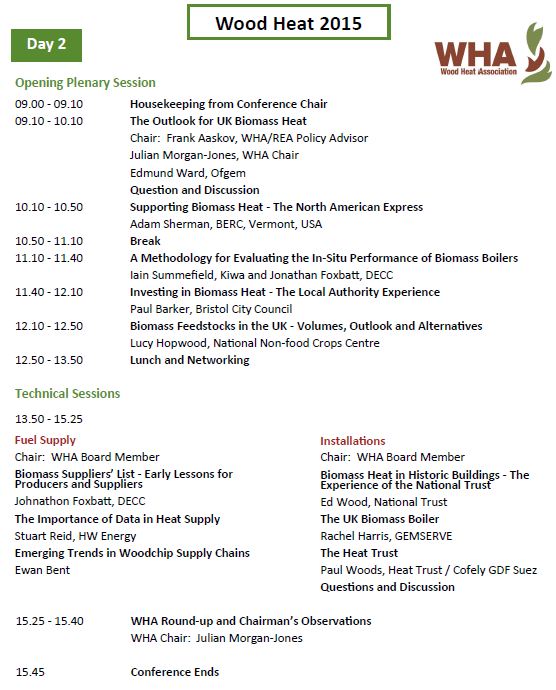
Wood Heat Conference 2015 - Now open for bookings


The 2015 Wood Heat conference is now open for bookings.

Despite degression, the UK renewable heat industry continues to grow thanks to effective support from the Renewable Heat Incentive.

Of all the renewable heat technologies, wood and biomass heat is still outperforming all others.

The UK's dedicated biomass and wood heat industry conference will run three weeks prior to the Government's Comprehensive Spending Review, offering the opportunity to learn from the experiences of UK businesses and those overseas.

The conference has the sub-title “Raising Our Standard”, and speakers will cover subjects including:

  • Fraud and compliance under the RHI
  • Soft support for the biomass heat sector in Scotland, Austria and the USA
  • Biomass CHP deployment in the UK
  • Evaluating the in-situ performance of biomass boilers - results from DECC research
  • The UK biomass boiler market


The conference will include a host of other subjects for all parts of the wood heat supply chain - installers and fuel producers/suppliers.

The conference will also include speakers from government, the Wood Heat Association and the Renewable Energy Association, enabling delegates to gain a thorough understanding of the opportunities available in the UK's modern wood heat and biomass industry.

The conference will take place on Wednesday 4th and Thursday 5th November 2015 in Bristol.

Full details can be found here.

Tuesday, 8 September 2015

South East Wood Fuels - Biomass open day


Monday, 2 June 2014

Green heat technologies more affordable with RHI upgrade

The Department for Energy and Climate Change (DECC) has announced changes to the non-domestic (commercial) Renewable Heat Incentive (RHI).

The main changes are as follows:
  • Increased financial support for:
    • renewable CHP
    • large biomass boilers (over 1MW)
    • deep geothermal
    • ground source heat pumps
    • solar-thermal
    • biogas combustion
  • New technologies added:
    • air-water heat pumps
    • commercial and industrial energy from waste

  • An evolved approach to budget management:
    • Improved market intelligence has been used to inform growth rates across the range of renewable heating technologies supported
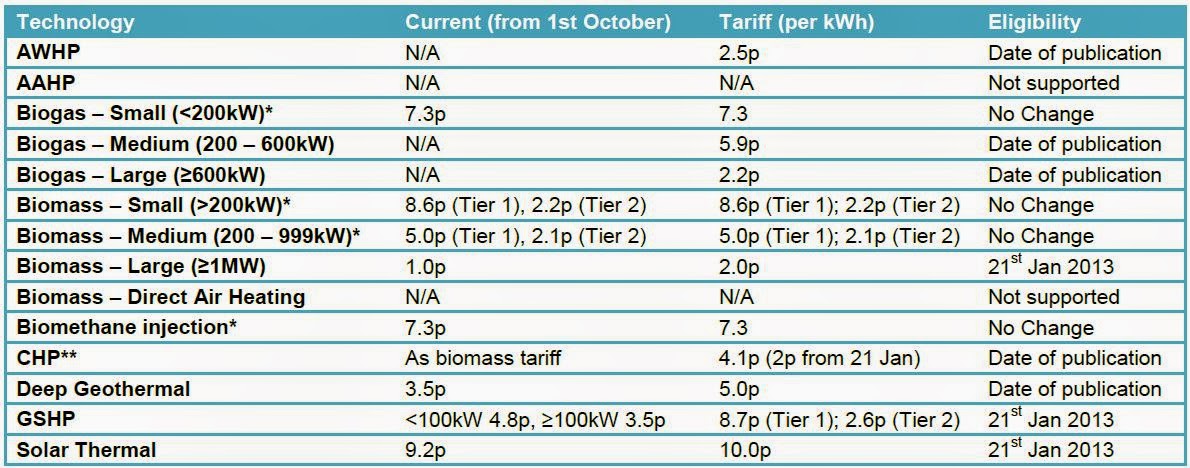
The updated tariff table is shown below.


These changes are the result of co-operation between industry and Government, and have been welcomed by the Renewable Energy Association (REA) and affiliated trade bodies.

"The RHI is now a truly world-leading renewable energy policy," said the REA's chief executive Dr Nina Skorupska. "Almost all renewable heat applications are now supported under the scheme, offering businesses greater choice than ever before on how to sustainably meet their heating needs.”

The Solar Trades Association provided evidence to Government in support of increasing the 'value for money cap' for renewable energy support programmes, which has enabled support for solar water heating to increase to 10p/kWh (from 9.2 pence/kWh).

Stuart Elmes, chair of the STA Solar Thermal Working Group, said: 

"The extra support for solar heating means that the economics will now stack up for more projects. More swimming pools, sports centres, food factories and hospitals will now be able to afford year-round heating from the sun."

We have also proposed that future improvements should include front-loading RHI payments for solar into the first seven years, as with the domestic scheme, to help businesses get over payback hurdles."

Support for large biomass heat has doubled (to 2p/kWh), but this technology sub-sector still draws the lowest fixed level of subsidy of any low carbon technology.

The newly formed Wood Heat Association (WHA) announced its affiliation to the REA last week. Speaking of these changes to the RHI, the WHA's interim chairman Julian Morgan-Jones said: 

"Under the previous cost-control mechanisms, wood heat was being unnecessarily constrained in order to preserve head room in the budget for heat pumps that was clearly not going to be used. The revised cost control mechanisms more closely match real world deployment and will ensure that wood heat can maximise its contribution to cost-effective emissions savings and renewable energy targets."

The RHI counts towards the UK's 2020 renewable energy target and helps reduce the UK's dependence on polluting fossil fuels. The above changes came into effect on May 28th 2014.

Full details can be found here.