The 2015 Wood Heat conference is now open for bookings.
Despite degression, the UK renewable heat industry continues to grow thanks to effective support from the Renewable Heat Incentive.
Of all the renewable heat technologies, wood and biomass heat is still outperforming all others.
The UK's dedicated biomass and wood heat industry conference will run three weeks prior to the Government's Comprehensive Spending Review, offering the opportunity to learn from the experiences of UK businesses and those overseas.
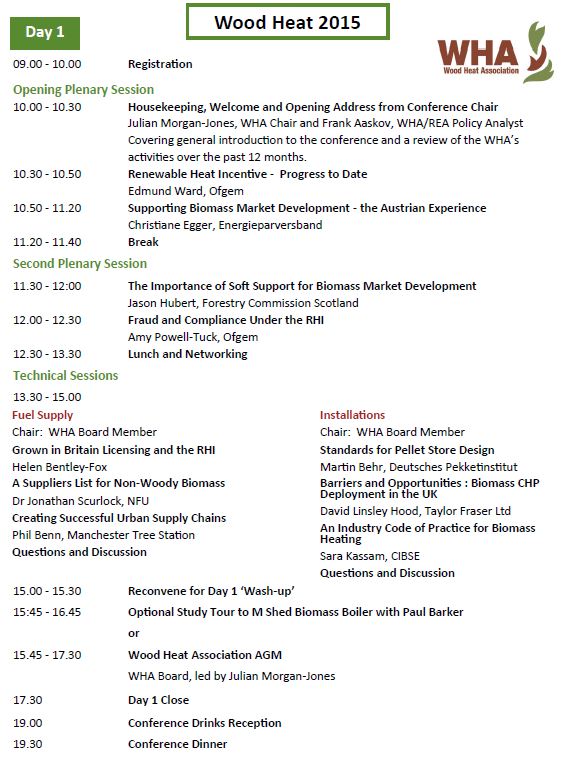
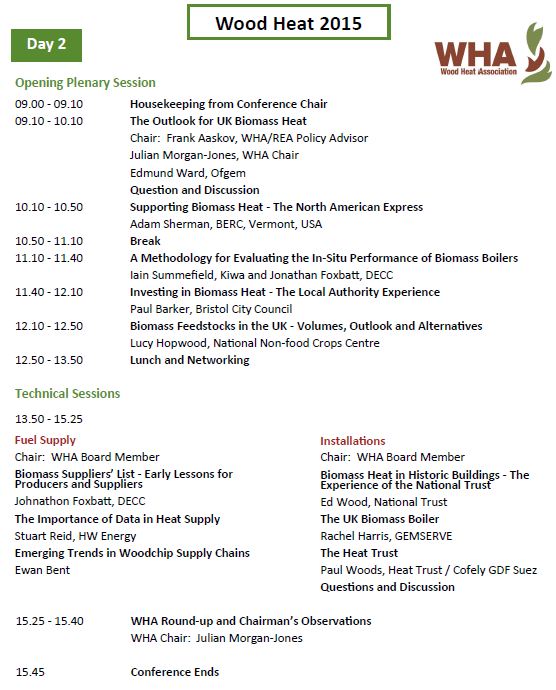
The conference has the sub-title “Raising Our Standard”, and speakers will cover subjects including:
- Fraud and compliance under the RHI
- Soft support for the biomass heat sector in Scotland, Austria and the USA
- Biomass CHP deployment in the UK
- Evaluating the in-situ performance of biomass boilers - results from DECC research
- The UK biomass boiler market
The conference will include a host of other subjects for all parts of the wood heat supply chain - installers and fuel producers/suppliers.
The conference will also include speakers from government, the Wood Heat Association and the Renewable Energy Association, enabling delegates to gain a thorough understanding of the opportunities available in the UK's modern wood heat and biomass industry.
The conference will take place on Wednesday 4th and Thursday 5th November 2015 in Bristol.
Full details can be found here.
The Kent Downs Woodfuel Pathfinder and High Weald AONB have partnered with Ignite to offer a new training course on woodfuels.
Ignite is an innovative training programme of practical seminars and interactive workshops with a focus on woodfuel.
Ignite is designed for those wanting to know more about woodfuel and to equip new and existing woodfuel businesses with the skills and knowledge required to meet the increasing demand from this growing market.
Ignite courses have been developed and are run by RDI Associates Limited, a registered training provider with Lantra Awards and all courses are delivered by experienced and accredited trainers.
The course is being run in partnership with Forest Advisory Consortium England partners, WoodNet and the Kent Downs and High Weald AONBs.
Woodfuel Quality Standards
This one day course introduces woodfuel suppliers and users to the full range of standards and quality assurance schemes in use in the supply chain and how to produce and specify the correct type of fuel.
It looks at how to ensure your woodfuel is compliant with the Timber Standard for Heat and Electricity covering the legal and sustainability criteria and the requirements of the Biomass Suppliers List.
The course also looks at how woodfuel properties can affect compliance with standards, how to specify and test fuel, and match fuel specifications to combustion systems.
The course provides an introduction to BS EN solid biofuels standards that have been adopted in the UK and reviews the various woodfuel quality assurance schemes and what relevance these may have to your business. The course involves a practical sampling demonstration at a working woodfuel supply depot.
Course attendees will also receive a copy of our Woodfuel Quality Standards Handbook and a Lantra Awards certificate of attendance.
Cost:
1 day course: £140+ VAT
- A 10% discount is offered to members of the Woodfuel Suppliers Group and Wood Heat Association (please confirm your membership on booking)
- Prices include all course materials, refreshments, lunch and course registration and certification fees
How to book:
Phone: 01765 609355
or
Email: Erica.spencer@ruraldevelopment.org.uk
or
Post:
Rural Development Initiatives Ltd
Unit 9
Sycamore Business Park
Dishforth Road
Copt Hewick
Ripon
HG4 5DF
Further details from the RDI events web page.
Are you sitting comfortably?
DECC has been busy releasing new and updated information about both the commercial and domestic RHI and renewable heat in general.
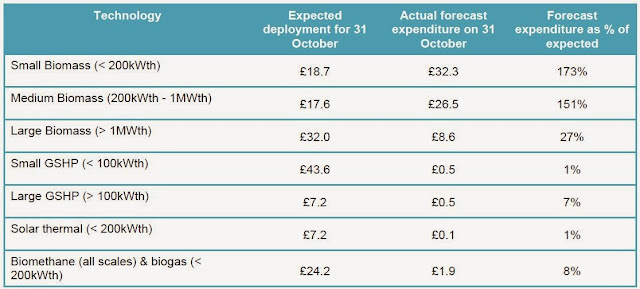
To my eyes the overall renewable heat situation looks extremely healthy at the moment, particularly if you are in the biomass sector. However, it is also clear that biomass is dominating the commercial RHI. Consequently DECC will introduce changes to the budgetary process to increase the degression trigger sensitivity for sub-1MW biomass.
We have read the latest update on the commercial RHI and have picked out the main points from the executive summary. We would urge interested readers to look at the entire document in case we have missed anything.
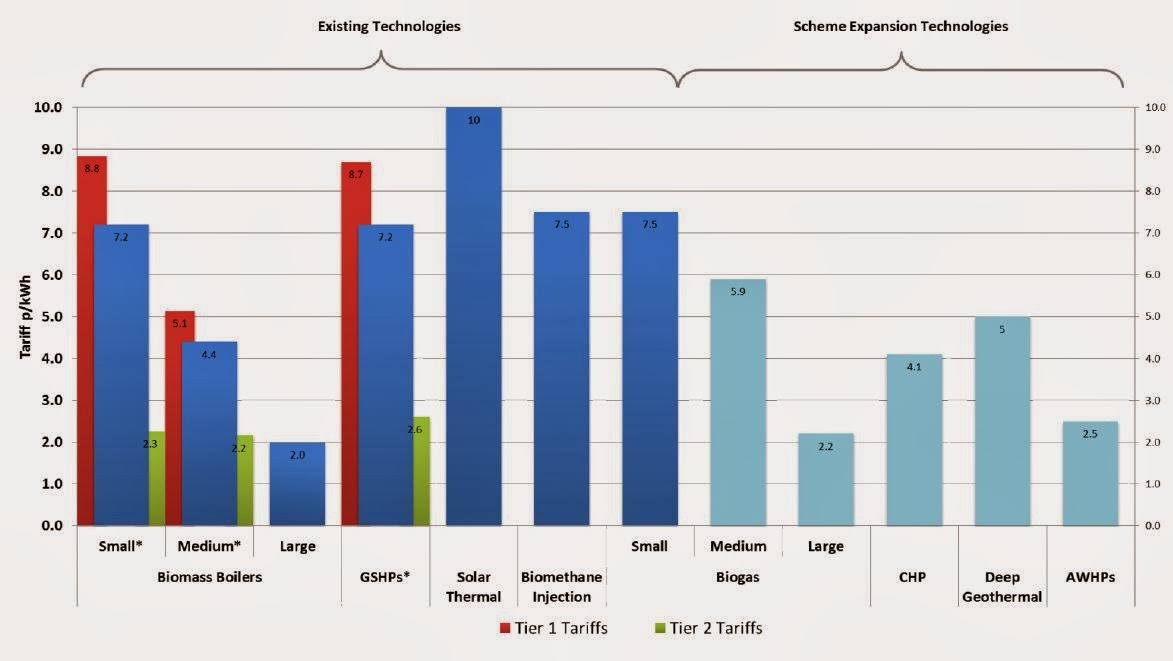
A key change is the capping of all tariffs at 10p/kWh. This means that the RPI inflation of tariffs will stop at 10p/kWh. For biomass it is the tier 1 small biomass tariff that is closest to this limit (n.b. the solar thermal tariff will be increased to 10p/kWh).
It is true that some renewable heat technologies are underperforming in the RHI, such as heat pumps and solar thermal. However, DECC has recognised this and will beef up support - via increased tariffs and budgets - as well altering some requirements (such as energy efficiency). The large biomass tariff, for example, will increase to 2.0p/kWh from 1.0p/kWh.
Eligibility
For new technologies and updated tariffs - 4 Dec 2013. Any applications with a date of accreditation of 21 January 2013 or later will benefit from the tariff increases brought forward as a result of the Early Tariff Review consultation (this applies to ground source heat pumps (GSHP), solar thermal and biomass over 1MWth).
Energy Efficiency
DECC will not be introducing explicit energy efficiency criteria for non-domestic RHI applicants at this time. The mixed views from consultation respondents made it clear that more work needs to be done to establish a range of effective but not unduly burdensome energy efficiency measures that could be introduced into the scheme.
Biomass Sustainability Update
Based on feedback from stakeholders about industry readiness, DECC will postpone implementing mandatory compliance with GHG lifecycle emissions savings to Autumn 2014, so that industry and participants can monitor their processes in light of the sustainability criteria and build the audit trail necessary to demonstrate compliance.
DECC intend for the Biomass Suppliers List to be open for applications from suppliers of biomass in Spring 2014.
Subject to the availability of Parliamentary time, DECC intend to implement land-use sustainability criteria by 1 April 2015.
Biomass CHP
DECC will be introducing support for biomass CHP (4.1p/kWh), biogas >200kW (5.9 p/kWh and 2.2pkWh depending on size) and deep geothermal (5.0p/kWh).
However, we do not intend to proceed at this time with support for heating only air-to-air heat pumps or biomass direct air as the consultation did not enable the development of appropriate deliverable policy.
Biogas combusion >200kWth
Subject to State Aid approval, tariffs will be set at 5.9p/kWh for installations with a thermal capacity of between 200 to 600kWth and 2.2p/kWh for those greater than 600kWth.
Deep geothermal
DECC will introduce a new tariff for deep geothermal heat at 5p/kWh. Deep geothermal heat will be defined as heat coming from a drilling depth of a minimum of 500m.
Heating only air-to-air heat pumps (AAHPs)
Although these technologies do produce renewable heat,
DECC will not be introducing support for them at this time. This is primarily because of the risk of incentivising the installation of separate heating and cooling AAHPs in order to claim the RHI, rather than a reversible AAHP, which is likely to be more energy efficient.
Air to Water Heat Pumps and Energy from Waste
DECC will be introducing support set at 2.5p/kWh for AWHP (designed to achieve a minimum seasonal performance factor of at least 2.5) and 2.0p/kWh for the biogenic proportion of energy from waste (commercial and industrial).
Value for Money Cap and Tariff Rate of Return
From Spring 2014 tariffs across the RHI will be capped at 10.0p/kWh of renewable heat (and continue to be adjusted by RPI annually).
Biomass
To date deployment of large biomass has been below expectations and therefore
DECC will go ahead with the proposed tariff increase to 2.0p/kWh.
Ground Source Heat Pump Tariffs
DECC will be replacing the current banded GSHP tariffs with a single tariff of 7.2p/kWh, which will be tiered.
The tier 1 tariff of 8.7p/kWh will be paid on the initial heat generated for an eligible purpose and the tier 2 tariff of 2.6p/kWh will be paid on the remaining eligible heat generated. This is equivalent to a tariff of 10.0p/kWh renewable heat assuming an SPF of 3.6.
Solar thermal
DECC will be raising the solar thermal tariff to 10.0p/kWh.
Budget management
Since implementation,
DECC has made three quarterly degression assessments, one of which resulted in the medium biomass tariff being reduced by 5%. The outcome of the most recent assessment was published at the end of November.
DECC will publish the fourth quarterly announcement by 1 March 2014.
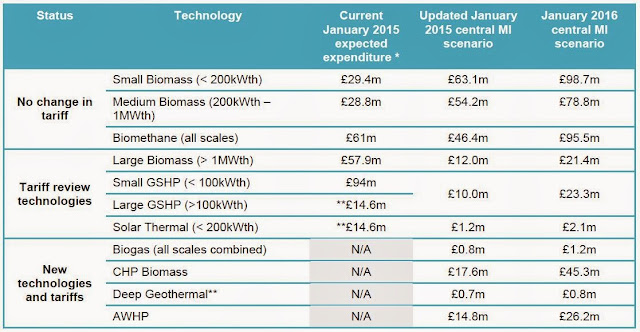
In the May 2013 tariff review consultation we set out that the budget management policy would need to be developed in light of any tariff changes or scheme extensions and to reflect the outcome of the spending review for 2015/16, which has since confirmed an RHI budget in 2015/16 of up to £430m.
Having reviewed the budget management mechanism to ensure it remains fit for purpose,
DECC will make some changes to the policy from Spring 2014 to:
- base the deployment levels set out in the degression mechanism on refreshed market intelligence rather than the expectations that were modelled prior to the scheme’s introduction;
- reduce the tolerance in the technology trigger for biomass under 1MWth and bio-methane injection by reducing the amount that these triggers are scaled above expected levels of deployment. They will change from being 150% of expected deployment to 120% of expected deployment. This will reduce the risk of unsustainable growth and dominance of the budget by a small number of technologies;
- set the triggers for technologies
DECC expects to deploy in relatively lower volumes (solar thermal, deep geothermal and all biogas) at 2.5% of the overall budget, rather than the current 5%.
Reducing uncertainty for projects with long-lead times
DECC intend to introduce a form of tariff guarantee for the largest installations (for example, those over 1MW), initially available for plant due to be commissioned by 31 March 2016. Subject to further policy development in 2014, State Aid and Parliamentary approval,
DECC will aim for this measure to be in place from April 2015 to March 2016 and thereafter factored into the next spending review discussions on the RHI so that it can be available from Spring 2016 for plant due to commission by 31 March 2020.
 Public Grants
After two years of the non-domestic RHI we think a more flexible approach to the interaction between public grants and the RHI could encourage more renewable heat installations to come forward. Pending further work alongside the 2014 review to look at the interaction between public grants and the non-domestic RHI,
DECC intend to introduce some additional flexibility next year. We will take forward regulatory amendments to extend the eligibility window for repayment of grants and to allow some grant recipients who are unable to pay back their grants to access the RHI via reduced tariff payments.
Public Grants
After two years of the non-domestic RHI we think a more flexible approach to the interaction between public grants and the RHI could encourage more renewable heat installations to come forward. Pending further work alongside the 2014 review to look at the interaction between public grants and the non-domestic RHI,
DECC intend to introduce some additional flexibility next year. We will take forward regulatory amendments to extend the eligibility window for repayment of grants and to allow some grant recipients who are unable to pay back their grants to access the RHI via reduced tariff payments.