Showing posts with label woodfuel. Show all posts

Friday, 27 November 2015

Training Opportunity: Woodfuel Quality Standards

Can you afford not to be up to date with BSL compliance and sustainability criteria?

Keep up to speed on the latest developments in woody biomass standards and specifications.

Why attend?

The Ignite Woodfuel Quality Standards course is essential training for anyone involved in the production of woodfuel.  

It includes the latest information on how to maintain compliance with the Biomass Suppliers List (BSL) and RHI land use and sustainability criteria, it provides a commercial insight into quality assurance and third party schemes such as Woodsure and ENPlus and provides a technical introduction to specifications and standards in use for woody biomass fuels including ONORM, BS-EN and BS-EN-ISO.


This one day course covers the key legislation and sustainability criteria which need to be considered during the production and specification of woodfuel. 

The day is divided into four sessions, including an outdoor based practical and demonstration:
  • BS EN and BS EN ISO Standards
  • Specifying Woodfuel 
  • Chipping & Sampling
  • Fuel Quality Assurance including meeting BSL requirements

The full course content can be accessed here.

The course is delivered by our qualified and experienced trainers with over 10 years of experience in delivering Ignite woodfuel training courses. 

Cost

This one day course costs £150+VAT* which includes the LANTRA Awards certification fee, course materials, lunch and refreshments.

* Members of Woodsure, the Wood Heat Association and the Confor Woodfuel Suppliers Group can take advantage of a 10% discount on course fees - just let us know at time of booking.

Ignite courses are accredited with LANTRA Awards and course fee includes certificate of attendance.

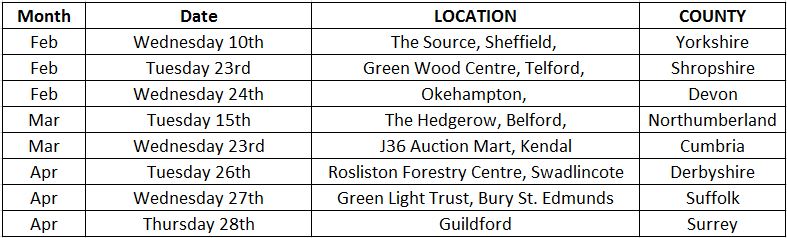
If you would like further information on any of our courses, please contact:

Erica at erica.spencer@ruraldevelopment.org.uk

or on 01765 609355.

For further information on events and courses being run by RDI, please click here.


Thursday, 8 October 2015

Woodfuel Quality Standards - new course available


Ignite is an innovative training programme of practical seminars and interactive workshops with a focus on woodfuel. 

Ignite is designed for those wanting to know more about woodfuel and to equip new and existing woodfuel businesses with the skills and knowledge required to meet the increasing demand from this growing market. Ignite courses have been developed and are run by RDI Associates Limited, a registered training provider with Lantra Awards and all courses are delivered by experienced and accredited trainers.

Woodfuel Quality Standards

This one day course introduces woodfuel suppliers and users to the full range of standards and quality assurance schemes in use in the supply chain and how to produce and specify the correct type of fuel. 

It looks at how to ensure your woodfuel is compliant with the Timber Standard for Heat and Electricity covering the legal and sustainability criteria and the requirements of the Biomass Suppliers List. 

The course also looks at how woodfuel properties can affect compliance with standards, how to specify and test fuel, and match fuel specifications to combustion systems. 

An introduction to BS EN solid biofuels standards will be provided, as will a review of the various woodfuel quality assurance schemes and the relevance these may have to your business. 

Finally, the course involves a practical sampling demonstration at a working woodfuel supply depot. 

Course attendees will also receive a copy of our Woodfuel Quality Standards Handbook and a Lantra Awards certificate of attendance.

Cost

1 day course - £140+ VAT

A 10% discount is offered to members of the Woodfuel Suppliers Group and Wood Heat Association. Please confirm your membership on booking. Prices include all course materials, refreshments, lunch and course registration and certification fees.

This course is being run in partnership with Forest Advisory Consortium England partners Woodnet and the Kent Downs AONB Woodfuel Pathfinder and the High Weald AONB.

How to book:

Phone : 01765 609355
Email : Erica.spencer@ruraldevelopment.org.uk
Post: Rural Development Initiatives Ltd
Unit 9
Sycamore Business Park
Dishforth Road
Copt Hewick
Ripon
HG4 5DF

Further details from www.ruraldevelopment.org.uk/events

Wednesday, 12 August 2015

Woodfuel training course - quality standards and quality assurance


The Kent Downs Woodfuel Pathfinder and High Weald AONB have partnered with Ignite to offer a new training course on woodfuels.

Ignite is an innovative training programme of practical seminars and interactive workshops with a focus on woodfuel. 

Ignite is designed for those wanting to know more about woodfuel and to equip new and existing woodfuel businesses with the skills and knowledge required to meet the increasing demand from this growing market. 

Ignite courses have been developed and are run by RDI Associates Limited, a registered training provider with Lantra Awards and all courses are delivered by experienced and accredited trainers.

The course is being run in partnership with Forest Advisory Consortium England partners, WoodNet and the Kent Downs and High Weald AONBs.

Woodfuel Quality Standards

This one day course introduces woodfuel suppliers and users to the full range of standards and quality assurance schemes in use in the supply chain and how to produce and specify the correct type of fuel. 

It looks at how to ensure your woodfuel is compliant with the Timber Standard for Heat and Electricity covering the legal and sustainability criteria and the requirements of the Biomass Suppliers List.

The course also looks at how woodfuel properties can affect compliance with standards, how to specify and test fuel, and match fuel specifications to combustion systems.

The course provides an introduction to BS EN solid biofuels standards that have been adopted in the UK and reviews the various woodfuel quality assurance schemes and what relevance these may have to your business. The course involves a practical sampling demonstration at a working woodfuel supply depot.

Course attendees will also receive a copy of our Woodfuel Quality Standards Handbook and a Lantra Awards certificate of attendance.

Cost:
1 day course: £140+ VAT

  • A 10% discount is offered to members of the Woodfuel Suppliers Group and Wood Heat Association (please confirm your membership on booking)
  • Prices include all course materials, refreshments, lunch and course registration and certification fees

How to book:
Phone: 01765 609355

or

Email: Erica.spencer@ruraldevelopment.org.uk

or

Post:
Rural Development Initiatives Ltd
Unit 9
Sycamore Business Park
Dishforth Road
Copt Hewick
Ripon
HG4 5DF

Further details from the RDI events web page.

Friday, 31 January 2014

What buyers of firewood want

We were so pleased to read about the results of Certainly Wood's customer feedback exercise.  Finding data for the wood fuel sector is notoriously hard - and if you do find some the base from which the statistics are derived can be woefully small.

At around 2,300 Certainly Wood's survey seems fairly robust.  We've not seen the actual survey or looked at the analysis - but taken at face value the results should be of interest to anyone involved in woodfuel.

Right at the top of the list is moisture content - and more specifically moisture content below 20%.  As we know Certainly Wood specialise in kiln-dried wood so this sort of confirms their USP.  However, it does reinforce that fact that most consumers are pretty well informed when it comes to seasoning and moisture and they clearly look for these attributes when buying logs.

Next up are sustainability, supply chain and production.  Encouraging to see that such high emphasis is placed on where the fuel comes from.  We are not familiar with Certainly Wood's supply chain but clearly their customers like buying British and are at least aware of the need for sustainable sourcing.


Given the paucity of information from the woodfuel sector this survey makes interesting reading.  We are also fairly impressed with the marketing approach.  

We know that not all firewood businesses are this large, but good marketing can clearly help drive business.  Berties Woodfuel, based in Hadlow in Kent, is another example of where simple marketing and branding can really help differentiate a business.


Thursday, 3 October 2013

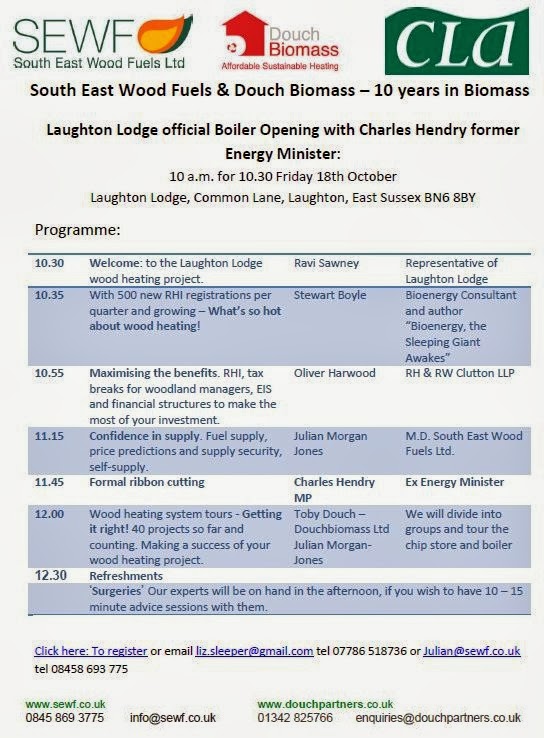
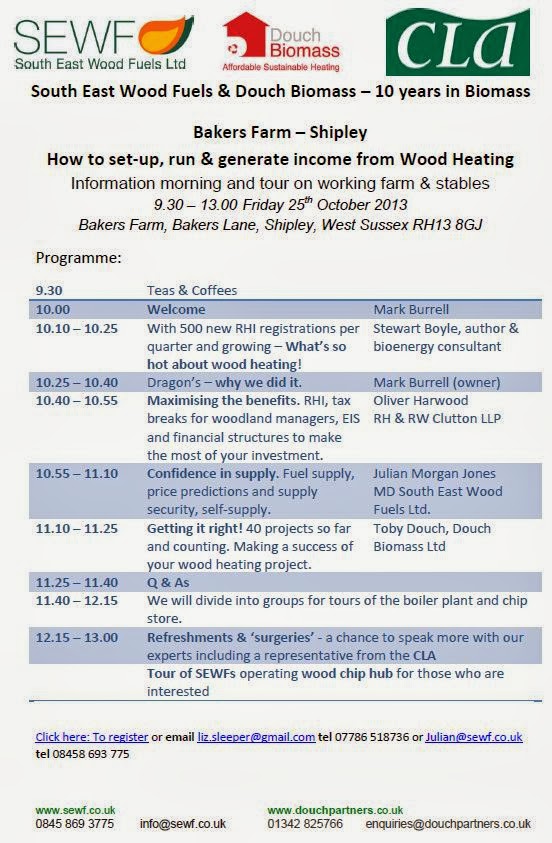
Events in Sussex will highlight progress in wood fuel and biomass heating sectors

South East Wood Fuels, Douch Biomass and the CLA have announced two events to showcase new biomass heating installations in Sussex and to provide an update on the woodfuel and biomass heating sectors.

The first will take place on Friday October 18th at Laughton Lodge in East Sussex.  The district heating system at this site has recently been upgraded and a new boiler installed.  

On hand will be a range of RHI, woodfuel and biomass heating experts who will highlight recent developments in the sector.  The event also offers free 'surgeries' for those interested in undertaking a woodfuel or biomass heating project.


The second event takes place at Bakers Farm in West Sussex on Friday October 25th.  Both events are free.  To register please visit the following sites to book your place:

  1. Laughton Lodge - Oct 18th: Click here
  2. Bakers Farm - Oct 25th: Click here


Friday, 1 February 2013

Government Forestry and Woodlands Policy Statement

Defra's response to the Independent Panel on Forestry's report has been released and it makes interesting reading.

The Panel’s report has essentially led to a refreshed Government forestry policy. It will be based around a set of priorities: protecting, improving and expanding public and private woodland assets. It also reflects key Government principles, such as economic growth, localism, deregulation, targeted government intervention and value for money.

Of great interest to this blog is the announcement of an 'action plan' led by the wood industry that will consider, among other things, the important future role played by the biomass and woodfuel markets in the management of our woodland resource.


The main headlines from the response are as follows:


  • The need to develop a new woodland culture and a resilient forestry and woodland sector,
  • The value of the Public Forest Estate, which will continue to benefit from public ownership, be held in trust for the nation and be managed by a new, operationally-independent body,
  • The importance of protecting our woodland assets,
  • The need to bring more woodland into active management and increase the extent of woodland cover in England,
  • The need to help the sector to find its voice and improve its economic performance,
  • The importance of preserving and maximising the social and environmental benefits provided by trees and woodlands, particularly in and around our towns and cities,
  • The scope for developing new markets based around a better understanding of the value and potential of our trees, woods and forests,
  • The value of retaining a skilled cadre of forestry experts within the public sector.
Exploring New Opportunities: The role of woodfuel

Defra's response recognises that local renewable heat projects have the potential to provide an economic return to owners of even small areas of woodland and can benefit many businesses involved in the wider forestry sector:
  • There are currently around 600 woodfuel supply outlets across Britain selling to local markets and there is potential to do more, provided this market is not developed at the expense of other wood processing industries and does not create unfair competition for our home grown products.
  • Undermanaged broadleaved woodland in particular could supply significant quantities of fuel without interrupting current supply chains. More effective management of our woodlands will also make a long-term contribution to our challenging climate change targets, through reducing reliance on fossil fuels and energy intensive materials.
  • With the introduction of the Renewable Heat Incentive the scope for developing new initiatives around woodfuel is growing.
To facilitate these objectives, the industry has invited Dr Peter Bonfield, OBE, Chief Executive of the Building Research Establishment (BRE), to lead the creation of a 'roadmap' (in autumn 2013) to a new and successful future for England’s forest-based supply chains. 

This will be developed in partnership with woodland owners, managers, buyers, processors, researchers, retailers, contractors, woodfuel suppliers, community groups and Government. 

Details of the organisations currently involved are on the Confor website.


A summary of the other main points are provided in the sections below.

Improving our Valuable Woodland Assets

This section of the response probably contains the most radical changes and clearly sets the policy towards economic growth:
  • Work with landowners and others to increase the amount of actively-managed woodland and review progress in five years,
  • Further reduce unnecessary regulation and red tape affecting the sector,
  • Support the sector as it develops its new industry-led Action Plan,
  • Work with the sector to explore the scope for exploiting economic opportunities, such as woodfuel markets and rural tourism,
  • Encourage, where appropriate, local government and Local Enterprise Partnerships to take advantage of the opportunities provided by Government policies to realise the potential of local woodland assets.
Specific activities around people and communities and wildlife and the natural environment will continue.

Expanding our Woodland Resource

Increase England’s woodland cover significantly to achieve greater economic, social and environmental benefits:
  • Deliver 12% woodland cover by 2060:
  • Work with the sector to find new ways of encouraging landowners to plant more trees where it best suits them and their local conditions,
  • Develop further the voluntary woodland carbon market and other sources of investment that reflect forestry’s low carbon credentials and wider public benefits to deliver a more wooded landscape,
  • Pilot an initiative to reduce burdens on landowners who want to plant woodland by clarifying where a full Environmental Statement is unlikely to be required.
Protecting our Trees, Woods and Forests

Defra will give greater priority to tree and plant health.  For example, the Living With Environmental Change (LWEC) Partnership will use £4 million of Defra funding, £0.5 million of additional Forestry Commission funding and up to £4 million additional funding from Research Councils to do in-depth research into tree diseases to inform the way outbreaks are handled in the future.

Governance and Structures

Defra plans to simplify current structures and step back from unnecessary day-to-day involvement:
  • Retaining a core of forestry expertise within Government with the capacity to deliver a range of functions, duties and powers,
  • Reviewing the Government’s forestry functions alongside the Triennial Review of the Environment Agency and Natural England,
  • Working with the devolved nations to ensure that vital cross-border functions in areas such as research, standards and tree health can continue to be delivered centrally, where this is appropriate,
  • Establishing via legislation a new, operationally-independent Public Forest Estate management body to hold the Estate in trust for the nation. It will be charged with generating a greater proportion of its income through appropriate commercial activity and with maximising the social, environmental and economic value of the assets under its care.
Realising More of our Woodlands’ Value

Defra acknowledges the social and environmental benefits of woodlands and to developing new market opportunities to realise these. Work already undertaken by the National Ecosystem Assessment, the Natural Capital Committee and the Ecosystem Markets will continue via:
  • Working with the Natural Capital Committee and the Office of National Statistics to develop a set of natural capital accounts for UK forestry assets and use this to inform the development of a set of natural capital accounts for the Public Forest Estate,
  • Developing a woodland ecosystem market roadmap to bring together actions by Government and our partners over the next 5 years to (a) build knowledge (b) develop wider networks of collaboration and expertise and (c) implement mechanisms and projects to demonstrate good practice,
  • Working with others to support the further development of markets in forest carbon and other ecosystem services such as water and biodiversity.

Monday, 19 November 2012

Update on RHI scheme

As the first anniversary of the Renewable Heat Incentive approaches we thought we would take a quick look at progress to date.

In terms of overall numbers the results are modest.  In England the number of accredited installations is 406.  Of these 358 (88%) are for biomass boilers, 25 (6%) for solar thermal and 19 (5%) for ground source heat pumps.
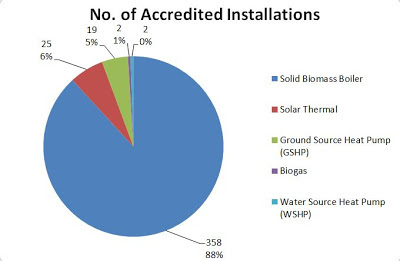
Data Source: Ofgem, 19/11/2012
The relatively low uptake in the solar thermal and ground source categories is interesting and suggests that these technologies are yet to find traction in commercial situations.  This low uptake may also be due to the popularity of the Feed in Tariff which has probably diverted attention towards solar PV, particularly where biomass is not an option.

The results also show that the RHI tariff is yet to be used for deep geothermal, municipal sold waste or bio-methane installations.  As these technologies are often used at larger scales it may be that other incentives are being favoured, such as the Renewables Obligation Certificate (ROC).  Another factor is the high capital cost of these technologies which undoubtedly take longer to plan and finance.  Uptake of the RHI might therefore pick up in time, but in the absence of any other information from DECC (e.g. pre-accreditation) it is hard to tell.

Biomass romps ahead

At 358 installations (commercial) biomass heating is leading the renewable heat scene at the moment.  Based on our experience these installations are mainly to be found on farms and estates and often focus on a large property that is connected to multiple domestic and non-domestic properties in close proximity.  We are also seeing smaller domestic systems that involve multiple dwellings connected to a single boiler.
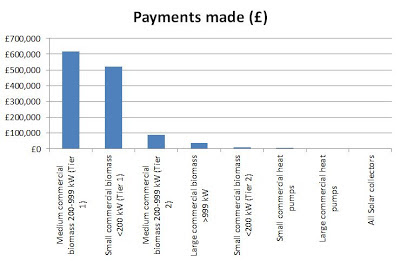
Date Source: Ofgem, 19/11/2012
Uptake in the new build/refurbishment sectors is happening, albeit at a much slower rate.  While planning applications for large regeneration projects and new housing are coming through, particularly in the Growth Areas and Growth Points of Kent, the specification of biomass heating is rare, which seems odd given the interest from private finance houses in RHI-based investments and ESCo business models.

The integration of other renewable heat technologies alongside biomass does not yet appear to be common either.  Even though solar thermal and biomass are best friends, to use a Jamie Oliver saying, we are yet to see it in action.  This may be because of high capital cost of biomass which could be excluding secondary/complementary technologies (i.e. biomass is often sized to be as close to 100% of the heat load as possible with oil for peak which often makes the business case for complementary technologies less attractive).

Uptake in Kent?

Unfortunately the Ofgem statistics do not allow analysis at region or county levels.  However, based on the work we are doing and the people we speak to, many of the large farm estates (particularly those with woodland interests) have made enquiries about the RHI and biomass technologies and several sites have gone ahead with projects.

Kamstrup heat meter in action
However, in the grand scheme of things uptake is still slow.  We think that whilst interest levels are high the upfront capital cost of biomass remains the single largest barrier and prevents many from proceeding further.  We know from the pre-feasibility studies we have carried out for people that the business case for biomass in the right situation is extremely compelling (i.e. 5 to 6 year payback, 10%+ return over the lifetime of the installation, 50% fuel cost reduction for wood chip).

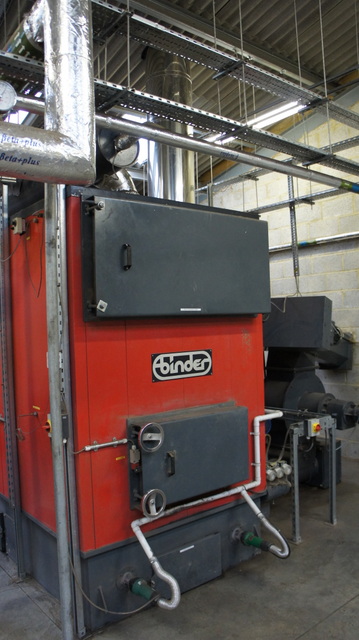
650 kW Binder at Hever Castle
Whilst we agree that biomass heating projects have a long lead in time, and take considerable project/business development, there may be a case for installing presenting finance options (if they have them) at a much earlier stage.

Domestic RHI on its way...

Don't forget that the purely domestic version of the RHI is being consulted on at the moment.  This scheme is due to open in Q2 or Q3 2013.  Our current thinking is that the tariff proposed for domestic biomass in the consultation is currently too low to make a significant difference in payback (and thus uptake).  If you are interested in the RHI and are in a situation where you could qualify for the commercial RHI (e.g. 2 or more domestic dwellings connected to a single boiler) you may well be better off taking action now.  We hope that the tariff under the domestic RHI improves and we will keep a keen eye on the consultation response by DECC.

Can we help?

The Kent Downs Woodfuel Pathfinder can provide pre-feasibility support for people considering biomass heating.  By 'pre-feasibility' we mean the assessment of viability and the development of an initial (non-market tested) business case.  We can also support people as they engage with the installer network.

If you would any help with the RHI and biomass heating then please get in touch with us on 01303 815 171 or matthew.morris@kentdowns.org.uk.  

Due to the way our project is funded our support needs to be provided mainly within Kent and should preferably link to woodfuel supply chains in/near the Kent Downs AONB.  If in doubt just call!  


Tuesday, 30 October 2012

CLA Woodfuel Event


Wednesday, 27 June 2012

Sustainable forestry strong in England


Latest figures published by Forestry Commission England show our woodlands are incredibly well protected and sustainable forestry remains strong.

According to records, just 0.4 per cent of trees felled in England were done illegally without a felling licence. Conservation habitats, such as heathland, have been restored from commercial plantations whilst keeping a slowly expanding wooded area overall. A thriving timber industry has increased domestic supply as imports have fallen.

Simon Hodgson, Forestry Commission England Chief Executive said:
“For the first time we have been able to publish a suite of new statistics to show what is happening to woods and forests in England and how Forestry Commission England is performing.

“The overall picture is great news for us. Protection of our woods and forests is strong with miniscule amounts of illegal felling. The general public are very much our eyes and ears on the ground and we are always heartened at the public’s willingness to report suspected illegal activity and we are developing an online system to make this quicker, easier and more accurate.

“We see domestic timber supplies increasing while imports shrink and a growing woodfuel network all of which boosts the local green economy. Commitments to restore and recreate conservation habitats from private and public plantations are being met while we see the overall area of woodland expanding."

The Forestry Commission remains a leader as a significant land manager in the care of the Engalnd’s best wildlife conservation sites - Sites of Special Scientific Interest (SSSIs) – with 99.6% in target condition.

“All that said significant challenges remain. Everyone agrees we need much greater growth in creating new woodlands and we are working to significantly increase long term investment from the private sector. We are working to mitigate the threats from a changing climate to trees in the future from new pests and diseases and poor growing conditions. Last, but most certainly not least, is the appalling record of Health and Safety in the forestry sector: skills and training are high but the number of fatalities in a small industry must be tackled."

Castle Head FSC - Tree Planting - Feb 2009
“We are already working with the sector to implement recommendations from the Forestry Regulation Task Force and look forward to receiving the Independent Forestry Panel’s final report to Government.”

27 June 2012
Forestry Commission News release 15523

Thursday, 12 April 2012

Bersco Engineering Open Day

Bersco Engineering, based on the Lympne Industrial Estate near Hythe, is an engineering company specialising in diesel and hydraulic servicing for a range of vehicles, including agricultural and forestry equipment.

The latest addition to their portfolio of services is a new partnership with Fuelwood (Warwick) Ltd which acts as a national importer/distributor of specialised woodfuel processing equipment.

As a result of this new relationship there is now a local supplier of high quality equipment, including Heizohack (chippers), Japa and Sami (log processors), Woodline (log splitters), LucasMill (portable saw mills), MOWI (trailers and cranes) and Fuelwoods own range of British manufactured kindling and log machines (Transaw, Splitta and Kindlet).

I attended Bersco's recent open day and met with owner Robert who was pleased with the good turn out.  There was a good mix of existing customers as well as some seasoned woodsmen who paid close attention to the demonstrations led by Jeremy from Fuelwood Ltd.  The hog roast also helped proceedings, as did the umpteen cups of tea provided by Leanne's team!

Fuelwood's Jeremy discussing kindling during a tea break
The Sami log processor was certainly an impressive piece of kit.  The model being demonstrated, the S185-TEC440, is not cheap at almost £30,000, but it made short work of some fairly large pieces of timber.  What was most impressive was the automatic sensors that scan the timer dimensions as it enters the machine and alters the cutting length and height of the splitter blade automatically.  This means that timer with a variety of dimensions can be fed into the machine without the operator having to alter the set-up each time.  The hydraulic log lift was another feature that was new to me.

The Kindlet machine was more familiar to me but I was impressed again at the ease with which it produces a consistent product.  According to Jeremy the PTO version can process up to 100 bags an hour...not bad considering the average price of a bag of kindling these days!

The SAMI log processor (PTO or 3-phase)

Also good for leaning on
The NET result...ahem

The Kindlet - Made in Britain


The SAMI log conveyor


Monday, 16 January 2012

Charity makes woodland fuel plea


Pearl Bordered Fritillary (picture courtesy D E Newland)
Managing neglected English woodlands to produce wood fuel could boost declining species of flowers, conservationists have said.

Plantlife has revealed that one in six woodland flower species is threatened with extinction, with plants hit by the "perfect storm" of under-managed woods, increasing deer populations and too many nutrients in the environment.

But sustainable woodland management to provide wood fuel could generate a low carbon energy source that people could buy to support their local countryside, in the same way as buying local farm produce, and improve woods for wildlife.

Plantlife said that in 1950 around half the country's woodlands were coppiced or scrub.

But by 2010, 97% of woods had become "high forest", with tall trees cutting out light and affecting plants, as well as creatures such as pearl-bordered fritillaries which rely on them.

Plantlife's landscape conservation manager Andrew Byfield said: "All flowering plants require light to grow.

"We think of woodland plants growing in deepest shade but most woodland plants like glades, woodland edges, thin woodlands and rides."

According to the plant charity, rare species including lady orchids and green hound's-tongue have suffered from a lack of woodland management such as coppicing.

More common species such as violets, primroses, early purple orchids and wood anemones also need well-managed woods to flourish.

Mr Byfield said English woodlands were losing their diversity as a result of the lack of management, as well as the pressure on plants from deer and the impact of nutrients which lead to over-growth of species such as brambles.