Showing posts with label domestic rhi. Show all posts

Tuesday, 22 April 2014

Updated commercial RHI tariffs announced

Ofgem has recently released the updated tariffs for the commercial RHI scheme.  These changes have taken place primarily due to the annual inflation of the RHI, the third increase since the scheme was launched.  However, changes have also taken place in response to increasing uptake of the scheme, particularly in the small and medium biomass projects.

The inflation of the tariff, this year by 2.7%, affects those already in receipt of payments from Ofgem as well as installations that will become accredited after April 1st 2014.

The following table focuses on the biomass tariff.  For example, for boilers sized up to 199 kW the Tier 1 tariff has increased from 8.6 p/kWh to 8.8 kWh (the Tier 2 tariff from 2.2 to 2.3 p/kWh).  The last column in the following table shows the updated tariff (from 01/04/2014).


Whilst these changes are not earth shattering the increases help to further enhance the economics of RHI accredited biomass boilers.  For example, the annual RHI payment for a 199 kW boiler serving a 280,000 kWh heat load would increase by around £500 per year.
The only downside to these changes is the reduction in the tariff for medium-scale biomass boilers that were accredited after July 1st 2013 (Tier 1 down to 5.1 p/kWh and Tier 2 remains at 2.2 p/kWh).  This change indicates that degression has taken place in the medium category due to rising uptake of the RHI in this category.

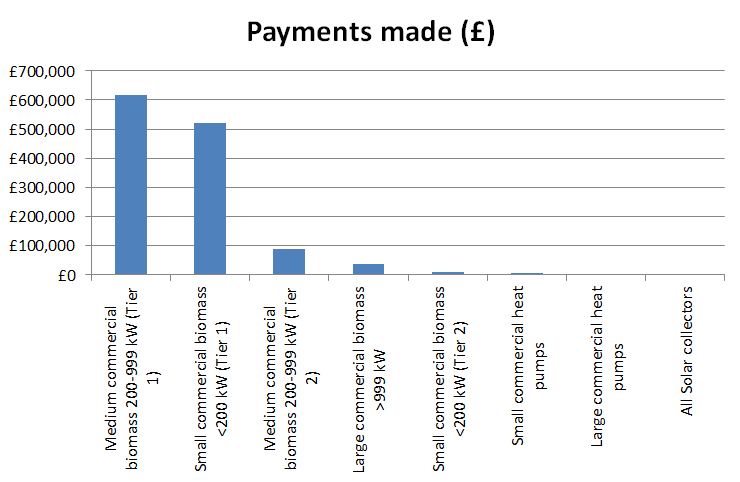
Whilst the overall expenditure for the RHI is proceeding according to forecast it is clear that the small biomass category has seen the largest increase in expenditure.


Ofgem states that:

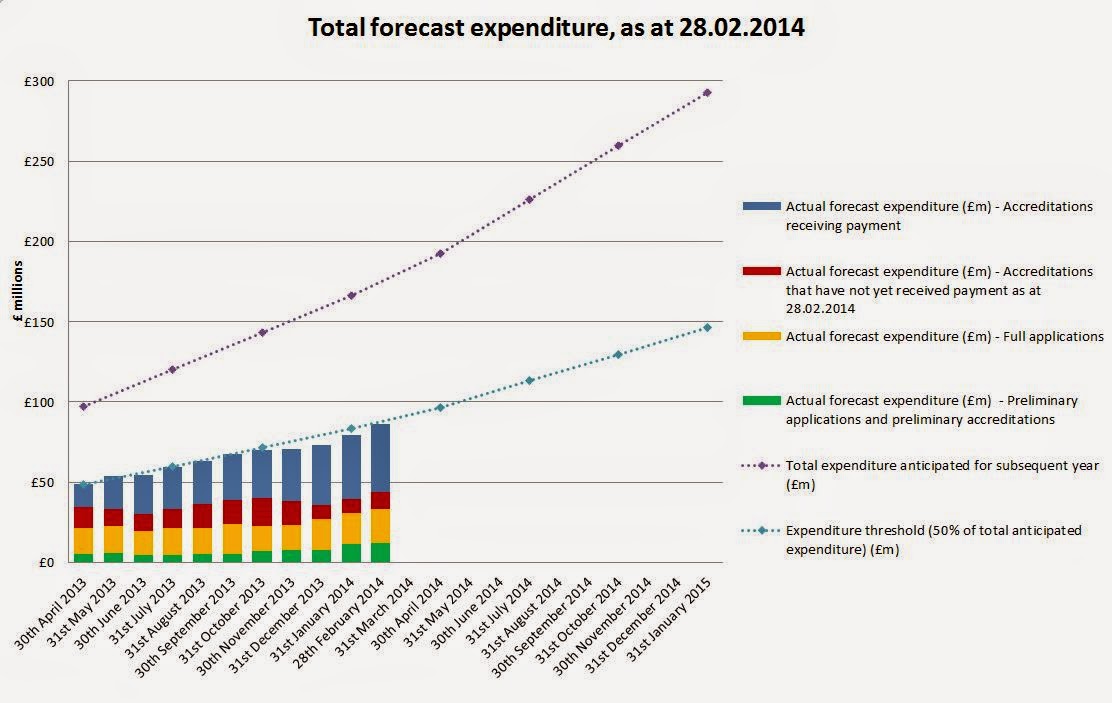
"Forecast spend over the next 12 months for small commercial biomass is £44.4m. This means that estimated spend for this technology is already £10.4m above its 30 April 2014 individual technology trigger point of £34.0m. This increases the possibility of a reduction to this tariff in the next quarter. However, this would only occur if next quarter’s 50% trigger for the scheme as a whole of £96.4m was also exceeded, which would require a £10.1m increase in total expenditure over March and April."

Other developments include:

  • Forecast spend over the next 12 months for medium & large commercial biomass has increased by 4% and 6% respectively.
  • Forecast spend for small heat pumps has seen a significant increase of 25% in the last month.
  • Forecast spend for all other tariff categories have seen little to no activity this month and remain considerably below their individual tariff triggers for the next quarter.

The future risk of degression is summarised by Ofgem as follows:

"Whether any reductions occur next quarter depends on how well the scheme overall, and each technology tariff, performs during March and April and whether total scheme spend grows by £10.1 million in that time. An increase of this size would occur if the scheme was to continue to grow at the rate we have seen this month which would cause the 50% total scheme trigger of £96.4m to be hit. DECC will receive the data needed to make this forecast in May, and will publish the next quarterly degression announcement by 1 June 2014, following which, any reduced tariffs would come into effect from 1 July 2014."

Thursday, 8 August 2013

Domestic RHI - summary of scheme proposals

DECC has published its response to the consultation on the domestic version of the Renewable Heat Incentive (RHI).  The response includes a lot of detail on the types of technology that will be supported, their 'performance' and the type of properties and tenure that will be eligible.

To assist readers we have produced a summary of the proposals as they stand.  This can be found here.

The proposals for biomass heating are of particular interest to this blog.  The main points of interest include:


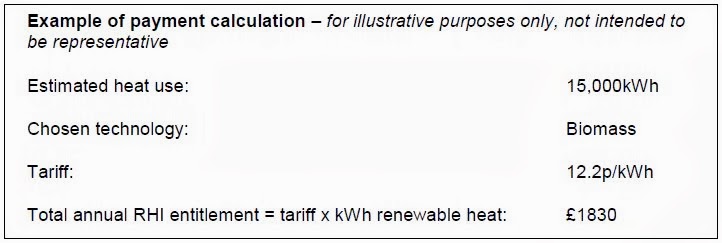
  • The tariff for biomass has increased from 8.7 p/kWh (initially proposed in 2012) to 12.2 p/kWh.  Whilst this is slightly below the 13-15 p/kWh we would have liked to see it is clearly an improvement.  The final tariff is yet to be announced but presumably it will be well before the proposed scheme opening date of April 1st 2014.

  • The tariff will be paid over seven years according to deemed heat.  This is the heat load as determined by the EPC that is created during a Green Deal assessment which is a mandatory requirement.

  • Legacy systems installed since 15th July 2009 will also be eligible providing they were installed by an MCS accredited company.  
  • Biomass equipment will need to meet meet air quality standards in relation to particulate matter (PM) and oxides of nitrogen (NOx). Legacy installations, installed between 15th July 2009 and the launch of the scheme, will not need to meet this requirement.
  • A new requirement around fuel sustainability will be introduced for  biomass installations.  To be eligible for and continue to receive RHI support for a biomass system, fuel needs to be sourced from a supplier registered on an approved supplier list. Such a list will be set up ahead of the launch of the scheme and will be the same one that is being established for the non-domestic RHI scheme.
The final point on sustainability is interesting and has important implications for wood fuel suppliers. To be included on the list, DECC intends that fuel suppliers will have to meet two criteria from April 2014:

  • Supply fuel which complies with the greenhouse gas (GHG) lifecycle emissions target of achieving 60% GHG savings against the EU fossil fuel heat average, assuming a boiler efficiency of 70%.
  • Report their performance against the relevant land criteria from the following list (although compliance with the criteria will not initially be required):

Evidence of legality and sustainability can come in two forms:

  • Category A evidence is independent certification of the timber/ timber products by any of the forest certification schemes that meet the policy requirements (such as FSC and PEFC).
  • Category B evidence is alternative documentary evidence that provides assurance that the source is legal and sustainable.
Category A evidence is the 'belt and braces' approach and undoubtedly involves the procurement of external expertise from Forest Stewardship Council and the accredited certification bodies are authorised to issue FSC certificates.

The alternative is Category B evidence and you will be glad to hear that this includes use of the Forestry Commission's Woodland Planning Grant (WPG) that falls under the English Woodland Grant Scheme (EWGS).  

However, the WPG Category B option is open to owners with less than 100 hectares of woodland, and more than 3 hectares, and whose woodlands are not certified.  As such it is envisaged that owners with more than 100 hectares will pursue the Category A, full certification option.

As ever we would recommend a good read of the full DECC document to make sure you pick up all of the salient points.


Tuesday, 11 December 2012

RHI update and summary of changes to RHI Register


This post provides an update on the RHI and summarises the recent changes made by Ofgem to some of the RHI application questions.

Progress update

Overall the number of biomass RHI applications has risen from 276 on September 25th to 585 on December 11th.  

Source: Ofgem public report - Dec 11, 2012
Source: Ofgem public report - Dec 11, 2012
This is a significant increase and indicates that the scheme is beginning to make progress.  

However, this scheme overall is still far behind the original forecasts and around £30-35m will be returned to the Treasury at the end of March.

Meanwhile, the consultation on the domestic version of the RHI closed on December 7th, the results from which  are due in March 2013.  More details, including the recent consultation addendum relating to a subsidy cap and its impact on heat pump tariffs, can be found here.

Application changes

With regards to the changes to the application questions Ofgem points out the following:
  • No extra information is necessary with the update to these questions.
  • The requirements are the same as before, questions have been reworded to improve the quality of RHI applications made, and ensure the application questions assist applicants understand what is required first time, both in terms of question responses and document uploads.
The following questions have been updated  - the changes are in brackets:
  • HD170, (Please select the type of premises in which heat from the installation (for which you are applying) is used. Please upload evidence of non-single domestic status at the document uploads at the end of the application (eg Non-Domestic (Business) Rates bill, multiple Council Tax bills or equivalent / similar evidence))
  • HG150, (Will the installation use any of the following fossil fuel-derived fuels: You can select more than one answer for this question)
  • HI150, (Please provide a meter reading for this meter. If this is not your first submission of this application then please do not change this meter reading unless agreed with Ofgem. This reading may need to be updated if, for example, you have made changes to metering requiring new readings, or your installation, heating system or application information has undergone significant amendments.)
  • HI151a-1/HI151B-2 etc, (Please provide the date on which this reading was taken (this should be no more than three days before the date on which the application is first submitted to Ofgem).
  • HK110, (Please enter the serial number of your installation. E.g. for boilers you will find this on the boiler name plate. Please upload a photo of your boiler name plate AND a copy of your invoice showing the date of purchase and model of your heat generating equipment (at the document uploads at the end of the application), OR a copy of your commissioning certificate showing model, capacity and commissioning date.)
  • HK120, (Please provide a comprehensive description of your installation, including the make & model of the main components. For further details of the information that should be included here, please refer to guidance and available applicant information.)
  • HL99, (Please confirm if you wish to Upload or Post the documents as supporting evidence? Please note that uploading documents is likely to mean the accreditation process is quicker.You must however always send bank and ID information under separate cover by post as instructed. Please do not change this setting to “post” if you have previously selected “upload”. Contact the enquiry line if you have any problems, and please see the IT system user guide for help on creating and uploading PDFs.)
  • HL170, (Please provide a comprehensive schematic or diagram of the heating system of which your installation forms part. This must include the following: 
    • All plants providing heat to the heating system, whether eligible or ineligible 
    • All uses supplied with heat from the heating system, both eligible and ineligible 
    • The pipework connections between all plants and heat uses, including clear indication of any pipework not located within a building 
    • The positions of relevant hot water and steam meters and their associated components.(e.g. both temperature sensors, flow meter and integrator). 
    • Please ensure that all of the items listed above are clearly labelled, that the schematic has a key, and that building boundaries are indicated.)

The application register can be found here and the application guidance here.

Monday, 19 November 2012

Update on RHI scheme

As the first anniversary of the Renewable Heat Incentive approaches we thought we would take a quick look at progress to date.

In terms of overall numbers the results are modest.  In England the number of accredited installations is 406.  Of these 358 (88%) are for biomass boilers, 25 (6%) for solar thermal and 19 (5%) for ground source heat pumps.

Data Source: Ofgem, 19/11/2012
The relatively low uptake in the solar thermal and ground source categories is interesting and suggests that these technologies are yet to find traction in commercial situations.  This low uptake may also be due to the popularity of the Feed in Tariff which has probably diverted attention towards solar PV, particularly where biomass is not an option.

The results also show that the RHI tariff is yet to be used for deep geothermal, municipal sold waste or bio-methane installations.  As these technologies are often used at larger scales it may be that other incentives are being favoured, such as the Renewables Obligation Certificate (ROC).  Another factor is the high capital cost of these technologies which undoubtedly take longer to plan and finance.  Uptake of the RHI might therefore pick up in time, but in the absence of any other information from DECC (e.g. pre-accreditation) it is hard to tell.

Biomass romps ahead

At 358 installations (commercial) biomass heating is leading the renewable heat scene at the moment.  Based on our experience these installations are mainly to be found on farms and estates and often focus on a large property that is connected to multiple domestic and non-domestic properties in close proximity.  We are also seeing smaller domestic systems that involve multiple dwellings connected to a single boiler.

Date Source: Ofgem, 19/11/2012
Uptake in the new build/refurbishment sectors is happening, albeit at a much slower rate.  While planning applications for large regeneration projects and new housing are coming through, particularly in the Growth Areas and Growth Points of Kent, the specification of biomass heating is rare, which seems odd given the interest from private finance houses in RHI-based investments and ESCo business models.

The integration of other renewable heat technologies alongside biomass does not yet appear to be common either.  Even though solar thermal and biomass are best friends, to use a Jamie Oliver saying, we are yet to see it in action.  This may be because of high capital cost of biomass which could be excluding secondary/complementary technologies (i.e. biomass is often sized to be as close to 100% of the heat load as possible with oil for peak which often makes the business case for complementary technologies less attractive).

Uptake in Kent?

Unfortunately the Ofgem statistics do not allow analysis at region or county levels.  However, based on the work we are doing and the people we speak to, many of the large farm estates (particularly those with woodland interests) have made enquiries about the RHI and biomass technologies and several sites have gone ahead with projects.

Kamstrup heat meter in action
However, in the grand scheme of things uptake is still slow.  We think that whilst interest levels are high the upfront capital cost of biomass remains the single largest barrier and prevents many from proceeding further.  We know from the pre-feasibility studies we have carried out for people that the business case for biomass in the right situation is extremely compelling (i.e. 5 to 6 year payback, 10%+ return over the lifetime of the installation, 50% fuel cost reduction for wood chip).

650 kW Binder at Hever Castle
Whilst we agree that biomass heating projects have a long lead in time, and take considerable project/business development, there may be a case for installing presenting finance options (if they have them) at a much earlier stage.

Domestic RHI on its way...

Don't forget that the purely domestic version of the RHI is being consulted on at the moment.  This scheme is due to open in Q2 or Q3 2013.  Our current thinking is that the tariff proposed for domestic biomass in the consultation is currently too low to make a significant difference in payback (and thus uptake).  If you are interested in the RHI and are in a situation where you could qualify for the commercial RHI (e.g. 2 or more domestic dwellings connected to a single boiler) you may well be better off taking action now.  We hope that the tariff under the domestic RHI improves and we will keep a keen eye on the consultation response by DECC.

Can we help?

The Kent Downs Woodfuel Pathfinder can provide pre-feasibility support for people considering biomass heating.  By 'pre-feasibility' we mean the assessment of viability and the development of an initial (non-market tested) business case.  We can also support people as they engage with the installer network.

If you would any help with the RHI and biomass heating then please get in touch with us on 01303 815 171 or matthew.morris@kentdowns.org.uk.  

Due to the way our project is funded our support needs to be provided mainly within Kent and should preferably link to woodfuel supply chains in/near the Kent Downs AONB.  If in doubt just call!  


Friday, 26 October 2012

Update on community energy and Green Deal


To be helpful we thought we'd end the week with a round up of some of the recent announcements on community energy and the Green Deal.

Whilst  these announcements are not about woodfuel or biomass heating they are related and it would be remiss of us not to mention them.  For example, insulating a building properly can help to reduce the size of biomass boiler required and in-turn the amount of woodfuel required.

Here are the headlines, more details below:

  • Green Deal Cashbacks – hundreds of pounds for those who subscribe to Green Deal early
  • Green Deal - assessments – bookings underway
  • Green Deal - advice line opens
  • Green Deal - “Quick Guides” published
  • Energy Bill Blitz - £40m competitions for local authorities
  • PlanLoCaL interactive pack for communities on Green Deal
  • Consultation on domestic Renewable Heat Incentive (RHI)  - open to 7 December 
  • Call for evidence on onshore wind and community benefit – open to 15 November

Green Deal Cashbacks
Cash back rates under the Green Deal
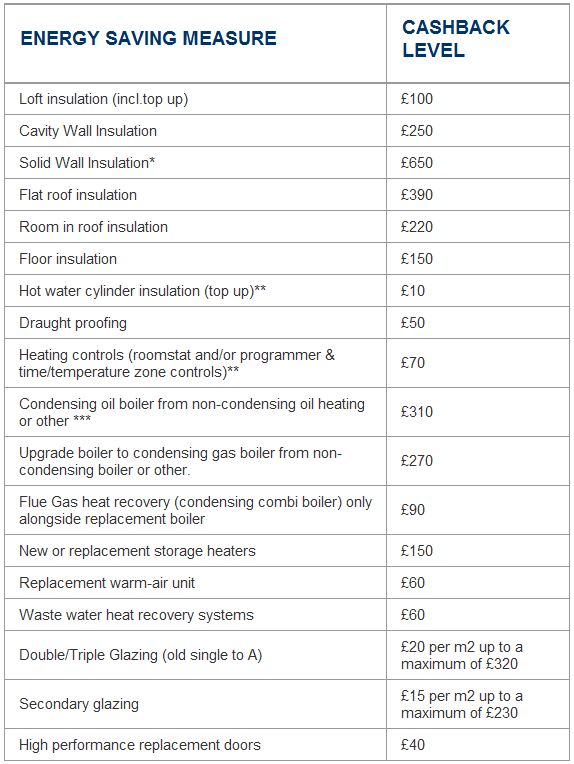
The Green Deal ‘Cashback’ Scheme is a first-come, first-served offer where householders can claim cash back from Government on energy saving improvements like insulation, front doors, windows and boilers. Packages could be worth over £1,000. It is available from 28 January 2013 for households in England and Wales and is a time limited offer. For cashback amounts see the DECC website.  Customers wanting to find out more about the Green Deal can call the Energy Saving Trust Advice Service on 0300 123 1234. 

Green Deal Assessments
Booking is underway for Green Deal assessments. Visit the website for further information for further information on assessments.  British Gas launched its Green Deal service this week.

Green Deal advice line opens:
Tel : 0300 123 1234.

Green Deal “Quick Guides” published:


Energy Bill Blitz – £40m competitions for local authorities:
The Government is putting local action at the heart of efforts to keep energy bills down and homes warm, with a £40 million competition aimed at driving local initiatives to boost energy efficiency, reduce fuel poverty and encourage collective switching and purchasing. Read the full press notice.

Centre for Sustainable Development – guide for communities on Green Deal 
PlanLoCaL (CSE) is preparing an interactive pack for communities on the delivery of the Green Deal - available from January 2013.  “Exploring Technologies” webpage also offers links to Plan LoCaL exercises to help community groups scope all their local potential resources of renewable energy.

Call for evidence on onshore wind and community benefit - closes 15 November

Friday, 21 September 2012

Domestic RHI proposals announced

In keeping with the cautious nature of UK energy policy-making DECC has launched three new RHI consultations - a domestic RHI, expansion of the non-domestic RHI and introduction of renewable heat tariffs for air-to-water and energy-from-waste.

Of these the long awaited domestic RHI is of considerable interest to the biomass heating sector. It provides some clarity on the final scheme that should emerge during summer 2013 and is essential reading for consumers and installers alike.

Proposed domestic RHI timeline
This article aims to highlight the main points of the domestic RHI proposals in relation to biomass heating technologies.  It also provides links the consultation documents and summaries from other commentators which may help to provide a more rounded picture.

Lets start with the DECC introduction which provides a succinct summary of the 116 page document:
The consultation on proposals for a domestic scheme sets out  proposals for longer term support to householders who install renewable heating kit such as biomass boilers, air (to water) and ground source heat pumps and solar thermal into homes.
The RHI for householders is aimed at any householder looking to replace their current heating with renewable heating kit or householders who have installed any such technology since 15 July 2009 (n.b. whether or not these installations will be eligible for  support will be decided decided upon as a result of this consultation).
The more detailed introduction to the consultation goes a bit further:
  • The scheme is aimed at helping households replace their existing fossil fuel-based heating systems with renewable-based ones (<45 kWh/thermal).
  • Support is proposed for the installation of Microgeneration Certification Scheme (or equivalent) certified ground and air source heat pumps, biomass boilers and solar thermal panels.
  • The subsidy would be provided through tariff based payments over a seven year period.
  • Payments would be made on the basis of deemed amount of renewable heat generated with the rate paid varying according to the type of renewable technology installed.
  • The tariffs take into account the additional costs of installation and running the renewable system and non-financial barriers (such as disruption in the home). They also build in compensation on the additional upfront installation costs of 7.5% to cover the cost of financing.
  • The scheme will be for individual domestic properties and is open to all.
  • Provided that properties meet certain energy efficiency criteria (meaning a key interaction with the Green Deal), owner-occupiers and private landlords would be eligible, together with householders who have installed renewable heating systems since 15 July 2009, including those who received the Renewable Heat Premium Payment (RHPP).
  • There is consideration of bespoke tariffs for the registered social landlord and new build sectors, recognising their potential contribution to the roll-out of renewable heat, but taking into account the possible lower installation-related and other costs they might benefit from.
The devil, as they say, is in the detail and a more thorough read through is required to reveal the finer points. The main items of interest, as far as we are concerned and again relating primarily to biomass, are below. Don't forget that these are only proposals at this stage and the final result will depend on the feedback to the consultation:

  • The basic idea behind for a domestic RHI is that it is a boiler replacement scheme: It is designed to encourage those who would be looking to change their current fossil fuel boiler due to age and/or loss of efficiency.
  • The tariff could be paid over a timescale shorter than 20 years (e.g. 7 years) to appeal to consumers who plan and budget in a shorter time frame.
  • Tariff levels are set to be more financially advantageous to those homes off the gas grid, although the scheme will be open to any home in the UK.  However, the policy could be restricted to just those off the gas grid or focused at particular geographic areas.
Proposed domestic RHI tariff
  • Second homes are excluded from the scheme.
  • It is proposed that installations in rented properties be eligible for the RHI with the landlord as the recipient (providing the landlord is the owner of the heating system).
  • Consumers who installed renewable heat installations since 15 July 2009 will be eligible to apply for the domestic RHI provided they:
  • Have installed an eligible technology.
  • Meet the eligibility criteria on energy efficiency.
  • Declare any government funding or support already received for the installation of renewable heat.
  • Do not have a back up fossil fuel heating system, or if they do, are prepared or have installed a heat usage meter on which the RHI payments can be based.
  • Meet all current MCS standards.
  • Where these legacy applicants meet the eligibility criteria, any government funding already received will be subtracted from the amount of RHI payable to the householder and will be reflected in the payments received. A phased application process for legacy installations may be used to help manage applications.
  • Biomass-only boilers and biomass pellet stoves with back boilers will be eligible for the RHI provided they meet 99% of the peak space heating load of the property using the calculation methodologies in MCS.
  • Fuel sustainability criteria used for the non-domestic RHI will also apply to the domestic scheme.  This would entail consumers purchasing fuel from an approved supplier list.
  • As with biomass sustainability, the domestic RHI scheme takes the same approach regarding emissions limits and the tests to assess compliance as that set out in the recent consultation on the non-domestic scheme.
  • It is proposed that only biomass appliances that are on the HETAS approved list will be eligible for the RHI.
  • Stoves with back boilers (log or chip), room heater stoves and condensing biomass boilers and stoves are excluded from the scheme.
  • Individual homes would be eligible to apply only once during the lifetime of the scheme. In line with this, domestic RHI payments would be calculated on the assumption of one eligible technology meeting the deemed total space heating (not hot water) demand of the property.
  • The installation of multiple eligible renewable technologies under the domestic RHI be restricted to solar thermal in combination only (e.g. solar thermal and biomass).
  • In order to receive the domestic RHI, consumers would be required to have completed all 'green ticks' on their Green Deal assessment that relate to the thermal efficiency of the house.
Example of Green Deal 'green ticks'
  • The domestic RHI will be paid on the basis of ‘deemed’ heat with metering being only required for certain situations.  Deemed heat is the estimated annual heat load which would be obtained via an existing accepted measurement process (most likely SAP).
  • In the majority of cases consumers would be required to remove their existing fossil fuel heating systems in order to be eligible for the RHI.
  • For biomass boilers bivalent systems (i.e. biomass plus fossil fuel system) would not be allowed, except for electric immersion heaters for hot water and solar thermal, due to the risks involved around the consumer switching back after 7 years.
  • For legacy applicants we are proposing to allow bivalent systems if they have been installed and the heat load will be calculated based on metered readings.
  • Where pre-existing fossil fuel Rayburn range cookers are in place, we propose that these need not be removed but that the range cooker should be disconnected from the heating pipes and boiler, allowing the householder to continue to use the cooking facilities. These systems would not be taken into account in ensuring that the renewable system covers 100% of the heat load.
  • Where pre-existing Aga range cookers are in place, for safety reasons we propose that these could remain connected to the boiler but they should be disconnected from the radiators.
The consultation document can be found on the DECC website.  The deadline for responses is December 12th.

Links

Here is a selection of early commentary on the consultation that may be of use in forming an overall opinion of what is being proposed:

Business Green
Greenwise Business
Guardian