Showing posts with label solar thermal. Show all posts

Wednesday, 11 December 2013

Commercial RHI - summary of changes to tariffs and technologies


Are you sitting comfortably?

DECC has been busy releasing new and updated information about both the commercial and domestic RHI and renewable heat in general.

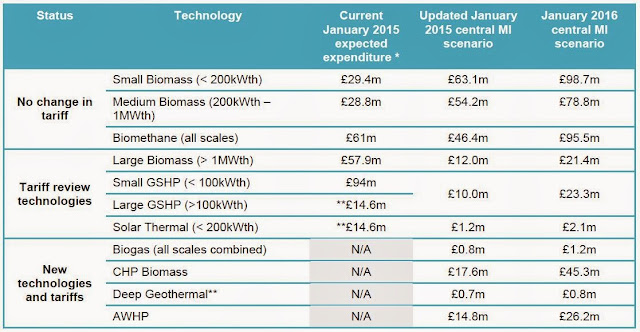
To my eyes the overall renewable heat situation looks extremely healthy at the moment, particularly if you are in the biomass sector.  However, it is also clear that biomass is dominating the commercial RHI.  Consequently DECC will introduce changes to the budgetary process to increase the degression trigger sensitivity for sub-1MW biomass.


We have read the latest update on the commercial RHI and have picked out the main points from the executive summary.  We would urge interested readers to look at the entire document in case we have missed anything.


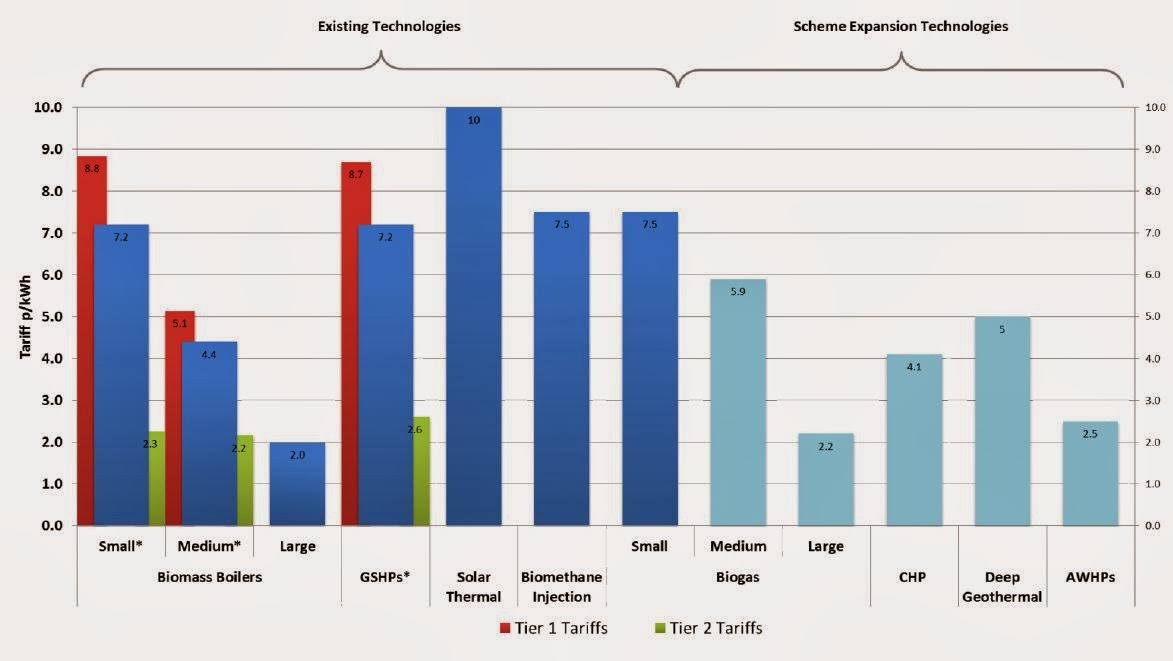
A key change is the capping of all tariffs at 10p/kWh.  This means that the RPI inflation of tariffs will stop at 10p/kWh.  For biomass it is the tier 1 small biomass tariff that is closest to this limit (n.b. the solar thermal tariff will be increased to 10p/kWh).

It is true that some renewable heat technologies are underperforming in the RHI, such as heat pumps and solar thermal.  However, DECC has recognised this and will beef up support - via increased tariffs and budgets - as well altering some requirements (such as energy efficiency).  The large biomass tariff, for example, will increase to 2.0p/kWh from 1.0p/kWh.


Eligibility

For new technologies and updated tariffs - 4 Dec 2013.  Any applications with a date of accreditation of 21 January 2013 or later will benefit from the tariff increases brought forward as a result of the Early Tariff Review consultation (this applies to ground source heat pumps (GSHP), solar thermal and biomass over 1MWth).


Energy Efficiency

DECC will not be introducing explicit energy efficiency criteria for non-domestic RHI applicants at this time. The mixed views from consultation respondents made it clear that more work needs to be done to establish a range of effective but not unduly burdensome energy efficiency measures that could be introduced into the scheme.


Biomass Sustainability Update

Based on feedback from stakeholders about industry readiness,  DECC  will postpone implementing mandatory compliance with GHG lifecycle emissions savings to Autumn 2014, so that industry and participants can monitor their processes in light of the sustainability criteria and build the audit trail necessary to demonstrate compliance.

DECC intend for the Biomass Suppliers List to be open for applications from suppliers of biomass in Spring 2014.

Subject to the availability of Parliamentary time,  DECC  intend to implement land-use sustainability criteria by 1 April 2015.


Biomass CHP

DECC will be introducing support for biomass CHP (4.1p/kWh), biogas >200kW (5.9 p/kWh and 2.2pkWh depending on size) and deep geothermal (5.0p/kWh). 

However, we do not intend to proceed at this time with support for heating only air-to-air heat pumps or biomass direct air as the consultation did not enable the development of appropriate deliverable policy.

Biogas combusion >200kWth

Subject to State Aid approval, tariffs will be set at 5.9p/kWh for installations with a thermal capacity of between 200 to 600kWth and 2.2p/kWh for those greater than 600kWth.

Deep geothermal

DECC will introduce a new tariff for deep geothermal heat at 5p/kWh. Deep geothermal heat will be defined as heat coming from a drilling depth of a minimum of 500m.

Heating only air-to-air heat pumps (AAHPs)

Although these technologies do produce renewable heat,  DECC  will not be introducing support for them at this time. This is primarily because of the risk of incentivising the installation of separate heating and cooling AAHPs in order to claim the RHI, rather than a reversible AAHP, which is likely to be more energy efficient.

Air to Water Heat Pumps and Energy from Waste

DECC will be introducing support set at 2.5p/kWh for AWHP (designed to achieve a minimum seasonal performance factor of at least 2.5) and 2.0p/kWh for the biogenic proportion of energy from waste (commercial and industrial).

Value for Money Cap and Tariff Rate of Return

From Spring 2014 tariffs across the RHI will be capped at 10.0p/kWh of renewable heat (and continue to be adjusted by RPI annually).

Biomass

To date deployment of large biomass has been below expectations and therefore  DECC  will go ahead with the proposed tariff increase to 2.0p/kWh.

Ground Source Heat Pump Tariffs

DECC will be replacing the current banded GSHP tariffs with a single tariff of 7.2p/kWh, which will be tiered.

The tier 1 tariff of 8.7p/kWh will be paid on the initial heat generated for an eligible purpose and the tier 2 tariff of 2.6p/kWh will be paid on the remaining eligible heat generated. This is equivalent to a tariff of 10.0p/kWh renewable heat assuming an SPF of 3.6.

Solar thermal

DECC will be raising the solar thermal tariff to 10.0p/kWh.

Budget management

Since implementation,  DECC  has made three quarterly degression assessments, one of which resulted in the medium biomass tariff being reduced by 5%. The outcome of the most recent assessment was published at the end of November.  DECC  will publish the fourth quarterly announcement by 1 March 2014.

In the May 2013 tariff review consultation we set out that the budget management policy would need to be developed in light of any tariff changes or scheme extensions and to reflect the outcome of the spending review for 2015/16, which has since confirmed an RHI budget in 2015/16 of up to £430m.


Having reviewed the budget management mechanism to ensure it remains fit for purpose,  DECC  will make some changes to the policy from Spring 2014 to:
  • base the deployment levels set out in the degression mechanism on refreshed market intelligence rather than the expectations that were modelled prior to the scheme’s introduction;
  • reduce the tolerance in the technology trigger for biomass under 1MWth and bio-methane injection by reducing the amount that these triggers are scaled above expected levels of deployment. They will change from being 150% of expected deployment to 120% of expected deployment. This will reduce the risk of unsustainable growth and dominance of the budget by a small number of technologies;
  • set the triggers for technologies  DECC  expects to deploy in relatively lower volumes (solar thermal, deep geothermal and all biogas) at 2.5% of the overall budget, rather than the current 5%.
Reducing uncertainty for projects with long-lead times

DECC intend to introduce a form of tariff guarantee for the largest installations (for example, those over 1MW), initially available for plant due to be commissioned by 31 March 2016. Subject to further policy development in 2014, State Aid and Parliamentary approval,  DECC  will aim for this measure to be in place from April 2015 to March 2016 and thereafter factored into the next spending review discussions on the RHI so that it can be available from Spring 2016 for plant due to commission by 31 March 2020.
Public Grants

After two years of the non-domestic RHI we think a more flexible approach to the interaction between public grants and the RHI could encourage more renewable heat installations to come forward. Pending further work alongside the 2014 review to look at the interaction between public grants and the non-domestic RHI,  DECC  intend to introduce some additional flexibility next year. We will take forward regulatory amendments to extend the eligibility window for repayment of grants and to allow some grant recipients who are unable to pay back their grants to access the RHI via reduced tariff payments.







Thursday, 8 August 2013

Domestic RHI - summary of scheme proposals

DECC has published its response to the consultation on the domestic version of the Renewable Heat Incentive (RHI).  The response includes a lot of detail on the types of technology that will be supported, their 'performance' and the type of properties and tenure that will be eligible.

To assist readers we have produced a summary of the proposals as they stand.  This can be found here.

The proposals for biomass heating are of particular interest to this blog.  The main points of interest include:


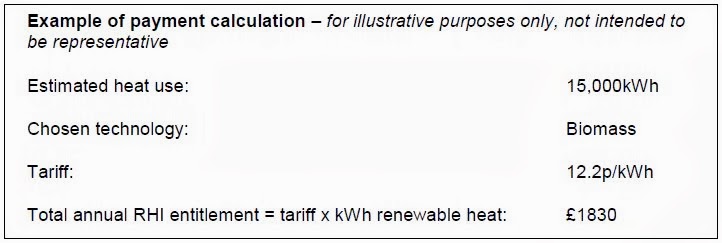
  • The tariff for biomass has increased from 8.7 p/kWh (initially proposed in 2012) to 12.2 p/kWh.  Whilst this is slightly below the 13-15 p/kWh we would have liked to see it is clearly an improvement.  The final tariff is yet to be announced but presumably it will be well before the proposed scheme opening date of April 1st 2014.

  • The tariff will be paid over seven years according to deemed heat.  This is the heat load as determined by the EPC that is created during a Green Deal assessment which is a mandatory requirement.

  • Legacy systems installed since 15th July 2009 will also be eligible providing they were installed by an MCS accredited company.  
  • Biomass equipment will need to meet meet air quality standards in relation to particulate matter (PM) and oxides of nitrogen (NOx). Legacy installations, installed between 15th July 2009 and the launch of the scheme, will not need to meet this requirement.
  • A new requirement around fuel sustainability will be introduced for  biomass installations.  To be eligible for and continue to receive RHI support for a biomass system, fuel needs to be sourced from a supplier registered on an approved supplier list. Such a list will be set up ahead of the launch of the scheme and will be the same one that is being established for the non-domestic RHI scheme.
The final point on sustainability is interesting and has important implications for wood fuel suppliers. To be included on the list, DECC intends that fuel suppliers will have to meet two criteria from April 2014:

  • Supply fuel which complies with the greenhouse gas (GHG) lifecycle emissions target of achieving 60% GHG savings against the EU fossil fuel heat average, assuming a boiler efficiency of 70%.
  • Report their performance against the relevant land criteria from the following list (although compliance with the criteria will not initially be required):

Evidence of legality and sustainability can come in two forms:

  • Category A evidence is independent certification of the timber/ timber products by any of the forest certification schemes that meet the policy requirements (such as FSC and PEFC).
  • Category B evidence is alternative documentary evidence that provides assurance that the source is legal and sustainable.
Category A evidence is the 'belt and braces' approach and undoubtedly involves the procurement of external expertise from Forest Stewardship Council and the accredited certification bodies are authorised to issue FSC certificates.

The alternative is Category B evidence and you will be glad to hear that this includes use of the Forestry Commission's Woodland Planning Grant (WPG) that falls under the English Woodland Grant Scheme (EWGS).  

However, the WPG Category B option is open to owners with less than 100 hectares of woodland, and more than 3 hectares, and whose woodlands are not certified.  As such it is envisaged that owners with more than 100 hectares will pursue the Category A, full certification option.

As ever we would recommend a good read of the full DECC document to make sure you pick up all of the salient points.


Monday, 8 July 2013

Latest results from Renewable Heat Incentive (RHI) show steady uptake

Ofgem's latest set of results for the Renewable Heat Incentive (RHI) paint a positive picture about the uptake of the World's first renewable heat incentive.  

Whilst the numbers overall are still small uptake accelerated during the first 15 months of the scheme and installed capacity approximately doubled every quarter.

At the end of March '13 there were 1,238 approved installations and a further 649 being processed.  Only eight applications had been rejected. Total installed capacity was 266 MW and these installations had generated 168 million kWhth.  Cumulative payments were £7.62m.


The technology split is still dominated by biomass (92%) with solar thermal and ground source heat pumps making up the majority of the remainder (3.9% and 3.4%, respectively).

The emergence of solar thermal as the second most installed technology under the RHI is interesting. It is not clear what the split is between stand-alone systems and those integrated with biomass systems. As Jamie Oliver would say biomass boilers and solar panels are "best friends" and the latter can make a useful contribution to the overall efficiency (and no doubt payback) of a biomass system.


The message overall, therefore, appears positive. We of course know that the RHI has already had to return some of its funds due to under-performance, but given the long lead-in time for biomass and its relative high capital cost it is perhaps not surprising that the situation is 'steady'.

In Kent installation activity for biomass boilers is again steady. Of the projects we know about around 2 MW of biomass heating capacity has come on-stream since December '12. These project at a range of scales but most are in the sub-200 kW range at the moment. Most are chip systems with local fuel supply.

RHI Developments

Whilst the policy overall is very much intact there have been one or two changes that are of interest:


  • Medium tariff (200-999 kW): This tariff was inflated on April 1st 2013 and then promptly deflated by 5% (which effectively brought the tariff back to its pre-April 1st level). This only has a minor impact on the attractiveness of the tariff which, in our opinion, remains very good.
  • Large tariff (1 MW+): This was doubled to 2.0p.
These tariff adjustments are fairly straightforward and only to represent some fine-tuning rather than a radical re-think or withdrawal of support.  The small tariff has remained unchanged to date.  The current tariff is shown below and can be found here

The Ofgem website indicates that the next tariff table will be published on September 15th. It is not known at this stage whether more changes are planned...we will keep an eye out.


Other developments include:

Degression

On 30 April 2013 the Renewable Heat Incentive Scheme (Amendment) Regulations 2013 came into effect. These regulations introduced:

  • A long term cost control mechanism, otherwise referred to as the degression mechanism.
  • removal of the provisions relating to the scheme suspension mechanism (Stand-by Budget Mechanism) introduced in the Renewable Heat Incentive Scheme (Amendment) Regulations 2012.
The degression mechanism enables reductions to be made to an individual tariff, or all tariffs, if certain requirements set out in the RHI (Amendment) Regulations are met. It aims to ensure that the non-domestic RHI does not exceed its fixed annual budgets by lowering tariffs to bring deployment down
in line with affordable levels.

Simplification of metering requirements

DECC is addressing issues raised by stakeholders about the complexity of metering requirements and the proportion of complex systems. DECC is addressing this by requiring that the installation only installs meters necessary for the RHI payment formula. This will allow heat loss from external
pipework to be disregarded in specific circumstances (ie if properly insulated). If it is either physically or financially problematic to install a heat meter, we will allow applicants to instead submit a heat loss calculation.

A number of industry associations are taking steps to develop RHI specific training and assessment programmes for those that wish to provide Independent Reports on Metering Arrangements (IRMA). In the interim the Building and Engineering Services Association has published a Guide to Good Practice for Heat Metering in the RHI.

Air quality (AQ) compliance

DECC is introducing requirements for all biomass burning installations to submit a valid certificate or an environmental permit with their application. This will need to show that the boiler complies with the required AQ limits. All applicants with biomass burning installations will now need to submit an RHI emission certificate or a valid environmental permit with their application. If an applicant is submitting an RHI emission certificate it will need to show that the boiler complies with the specified air quality limits.


Friday, 22 February 2013

Update on Renewable Heat Incentive (RHI) - Feb 2013

Here is our latest snapshot on the progress being made by the Renewable Heat Incentive.

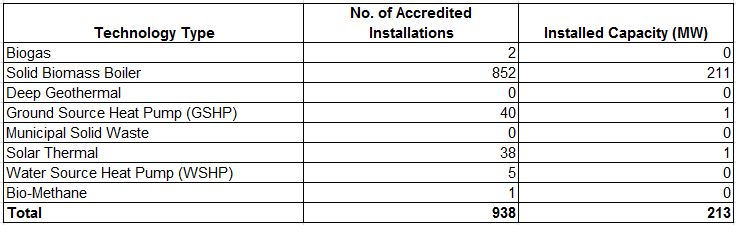
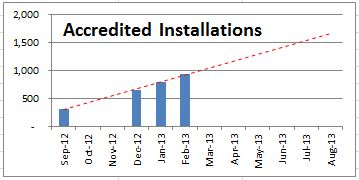
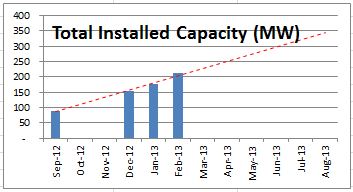
Total installations are now approaching 1,000.  The first bio-gas and bio-methane installations are now online, including the country's first RHI accredited bio-methane plant at Poundbury on the Duchy of Cornwall estate.  Installed capacity is now at 213 megawatts.


If we look at data from previous months we can see that the rate of uptake is steady and it has taken roughly five months for the number of accredited installations to double.  This rate of progress, whilst modest, is probably a good thing for the scheme overall as more rapid acceleration (or sudden step changes) could affect Ofgem's ability to manage the scheme.


The red dotted line in the figures above and below is a simple linear trend line.  At this stage the rate of progress remains steady and the scheme should reach 350 MW of installed capacity by August 2013.


The actual heat generation from the current installations is shown in the pie chart below.  Biomass still accounts for the vast majority of all output.  

Note that the single bio-methane installation (anaerobic digestion) is already the fifth largest heat generator - a hint at the enormous potential of this technology.  It will be interesting to see how many bio-methane and bio-gas installations can be supported by the RHI given the fixed annual budgets and cost control mechanisms that are in place.


A video of the J V Energen plant at Poundbury can be viewed below.  More information can be found here.


Tuesday, 11 December 2012

RHI update and summary of changes to RHI Register


This post provides an update on the RHI and summarises the recent changes made by Ofgem to some of the RHI application questions.

Progress update

Overall the number of biomass RHI applications has risen from 276 on September 25th to 585 on December 11th.  

Source: Ofgem public report - Dec 11, 2012
Source: Ofgem public report - Dec 11, 2012
This is a significant increase and indicates that the scheme is beginning to make progress.  

However, this scheme overall is still far behind the original forecasts and around £30-35m will be returned to the Treasury at the end of March.

Meanwhile, the consultation on the domestic version of the RHI closed on December 7th, the results from which  are due in March 2013.  More details, including the recent consultation addendum relating to a subsidy cap and its impact on heat pump tariffs, can be found here.

Application changes

With regards to the changes to the application questions Ofgem points out the following:
  • No extra information is necessary with the update to these questions.
  • The requirements are the same as before, questions have been reworded to improve the quality of RHI applications made, and ensure the application questions assist applicants understand what is required first time, both in terms of question responses and document uploads.
The following questions have been updated  - the changes are in brackets:
  • HD170, (Please select the type of premises in which heat from the installation (for which you are applying) is used. Please upload evidence of non-single domestic status at the document uploads at the end of the application (eg Non-Domestic (Business) Rates bill, multiple Council Tax bills or equivalent / similar evidence))
  • HG150, (Will the installation use any of the following fossil fuel-derived fuels: You can select more than one answer for this question)
  • HI150, (Please provide a meter reading for this meter. If this is not your first submission of this application then please do not change this meter reading unless agreed with Ofgem. This reading may need to be updated if, for example, you have made changes to metering requiring new readings, or your installation, heating system or application information has undergone significant amendments.)
  • HI151a-1/HI151B-2 etc, (Please provide the date on which this reading was taken (this should be no more than three days before the date on which the application is first submitted to Ofgem).
  • HK110, (Please enter the serial number of your installation. E.g. for boilers you will find this on the boiler name plate. Please upload a photo of your boiler name plate AND a copy of your invoice showing the date of purchase and model of your heat generating equipment (at the document uploads at the end of the application), OR a copy of your commissioning certificate showing model, capacity and commissioning date.)
  • HK120, (Please provide a comprehensive description of your installation, including the make & model of the main components. For further details of the information that should be included here, please refer to guidance and available applicant information.)
  • HL99, (Please confirm if you wish to Upload or Post the documents as supporting evidence? Please note that uploading documents is likely to mean the accreditation process is quicker.You must however always send bank and ID information under separate cover by post as instructed. Please do not change this setting to “post” if you have previously selected “upload”. Contact the enquiry line if you have any problems, and please see the IT system user guide for help on creating and uploading PDFs.)
  • HL170, (Please provide a comprehensive schematic or diagram of the heating system of which your installation forms part. This must include the following: 
    • All plants providing heat to the heating system, whether eligible or ineligible 
    • All uses supplied with heat from the heating system, both eligible and ineligible 
    • The pipework connections between all plants and heat uses, including clear indication of any pipework not located within a building 
    • The positions of relevant hot water and steam meters and their associated components.(e.g. both temperature sensors, flow meter and integrator). 
    • Please ensure that all of the items listed above are clearly labelled, that the schematic has a key, and that building boundaries are indicated.)

The application register can be found here and the application guidance here.

Friday, 21 September 2012

Domestic RHI proposals announced

In keeping with the cautious nature of UK energy policy-making DECC has launched three new RHI consultations - a domestic RHI, expansion of the non-domestic RHI and introduction of renewable heat tariffs for air-to-water and energy-from-waste.

Of these the long awaited domestic RHI is of considerable interest to the biomass heating sector. It provides some clarity on the final scheme that should emerge during summer 2013 and is essential reading for consumers and installers alike.

Proposed domestic RHI timeline
This article aims to highlight the main points of the domestic RHI proposals in relation to biomass heating technologies.  It also provides links the consultation documents and summaries from other commentators which may help to provide a more rounded picture.

Lets start with the DECC introduction which provides a succinct summary of the 116 page document:
The consultation on proposals for a domestic scheme sets out  proposals for longer term support to householders who install renewable heating kit such as biomass boilers, air (to water) and ground source heat pumps and solar thermal into homes.
The RHI for householders is aimed at any householder looking to replace their current heating with renewable heating kit or householders who have installed any such technology since 15 July 2009 (n.b. whether or not these installations will be eligible for  support will be decided decided upon as a result of this consultation).
The more detailed introduction to the consultation goes a bit further:
  • The scheme is aimed at helping households replace their existing fossil fuel-based heating systems with renewable-based ones (<45 kWh/thermal).
  • Support is proposed for the installation of Microgeneration Certification Scheme (or equivalent) certified ground and air source heat pumps, biomass boilers and solar thermal panels.
  • The subsidy would be provided through tariff based payments over a seven year period.
  • Payments would be made on the basis of deemed amount of renewable heat generated with the rate paid varying according to the type of renewable technology installed.
  • The tariffs take into account the additional costs of installation and running the renewable system and non-financial barriers (such as disruption in the home). They also build in compensation on the additional upfront installation costs of 7.5% to cover the cost of financing.
  • The scheme will be for individual domestic properties and is open to all.
  • Provided that properties meet certain energy efficiency criteria (meaning a key interaction with the Green Deal), owner-occupiers and private landlords would be eligible, together with householders who have installed renewable heating systems since 15 July 2009, including those who received the Renewable Heat Premium Payment (RHPP).
  • There is consideration of bespoke tariffs for the registered social landlord and new build sectors, recognising their potential contribution to the roll-out of renewable heat, but taking into account the possible lower installation-related and other costs they might benefit from.
The devil, as they say, is in the detail and a more thorough read through is required to reveal the finer points. The main items of interest, as far as we are concerned and again relating primarily to biomass, are below. Don't forget that these are only proposals at this stage and the final result will depend on the feedback to the consultation:

  • The basic idea behind for a domestic RHI is that it is a boiler replacement scheme: It is designed to encourage those who would be looking to change their current fossil fuel boiler due to age and/or loss of efficiency.
  • The tariff could be paid over a timescale shorter than 20 years (e.g. 7 years) to appeal to consumers who plan and budget in a shorter time frame.
  • Tariff levels are set to be more financially advantageous to those homes off the gas grid, although the scheme will be open to any home in the UK.  However, the policy could be restricted to just those off the gas grid or focused at particular geographic areas.
Proposed domestic RHI tariff
  • Second homes are excluded from the scheme.
  • It is proposed that installations in rented properties be eligible for the RHI with the landlord as the recipient (providing the landlord is the owner of the heating system).
  • Consumers who installed renewable heat installations since 15 July 2009 will be eligible to apply for the domestic RHI provided they:
  • Have installed an eligible technology.
  • Meet the eligibility criteria on energy efficiency.
  • Declare any government funding or support already received for the installation of renewable heat.
  • Do not have a back up fossil fuel heating system, or if they do, are prepared or have installed a heat usage meter on which the RHI payments can be based.
  • Meet all current MCS standards.
  • Where these legacy applicants meet the eligibility criteria, any government funding already received will be subtracted from the amount of RHI payable to the householder and will be reflected in the payments received. A phased application process for legacy installations may be used to help manage applications.
  • Biomass-only boilers and biomass pellet stoves with back boilers will be eligible for the RHI provided they meet 99% of the peak space heating load of the property using the calculation methodologies in MCS.
  • Fuel sustainability criteria used for the non-domestic RHI will also apply to the domestic scheme.  This would entail consumers purchasing fuel from an approved supplier list.
  • As with biomass sustainability, the domestic RHI scheme takes the same approach regarding emissions limits and the tests to assess compliance as that set out in the recent consultation on the non-domestic scheme.
  • It is proposed that only biomass appliances that are on the HETAS approved list will be eligible for the RHI.
  • Stoves with back boilers (log or chip), room heater stoves and condensing biomass boilers and stoves are excluded from the scheme.
  • Individual homes would be eligible to apply only once during the lifetime of the scheme. In line with this, domestic RHI payments would be calculated on the assumption of one eligible technology meeting the deemed total space heating (not hot water) demand of the property.
  • The installation of multiple eligible renewable technologies under the domestic RHI be restricted to solar thermal in combination only (e.g. solar thermal and biomass).
  • In order to receive the domestic RHI, consumers would be required to have completed all 'green ticks' on their Green Deal assessment that relate to the thermal efficiency of the house.
Example of Green Deal 'green ticks'
  • The domestic RHI will be paid on the basis of ‘deemed’ heat with metering being only required for certain situations.  Deemed heat is the estimated annual heat load which would be obtained via an existing accepted measurement process (most likely SAP).
  • In the majority of cases consumers would be required to remove their existing fossil fuel heating systems in order to be eligible for the RHI.
  • For biomass boilers bivalent systems (i.e. biomass plus fossil fuel system) would not be allowed, except for electric immersion heaters for hot water and solar thermal, due to the risks involved around the consumer switching back after 7 years.
  • For legacy applicants we are proposing to allow bivalent systems if they have been installed and the heat load will be calculated based on metered readings.
  • Where pre-existing fossil fuel Rayburn range cookers are in place, we propose that these need not be removed but that the range cooker should be disconnected from the heating pipes and boiler, allowing the householder to continue to use the cooking facilities. These systems would not be taken into account in ensuring that the renewable system covers 100% of the heat load.
  • Where pre-existing Aga range cookers are in place, for safety reasons we propose that these could remain connected to the boiler but they should be disconnected from the radiators.
The consultation document can be found on the DECC website.  The deadline for responses is December 12th.

Links

Here is a selection of early commentary on the consultation that may be of use in forming an overall opinion of what is being proposed:

Business Green
Greenwise Business
Guardian