Showing posts with label heat pump. Show all posts

Monday, 11 August 2014

Renewable Heat Incentive - latest uptake figures from DECC

The latest RHI figures continue to demonstrate how successful the scheme has been at increasing the rate of renewable heat generation in Great Britain.

Biomass heating remains the clear 'winner' of the RHI and account for 94% of all installations, 99% of the installed capacity and 85% of the payments made under the scheme.  

Whilst the number of biomethane installations is small (just 3) they are starting to account for around 5.6% of the total payments made (which is great than the 'large biomass' category).  As I stated before this seems to demonstrate the enormous potential of biomethane production from anaerobic digestion.


Of note, particularly to those considering installing a biomass system, is the recent acceleration in applications seen in June.
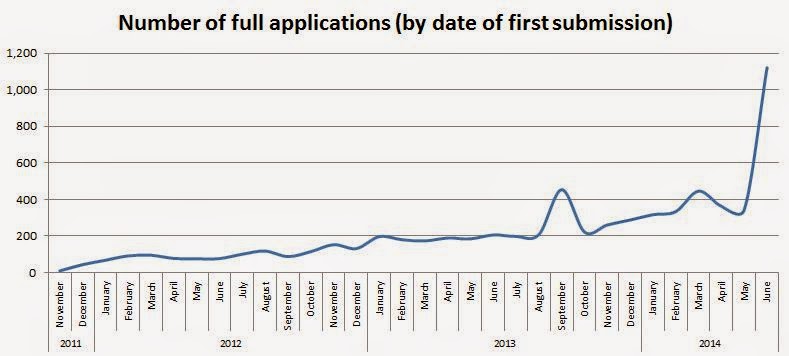


Whilst the precise reasons for this dramatic increase are not clear (backlog?) it is possible that it might lead to additional tariff adjustments later in the year (on top of the 5% reduction for small biomass implemented on July 1st).

In terms of geography the South West region continues to lead the way with 19% of all installations. 


In the South East, where this blog lives, Kent has the most accredited installations.


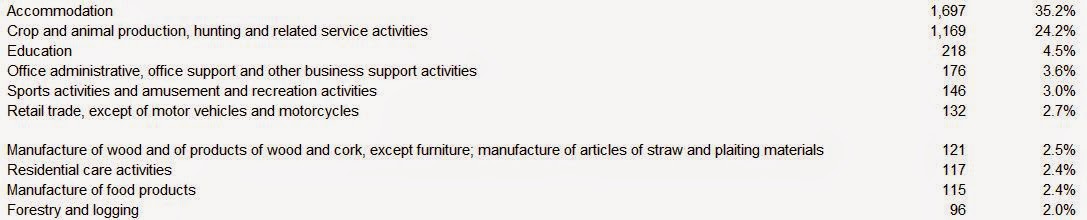
The top 10 business types benefiting from the RHI are shown in the table.


Will there be more tariff adjustments in 2014?

In simple terms - yes, quite likely.

The results of the next tariff review will be  the announcement on 31 August 2014 (with any changes commencing on 1 October 2014).

The data suggests the expenditure thresholds for the overall RHI budget are starting to be exceeded.  The cause of this is 'small biomass' tariff which is now well over its  expenditure threshold. 

This situation has been tolerated for a while because uptake of the non-biomass tariffs was, and still is, well below forecast and the overall budget was within its limits.  The difference now is that uptake of the 'small biomass' tariff has accelerated so fast that it has now impacted the finances of the overall scheme.

Given the scale of the current overspend it is possible that a 10% reduction in the 'small biomass' tariff might take place on October 1st.  This would reduce the tariff from 8.4 p/kWh (tier 1) and 2.2 p/kWh (tier 2) to 7.6 pence and 2.0 pence, respectively.

The impact of this reduction for a 199 kW biomass boiler is around £2,000 a year (although this depends heavily on the heat load and of course the actual meter readings).

Summary

There has been a large 'spike' in applications in June - whether this develops into a 'trend' is yet to be seen.  Regardless of this the scheme overall is starting to overspend and as such the rules for degression are clear.

Any decision to reduce tariffs (in October) will most likely affect the 'small biomass' tariff.

Any sub-200 kW installations that are currently in progress now have a clear signal to complete as soon as possible.  New projects, with an expected commissioning date post-October 1st, should probably factor-in a lower tariff for feasibility and business planning purposes.


Monday, 2 June 2014

Green heat technologies more affordable with RHI upgrade

The Department for Energy and Climate Change (DECC) has announced changes to the non-domestic (commercial) Renewable Heat Incentive (RHI).

The main changes are as follows:
  • Increased financial support for:
    • renewable CHP
    • large biomass boilers (over 1MW)
    • deep geothermal
    • ground source heat pumps
    • solar-thermal
    • biogas combustion
  • New technologies added:
    • air-water heat pumps
    • commercial and industrial energy from waste

  • An evolved approach to budget management:
    • Improved market intelligence has been used to inform growth rates across the range of renewable heating technologies supported
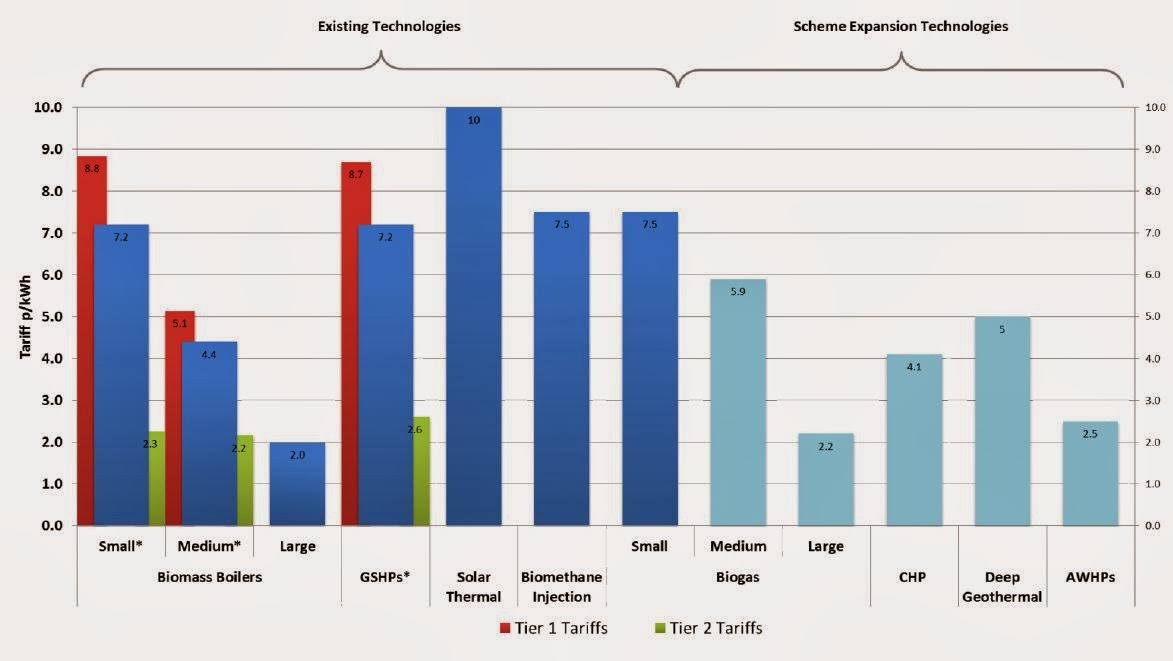
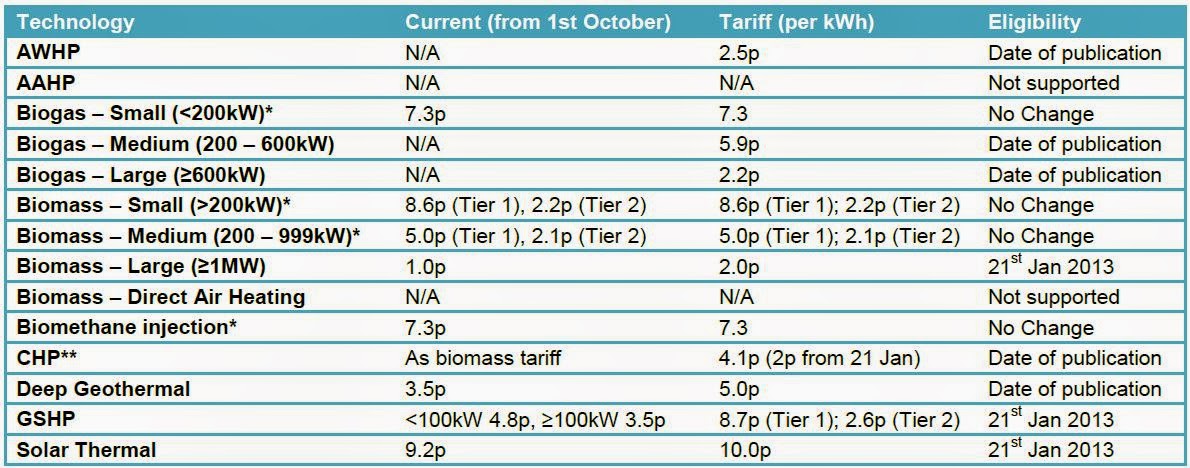
The updated tariff table is shown below.


These changes are the result of co-operation between industry and Government, and have been welcomed by the Renewable Energy Association (REA) and affiliated trade bodies.

"The RHI is now a truly world-leading renewable energy policy," said the REA's chief executive Dr Nina Skorupska. "Almost all renewable heat applications are now supported under the scheme, offering businesses greater choice than ever before on how to sustainably meet their heating needs.”

The Solar Trades Association provided evidence to Government in support of increasing the 'value for money cap' for renewable energy support programmes, which has enabled support for solar water heating to increase to 10p/kWh (from 9.2 pence/kWh).

Stuart Elmes, chair of the STA Solar Thermal Working Group, said: 

"The extra support for solar heating means that the economics will now stack up for more projects. More swimming pools, sports centres, food factories and hospitals will now be able to afford year-round heating from the sun."

We have also proposed that future improvements should include front-loading RHI payments for solar into the first seven years, as with the domestic scheme, to help businesses get over payback hurdles."

Support for large biomass heat has doubled (to 2p/kWh), but this technology sub-sector still draws the lowest fixed level of subsidy of any low carbon technology.

The newly formed Wood Heat Association (WHA) announced its affiliation to the REA last week. Speaking of these changes to the RHI, the WHA's interim chairman Julian Morgan-Jones said: 

"Under the previous cost-control mechanisms, wood heat was being unnecessarily constrained in order to preserve head room in the budget for heat pumps that was clearly not going to be used. The revised cost control mechanisms more closely match real world deployment and will ensure that wood heat can maximise its contribution to cost-effective emissions savings and renewable energy targets."

The RHI counts towards the UK's 2020 renewable energy target and helps reduce the UK's dependence on polluting fossil fuels. The above changes came into effect on May 28th 2014.

Full details can be found here.

Tuesday, 21 January 2014

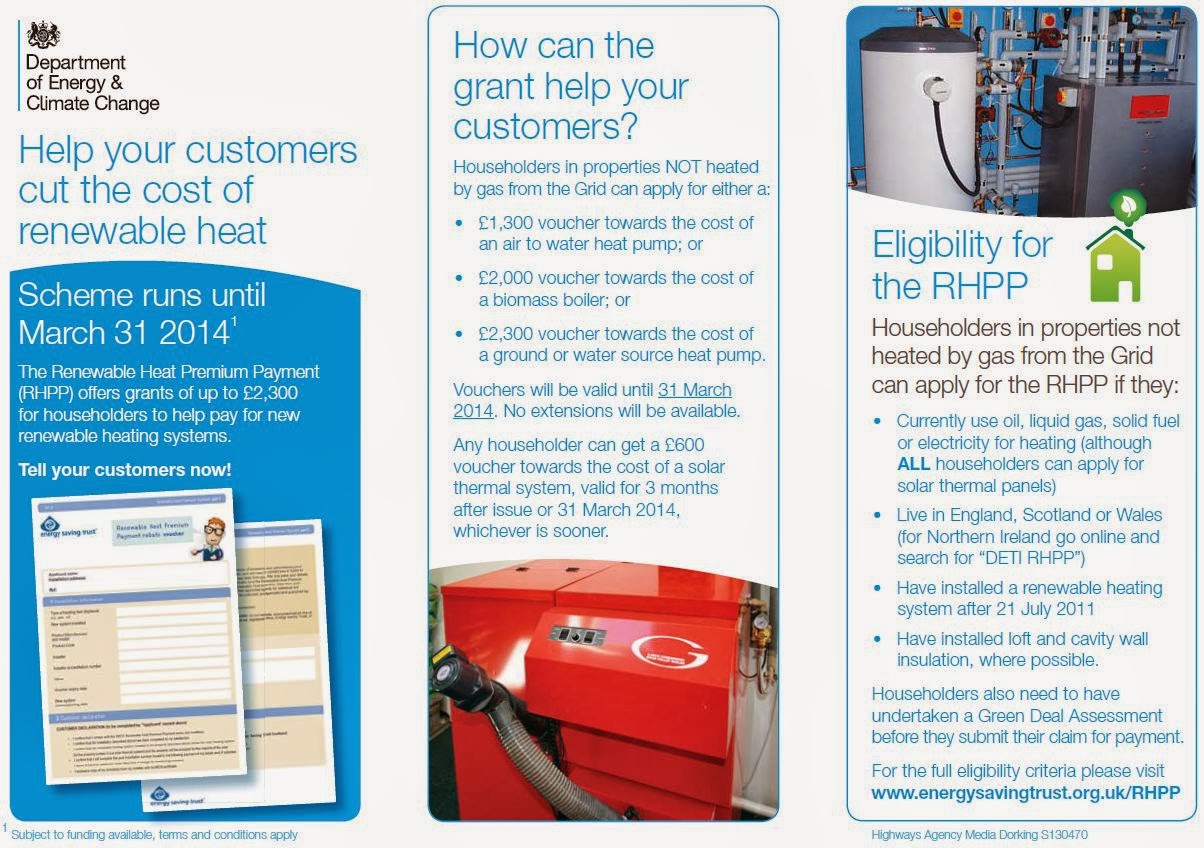
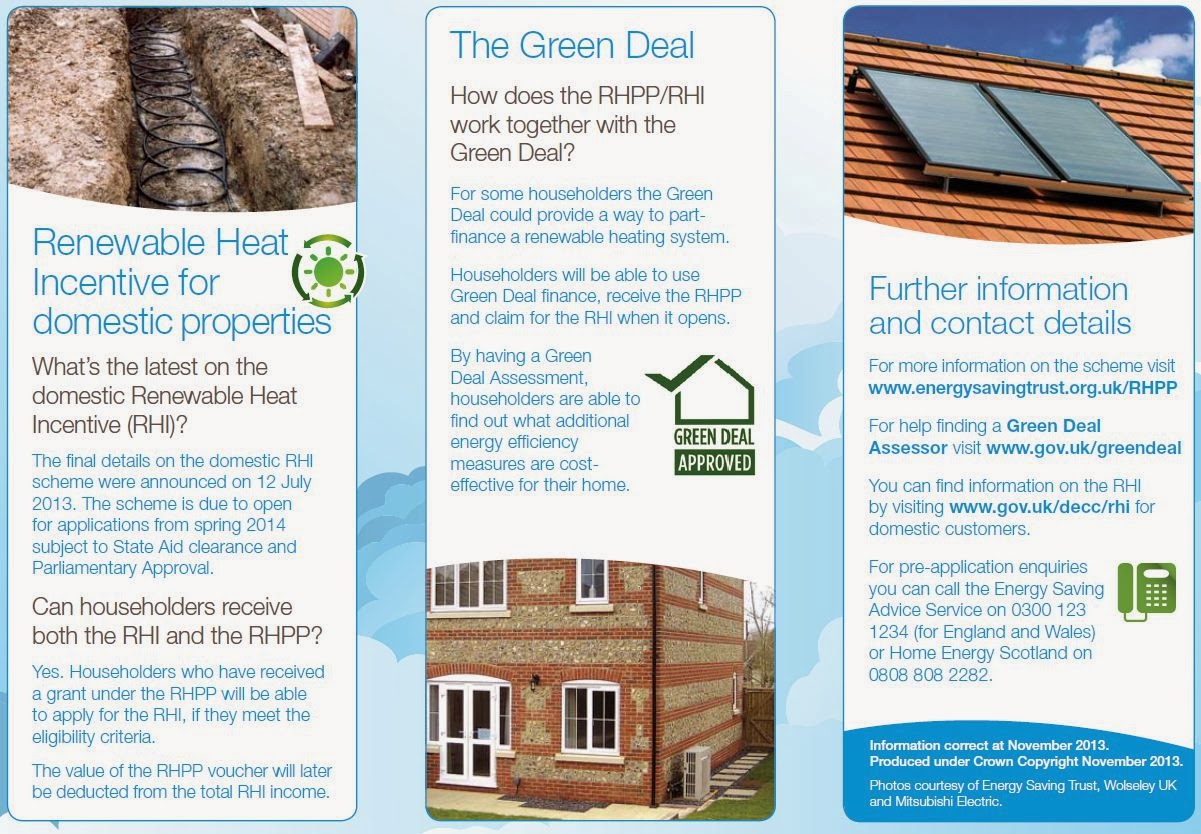
RHPP due to end soon - £2,000 grant towards the cost of a biomass boiler


Last chance for off-the-gas-grid households who want to make the most of the Government’s one-off grant designed to help meet the costs of installing renewable technologies in homes across the country.

The Renewable Heat Premium Payment Scheme will close on March 31st 2014 and householders are encouraged to apply now before it’s too late. 

Grants of up to £2,300 are available for households to help pay for new renewable heating systems including biomass boilers and ground, water source or air-to-water heat pumps.

The cut-in date for this scheme is 21st July 2011 and participating households must have undertaken a Green Deal assessment.

Vouchers will be valid until 31 March 2014  when all required paperwork will need to be submitted for payment  to the Energy Saving Trust. No extensions will be available to this deadline.

The following leaflet has now been developed to explain the benefit of applying in customer friendly language and where to go for more information.


Wednesday, 11 December 2013

Commercial RHI - summary of changes to tariffs and technologies


Are you sitting comfortably?

DECC has been busy releasing new and updated information about both the commercial and domestic RHI and renewable heat in general.

To my eyes the overall renewable heat situation looks extremely healthy at the moment, particularly if you are in the biomass sector.  However, it is also clear that biomass is dominating the commercial RHI.  Consequently DECC will introduce changes to the budgetary process to increase the degression trigger sensitivity for sub-1MW biomass.


We have read the latest update on the commercial RHI and have picked out the main points from the executive summary.  We would urge interested readers to look at the entire document in case we have missed anything.


A key change is the capping of all tariffs at 10p/kWh.  This means that the RPI inflation of tariffs will stop at 10p/kWh.  For biomass it is the tier 1 small biomass tariff that is closest to this limit (n.b. the solar thermal tariff will be increased to 10p/kWh).

It is true that some renewable heat technologies are underperforming in the RHI, such as heat pumps and solar thermal.  However, DECC has recognised this and will beef up support - via increased tariffs and budgets - as well altering some requirements (such as energy efficiency).  The large biomass tariff, for example, will increase to 2.0p/kWh from 1.0p/kWh.


Eligibility

For new technologies and updated tariffs - 4 Dec 2013.  Any applications with a date of accreditation of 21 January 2013 or later will benefit from the tariff increases brought forward as a result of the Early Tariff Review consultation (this applies to ground source heat pumps (GSHP), solar thermal and biomass over 1MWth).


Energy Efficiency

DECC will not be introducing explicit energy efficiency criteria for non-domestic RHI applicants at this time. The mixed views from consultation respondents made it clear that more work needs to be done to establish a range of effective but not unduly burdensome energy efficiency measures that could be introduced into the scheme.


Biomass Sustainability Update

Based on feedback from stakeholders about industry readiness,  DECC  will postpone implementing mandatory compliance with GHG lifecycle emissions savings to Autumn 2014, so that industry and participants can monitor their processes in light of the sustainability criteria and build the audit trail necessary to demonstrate compliance.

DECC intend for the Biomass Suppliers List to be open for applications from suppliers of biomass in Spring 2014.

Subject to the availability of Parliamentary time,  DECC  intend to implement land-use sustainability criteria by 1 April 2015.


Biomass CHP

DECC will be introducing support for biomass CHP (4.1p/kWh), biogas >200kW (5.9 p/kWh and 2.2pkWh depending on size) and deep geothermal (5.0p/kWh). 

However, we do not intend to proceed at this time with support for heating only air-to-air heat pumps or biomass direct air as the consultation did not enable the development of appropriate deliverable policy.

Biogas combusion >200kWth

Subject to State Aid approval, tariffs will be set at 5.9p/kWh for installations with a thermal capacity of between 200 to 600kWth and 2.2p/kWh for those greater than 600kWth.

Deep geothermal

DECC will introduce a new tariff for deep geothermal heat at 5p/kWh. Deep geothermal heat will be defined as heat coming from a drilling depth of a minimum of 500m.

Heating only air-to-air heat pumps (AAHPs)

Although these technologies do produce renewable heat,  DECC  will not be introducing support for them at this time. This is primarily because of the risk of incentivising the installation of separate heating and cooling AAHPs in order to claim the RHI, rather than a reversible AAHP, which is likely to be more energy efficient.

Air to Water Heat Pumps and Energy from Waste

DECC will be introducing support set at 2.5p/kWh for AWHP (designed to achieve a minimum seasonal performance factor of at least 2.5) and 2.0p/kWh for the biogenic proportion of energy from waste (commercial and industrial).

Value for Money Cap and Tariff Rate of Return

From Spring 2014 tariffs across the RHI will be capped at 10.0p/kWh of renewable heat (and continue to be adjusted by RPI annually).

Biomass

To date deployment of large biomass has been below expectations and therefore  DECC  will go ahead with the proposed tariff increase to 2.0p/kWh.

Ground Source Heat Pump Tariffs

DECC will be replacing the current banded GSHP tariffs with a single tariff of 7.2p/kWh, which will be tiered.

The tier 1 tariff of 8.7p/kWh will be paid on the initial heat generated for an eligible purpose and the tier 2 tariff of 2.6p/kWh will be paid on the remaining eligible heat generated. This is equivalent to a tariff of 10.0p/kWh renewable heat assuming an SPF of 3.6.

Solar thermal

DECC will be raising the solar thermal tariff to 10.0p/kWh.

Budget management

Since implementation,  DECC  has made three quarterly degression assessments, one of which resulted in the medium biomass tariff being reduced by 5%. The outcome of the most recent assessment was published at the end of November.  DECC  will publish the fourth quarterly announcement by 1 March 2014.

In the May 2013 tariff review consultation we set out that the budget management policy would need to be developed in light of any tariff changes or scheme extensions and to reflect the outcome of the spending review for 2015/16, which has since confirmed an RHI budget in 2015/16 of up to £430m.


Having reviewed the budget management mechanism to ensure it remains fit for purpose,  DECC  will make some changes to the policy from Spring 2014 to:
  • base the deployment levels set out in the degression mechanism on refreshed market intelligence rather than the expectations that were modelled prior to the scheme’s introduction;
  • reduce the tolerance in the technology trigger for biomass under 1MWth and bio-methane injection by reducing the amount that these triggers are scaled above expected levels of deployment. They will change from being 150% of expected deployment to 120% of expected deployment. This will reduce the risk of unsustainable growth and dominance of the budget by a small number of technologies;
  • set the triggers for technologies  DECC  expects to deploy in relatively lower volumes (solar thermal, deep geothermal and all biogas) at 2.5% of the overall budget, rather than the current 5%.
Reducing uncertainty for projects with long-lead times

DECC intend to introduce a form of tariff guarantee for the largest installations (for example, those over 1MW), initially available for plant due to be commissioned by 31 March 2016. Subject to further policy development in 2014, State Aid and Parliamentary approval,  DECC  will aim for this measure to be in place from April 2015 to March 2016 and thereafter factored into the next spending review discussions on the RHI so that it can be available from Spring 2016 for plant due to commission by 31 March 2020.

Public Grants

After two years of the non-domestic RHI we think a more flexible approach to the interaction between public grants and the RHI could encourage more renewable heat installations to come forward. Pending further work alongside the 2014 review to look at the interaction between public grants and the non-domestic RHI,  DECC  intend to introduce some additional flexibility next year. We will take forward regulatory amendments to extend the eligibility window for repayment of grants and to allow some grant recipients who are unable to pay back their grants to access the RHI via reduced tariff payments.


Tuesday, 11 December 2012

RHI update and summary of changes to RHI Register


This post provides an update on the RHI and summarises the recent changes made by Ofgem to some of the RHI application questions.

Progress update

Overall the number of biomass RHI applications has risen from 276 on September 25th to 585 on December 11th.  

Source: Ofgem public report - Dec 11, 2012
Source: Ofgem public report - Dec 11, 2012
This is a significant increase and indicates that the scheme is beginning to make progress.  

However, this scheme overall is still far behind the original forecasts and around £30-35m will be returned to the Treasury at the end of March.

Meanwhile, the consultation on the domestic version of the RHI closed on December 7th, the results from which  are due in March 2013.  More details, including the recent consultation addendum relating to a subsidy cap and its impact on heat pump tariffs, can be found here.

Application changes

With regards to the changes to the application questions Ofgem points out the following:
  • No extra information is necessary with the update to these questions.
  • The requirements are the same as before, questions have been reworded to improve the quality of RHI applications made, and ensure the application questions assist applicants understand what is required first time, both in terms of question responses and document uploads.
The following questions have been updated  - the changes are in brackets:
  • HD170, (Please select the type of premises in which heat from the installation (for which you are applying) is used. Please upload evidence of non-single domestic status at the document uploads at the end of the application (eg Non-Domestic (Business) Rates bill, multiple Council Tax bills or equivalent / similar evidence))
  • HG150, (Will the installation use any of the following fossil fuel-derived fuels: You can select more than one answer for this question)
  • HI150, (Please provide a meter reading for this meter. If this is not your first submission of this application then please do not change this meter reading unless agreed with Ofgem. This reading may need to be updated if, for example, you have made changes to metering requiring new readings, or your installation, heating system or application information has undergone significant amendments.)
  • HI151a-1/HI151B-2 etc, (Please provide the date on which this reading was taken (this should be no more than three days before the date on which the application is first submitted to Ofgem).
  • HK110, (Please enter the serial number of your installation. E.g. for boilers you will find this on the boiler name plate. Please upload a photo of your boiler name plate AND a copy of your invoice showing the date of purchase and model of your heat generating equipment (at the document uploads at the end of the application), OR a copy of your commissioning certificate showing model, capacity and commissioning date.)
  • HK120, (Please provide a comprehensive description of your installation, including the make & model of the main components. For further details of the information that should be included here, please refer to guidance and available applicant information.)
  • HL99, (Please confirm if you wish to Upload or Post the documents as supporting evidence? Please note that uploading documents is likely to mean the accreditation process is quicker.You must however always send bank and ID information under separate cover by post as instructed. Please do not change this setting to “post” if you have previously selected “upload”. Contact the enquiry line if you have any problems, and please see the IT system user guide for help on creating and uploading PDFs.)
  • HL170, (Please provide a comprehensive schematic or diagram of the heating system of which your installation forms part. This must include the following: 
    • All plants providing heat to the heating system, whether eligible or ineligible 
    • All uses supplied with heat from the heating system, both eligible and ineligible 
    • The pipework connections between all plants and heat uses, including clear indication of any pipework not located within a building 
    • The positions of relevant hot water and steam meters and their associated components.(e.g. both temperature sensors, flow meter and integrator). 
    • Please ensure that all of the items listed above are clearly labelled, that the schematic has a key, and that building boundaries are indicated.)

The application register can be found here and the application guidance here.