Showing posts with label renewable energy subsidy. Show all posts

Wednesday, 3 June 2015

RHI - tariff changes for biomass boilers announced

The Department of Energy and Climate Change has announced changes to the RHI tariffs for biomass in both the domestic and non-domestic schemes.

Domestic RHI

DECC announced on 29 May 2015 that the degression ‘super trigger’ for domestic biomass had been passed. 

This means that the current biomass tariff of 8.93p per kilowatt hour will be reduced by 20% to 7.14p per kilowatt hour for all new applications made from 1 July 2015.  The new tariff table is shown below.

To calculate the impact of this change simply multiply the tariff by the kWh total for space heating and hot water on your EPC (e.g. 15,000 kWh x 0.0893 = £1,339 per year for seven years).
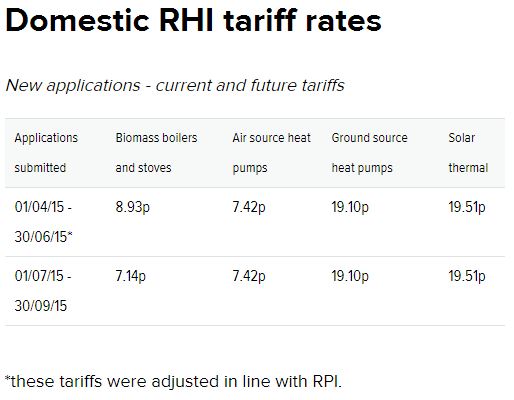


The tariffs for domestic air source heat pumps, ground source heat pumps and solar thermal are not affected by the 1 July 2015 degression.  Legacy applicants are not affected by degression.

Non-Domestic (Commercial) RHI

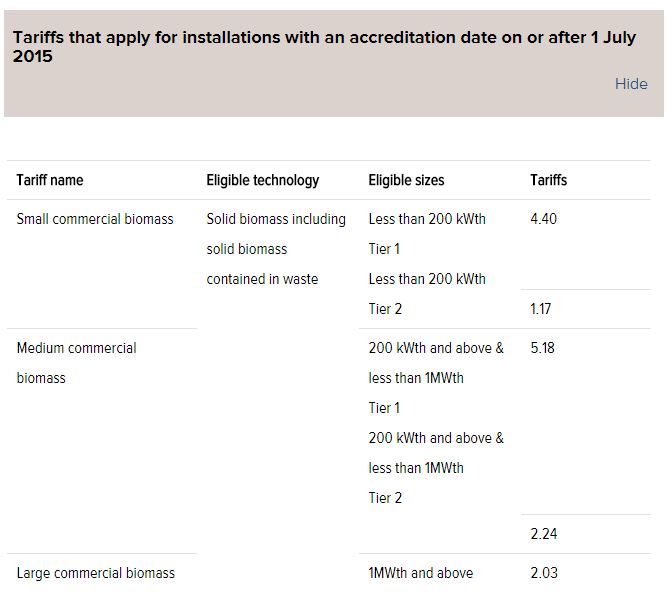
DECC has also announced a 25% reduction to the small commercial biomass tariff for the quarterly period starting on 1 July 2015.

This is a fairly significant reduction that will affect the economics of schemes up to 199 kW - particularly those involving wood pellets and the replacement (partial or full) of mains gas.

Nevertheless, a subsidy is still a subsidy and 4.4 p/kWh is still a positive contribution.

The risk with this degression is that larger boilers will be installed to gain the 'medium' tariff.  Whilst tempting this is likely to be a false economy as an over-sized boiler will be used less and is likely to have worse overall efficiency (it may well cost more as well).

Our advice would be to size correctly and be satisfied that a subsidy is still available.

If your sub-200 kW project is nearing completion then you have only a few weeks left to commission and apply in order to gain the current tariff (5.87 p/kWh).


More details can be found on the Ofgem website.

Monday, 11 August 2014

Renewable Heat Incentive - latest uptake figures from DECC

The latest RHI figures continue to demonstrate how successful the scheme has been at increasing the rate of renewable heat generation in Great Britain.

Biomass heating remains the clear 'winner' of the RHI and account for 94% of all installations, 99% of the installed capacity and 85% of the payments made under the scheme.  

Whilst the number of biomethane installations is small (just 3) they are starting to account for around 5.6% of the total payments made (which is great than the 'large biomass' category).  As I stated before this seems to demonstrate the enormous potential of biomethane production from anaerobic digestion.


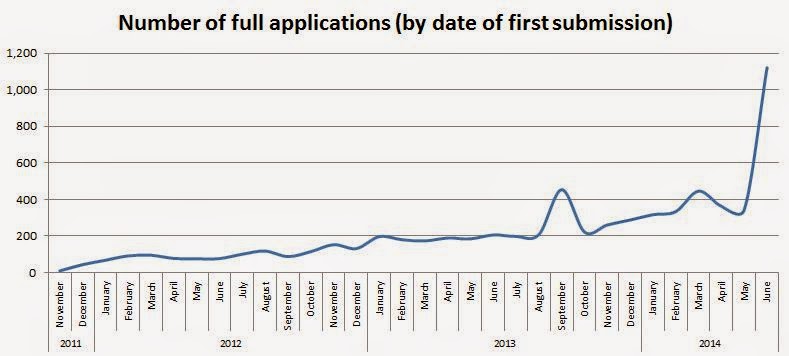
Of note, particularly to those considering installing a biomass system, is the recent acceleration in applications seen in June.


Whilst the precise reasons for this dramatic increase are not clear (backlog?) it is possible that it might lead to additional tariff adjustments later in the year (on top of the 5% reduction for small biomass implemented on July 1st).

In terms of geography the South West region continues to lead the way with 19% of all installations. 


In the South East, where this blog lives, Kent has the most accredited installations.


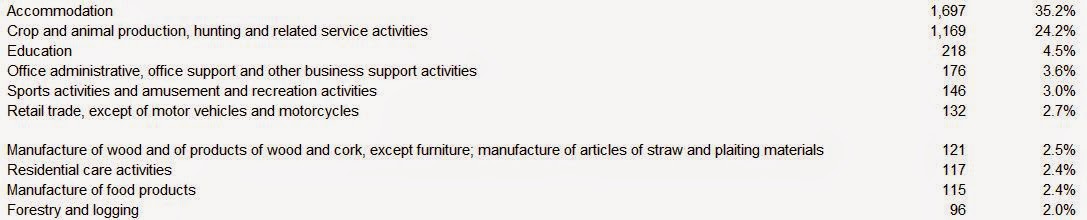
The top 10 business types benefiting from the RHI are shown in the table.


Will there be more tariff adjustments in 2014?

In simple terms - yes, quite likely.

The results of the next tariff review will be  the announcement on 31 August 2014 (with any changes commencing on 1 October 2014).

The data suggests the expenditure thresholds for the overall RHI budget are starting to be exceeded.  The cause of this is 'small biomass' tariff which is now well over its  expenditure threshold. 

This situation has been tolerated for a while because uptake of the non-biomass tariffs was, and still is, well below forecast and the overall budget was within its limits.  The difference now is that uptake of the 'small biomass' tariff has accelerated so fast that it has now impacted the finances of the overall scheme.

Given the scale of the current overspend it is possible that a 10% reduction in the 'small biomass' tariff might take place on October 1st.  This would reduce the tariff from 8.4 p/kWh (tier 1) and 2.2 p/kWh (tier 2) to 7.6 pence and 2.0 pence, respectively.

The impact of this reduction for a 199 kW biomass boiler is around £2,000 a year (although this depends heavily on the heat load and of course the actual meter readings).

Summary

There has been a large 'spike' in applications in June - whether this develops into a 'trend' is yet to be seen.  Regardless of this the scheme overall is starting to overspend and as such the rules for degression are clear.

Any decision to reduce tariffs (in October) will most likely affect the 'small biomass' tariff.

Any sub-200 kW installations that are currently in progress now have a clear signal to complete as soon as possible.  New projects, with an expected commissioning date post-October 1st, should probably factor-in a lower tariff for feasibility and business planning purposes.