Showing posts with label biomass heating. Show all posts

Monday, 9 February 2015

Kent Downs Woodfuel Pathfinder - FREE Conference

The Woodfuel Pathfinder has now been operating for almost four years and we are fast approaching the end of the current phase of the project.

The ADAFOR Interreg project, which has enabled the Pathfinder to operate for the last two years, comes to a close at the end of March 2015.

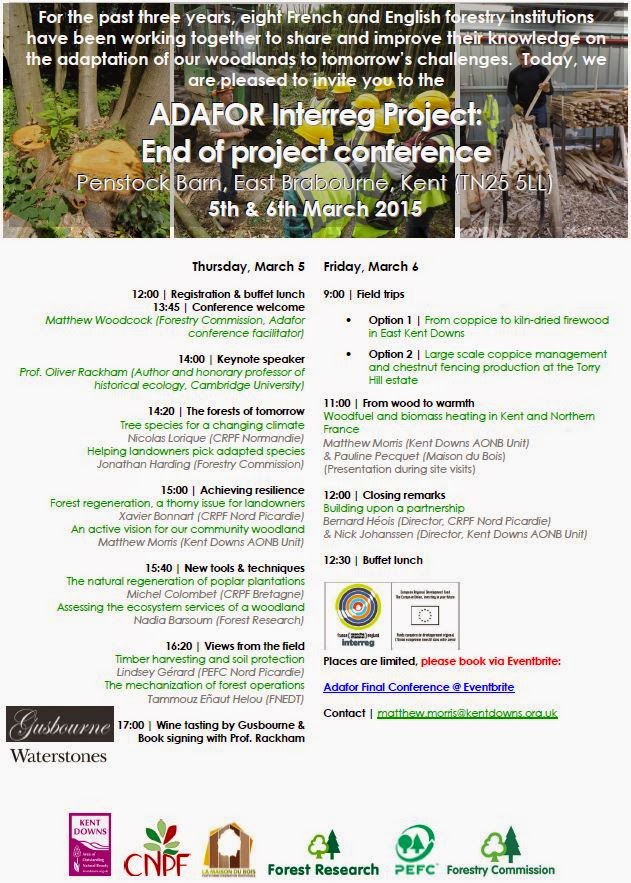
To mark the end of ADAFOR the project partners will hold a small, two-day conference on March 5th and 6th at East Brabourne.

We would like to extend an invitation to readers of this blog and their colleagues.  The conference is FREE to attend.

To book a place please go to our Eventbrite page.

Alternatively email us at matthew.morris@kentdowns.org.uk or call 01303 815 171.


Friday, 9 January 2015

Working with wood chip at Hever Castle - FREE CLA event

You may have heard a bit about Hever Castle's wood fuel and biomass heating project already.  

If you want to learn more then Douch Biomass and South East Wood Fuels will host a talk and site visit at Hever on March 24th.

Full details can be found on the CLA website.  Details can also be found below.


Thursday, 30 October 2014

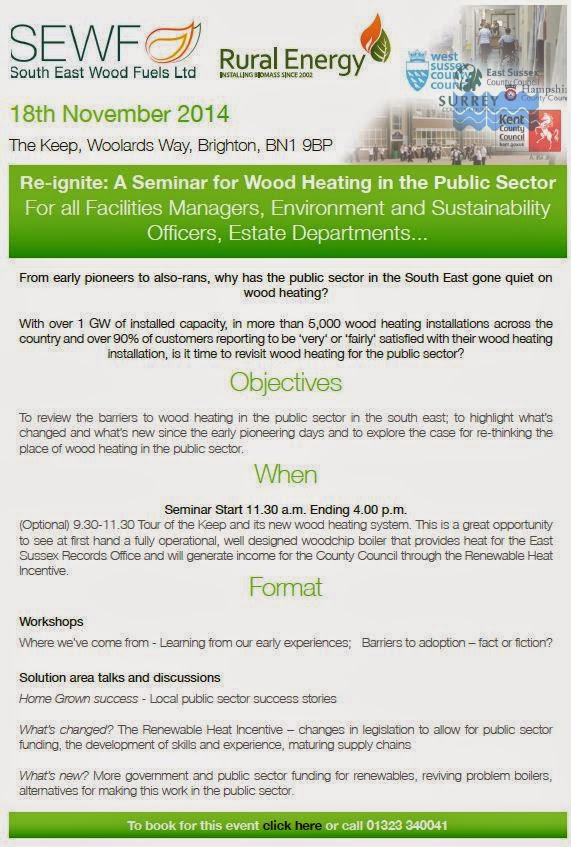
Re-ignite: A seminar for Wood Heating in the Public Sector

Installing biomass heating in public sector buildings can be very hard to achieve.  Barriers range from institutional inertia to a basic lack of understanding of alternatives to oil, gas or LPG systems.

To help unravel this complicated set of problems South East Wood Fuels, in partnership with Rural Energy, will deliver a one day seminar on November 18th at The Keep in Brighton.

Places can be booked via the South East Wood Fuels website or by telephone on 01323 340041.


Tuesday, 28 October 2014

National Woodfuel Conference 2014

The Pathfinder project recently attended the National Wood Fuel Conference which took place on October 17th at Denbies Wine Estate near Dorking in Surrey.

The event was very well attended and many of the most notable wood fuel, biomass and forestry companies were in attendance.  The event was expertly put together by Surrey Hills Enterprises (part of the Surrey Hills AONB).

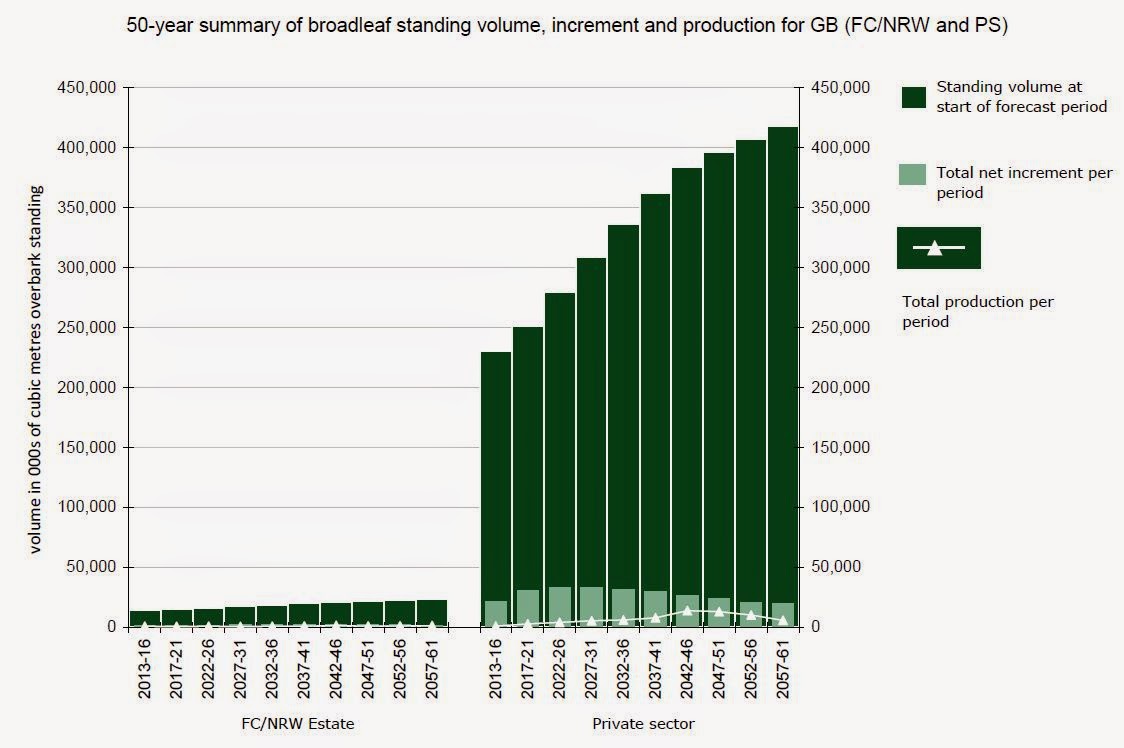
Highlights for us included a presentation by Ben Ditchburn from the Forestry Commission (see here) who provided strong evidence of the level of timber and biomass stocks in woodlands in the South East of England.  

Ben's presentation was widely appreciated, primarily because his data confirmed how timber extraction, even at enhanced levels, will sit comfortably alongside increasing stocks of timber and carbon in our forests.


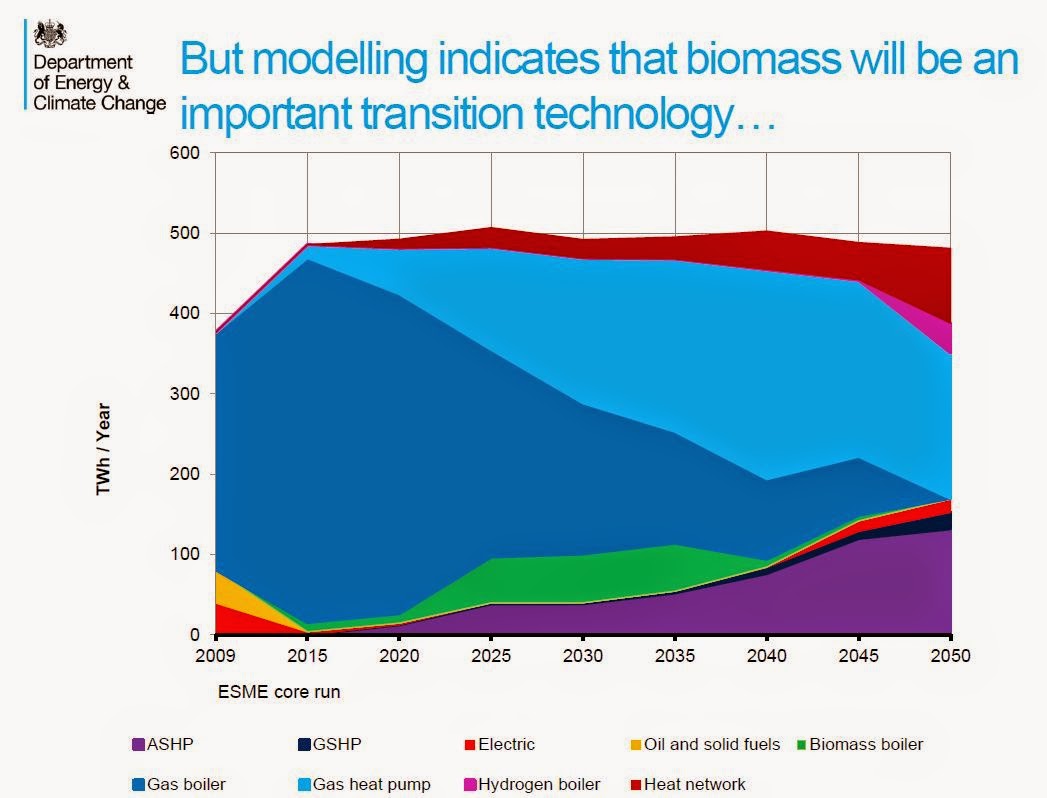
Guy Boulby from DECC, who's presentation covered the future of heating in the UK, discussed the likely role that biomass heating will play over the next 20 to 30 years.  Ben explained how biomass will act as an important transition technology until other technologies will start to play a bigger role.


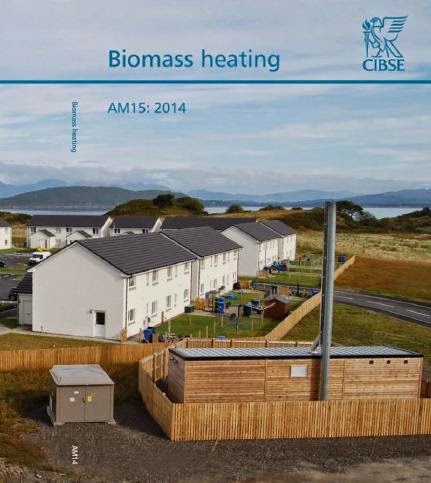
Of great interest was the launch of new biomass heating guidance from CIBSE by David Palmer and his colleagues.

The presentation provided a background to why the guidance was needed and how it has been developed.

The guidance, which can be downloaded free of charge from the CIBSE website, focuses on technical aspects and will be of most use to biomass heating installers, heating engineers and people and building services specialists.

All in all the National Wood Fuel Conference, now in its fourth year, provided an authoritative demonstration of wood fuel sustainability and how the biomass sector can help bring neglected woodlands back into positive management.

All of the presentations can be found here.

Monday, 11 August 2014

Renewable Heat Incentive - latest uptake figures from DECC

The latest RHI figures continue to demonstrate how successful the scheme has been at increasing the rate of renewable heat generation in Great Britain.

Biomass heating remains the clear 'winner' of the RHI and account for 94% of all installations, 99% of the installed capacity and 85% of the payments made under the scheme.  

Whilst the number of biomethane installations is small (just 3) they are starting to account for around 5.6% of the total payments made (which is great than the 'large biomass' category).  As I stated before this seems to demonstrate the enormous potential of biomethane production from anaerobic digestion.


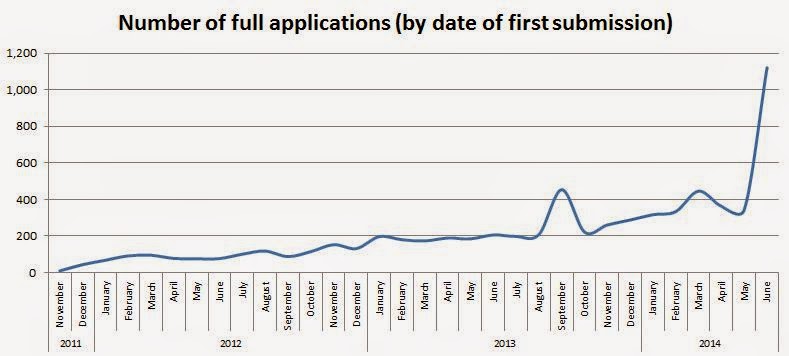
Of note, particularly to those considering installing a biomass system, is the recent acceleration in applications seen in June.


Whilst the precise reasons for this dramatic increase are not clear (backlog?) it is possible that it might lead to additional tariff adjustments later in the year (on top of the 5% reduction for small biomass implemented on July 1st).

In terms of geography the South West region continues to lead the way with 19% of all installations. 


In the South East, where this blog lives, Kent has the most accredited installations.


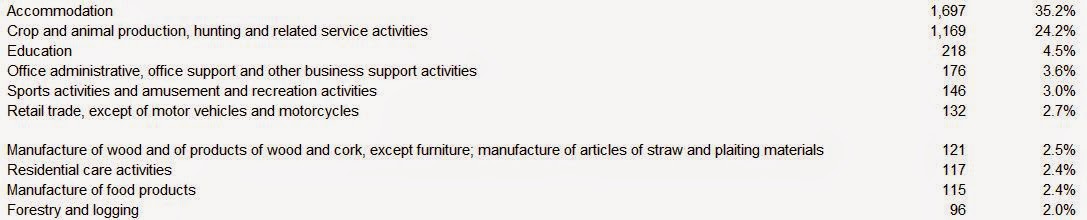
The top 10 business types benefiting from the RHI are shown in the table.


Will there be more tariff adjustments in 2014?

In simple terms - yes, quite likely.

The results of the next tariff review will be  the announcement on 31 August 2014 (with any changes commencing on 1 October 2014).

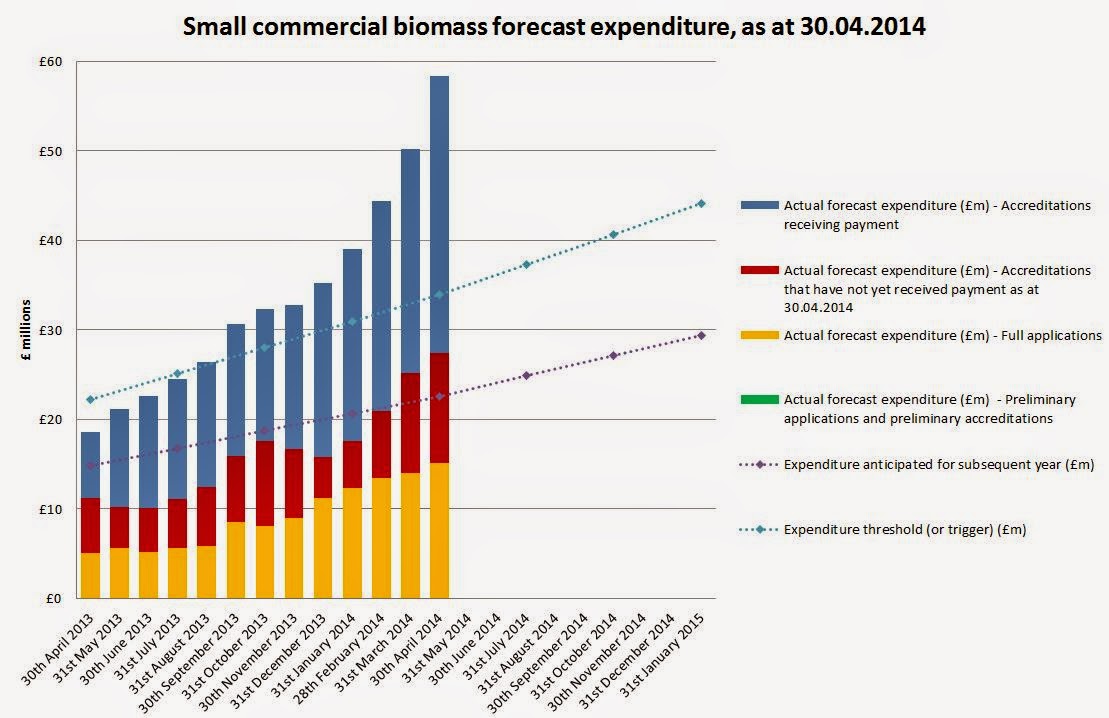
The data suggests the expenditure thresholds for the overall RHI budget are starting to be exceeded.  The cause of this is 'small biomass' tariff which is now well over its  expenditure threshold. 

This situation has been tolerated for a while because uptake of the non-biomass tariffs was, and still is, well below forecast and the overall budget was within its limits.  The difference now is that uptake of the 'small biomass' tariff has accelerated so fast that it has now impacted the finances of the overall scheme.

Given the scale of the current overspend it is possible that a 10% reduction in the 'small biomass' tariff might take place on October 1st.  This would reduce the tariff from 8.4 p/kWh (tier 1) and 2.2 p/kWh (tier 2) to 7.6 pence and 2.0 pence, respectively.

The impact of this reduction for a 199 kW biomass boiler is around £2,000 a year (although this depends heavily on the heat load and of course the actual meter readings).

Summary

There has been a large 'spike' in applications in June - whether this develops into a 'trend' is yet to be seen.  Regardless of this the scheme overall is starting to overspend and as such the rules for degression are clear.

Any decision to reduce tariffs (in October) will most likely affect the 'small biomass' tariff.

Any sub-200 kW installations that are currently in progress now have a clear signal to complete as soon as possible.  New projects, with an expected commissioning date post-October 1st, should probably factor-in a lower tariff for feasibility and business planning purposes.

Thursday, 26 June 2014

Non-domestic RHI - small biomass tariff reduced

Ofgem has announced that the small biomass tariff will be reduced by 5% from July 1st 2014.

This is in response to increasing uptake in the sub 200 kW category as well as higher than anticipated levels of eligible heat being submitted in meter readings.

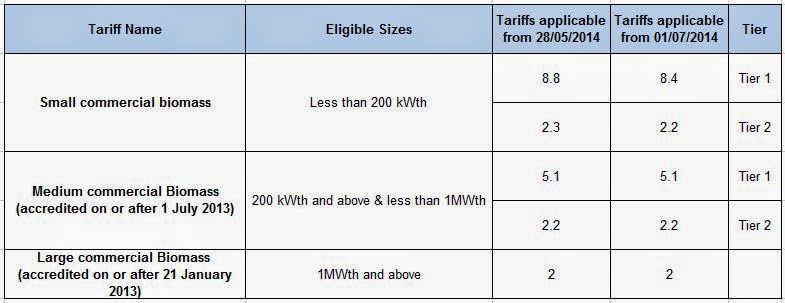
This degression of the small biomass category follows the annual inflation increase that took place on April 1st.  This saw the tariff increase from 8.6 p/kWh (Tier 1) and 2.2 p/kWh (Tier 2) to 8.8 and 2.3 p/kWh, respectively.

The 5% reduction from July 1st will mean that the tariff falls again to 8.4 and 2.2 p/kWh (which is similar to the levels seen in 2012).


The latest uptake figures clearly indicate that whilst the RHI overall is operating within it budgets, uptake of the small biomass category has accelerated.


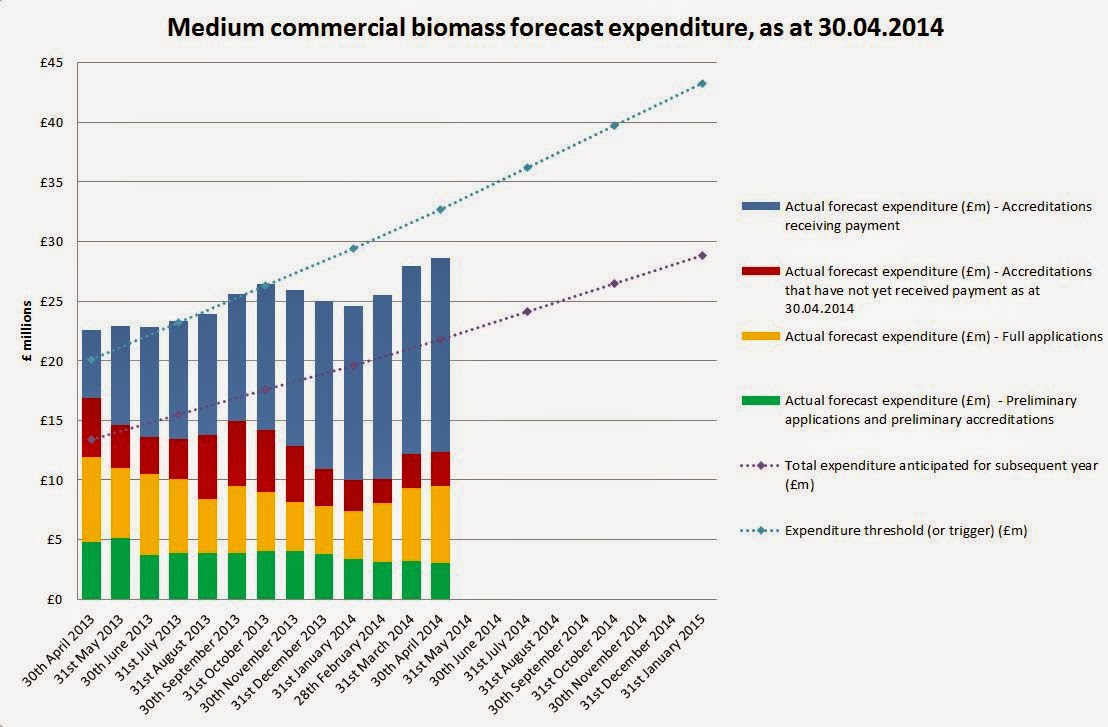
Meanwhile, uptake of the medium tariff remains strong but is currently operating below budget forecasts.


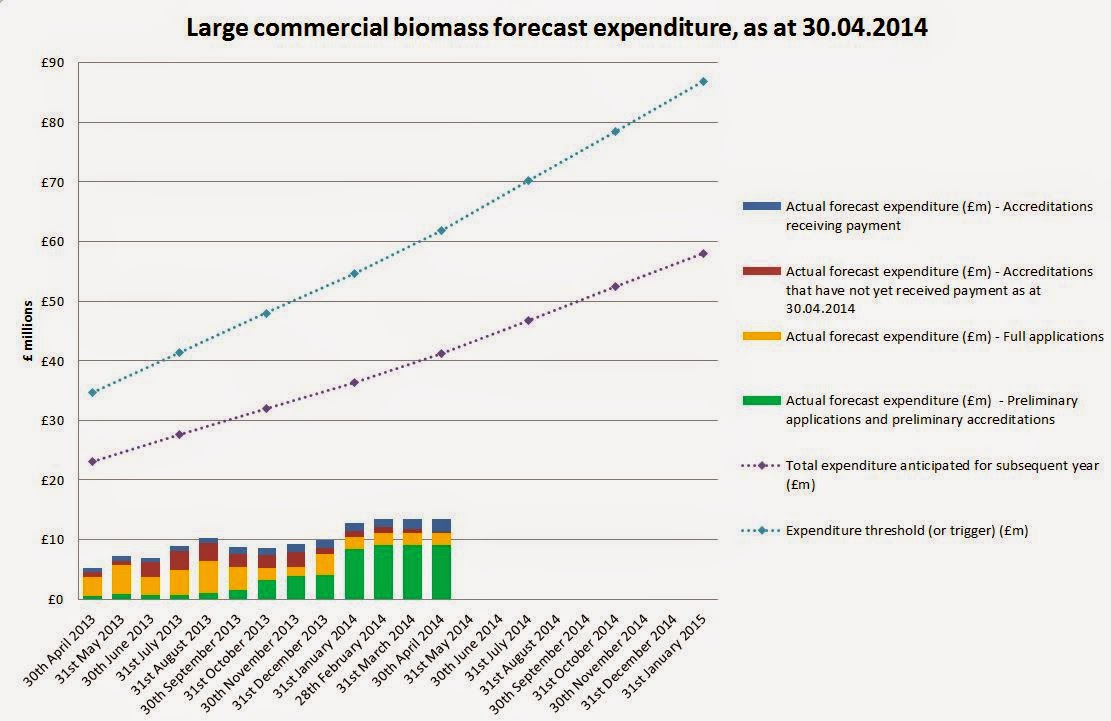
Activity in the large biomass tariff category is far lower than the other categories.  However, there are clearly a number of schemes at pre-application stage (green column) and these may start to have greater impact on budgets over the next 24 months.


Overall biomass heating remains the clear 'winner' in the non-domestic RHI.  The majority of the available budget (and installed capacity) is currently allocated to biomass technologies and activity in the other RHI-eligible technologies remains relatively modest. 

Thursday, 27 February 2014

Forestry & Wood Fuel Update - April 2014 - Free Event

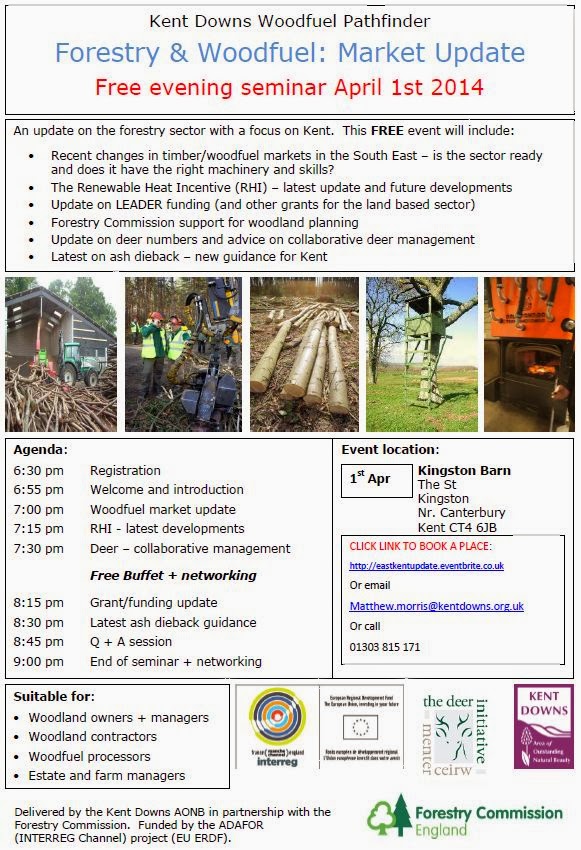
The Woodfuel Pathfinder will deliver its next event at Kingston Barn on the evening on April 1st.  Full details can be found below.

To register for the event please use this link.  

Alternatively please call the AONB Unit on 01303 815 171.


Wednesday, 11 December 2013

Commercial RHI - summary of changes to tariffs and technologies


Are you sitting comfortably?

DECC has been busy releasing new and updated information about both the commercial and domestic RHI and renewable heat in general.

To my eyes the overall renewable heat situation looks extremely healthy at the moment, particularly if you are in the biomass sector.  However, it is also clear that biomass is dominating the commercial RHI.  Consequently DECC will introduce changes to the budgetary process to increase the degression trigger sensitivity for sub-1MW biomass.


We have read the latest update on the commercial RHI and have picked out the main points from the executive summary.  We would urge interested readers to look at the entire document in case we have missed anything.


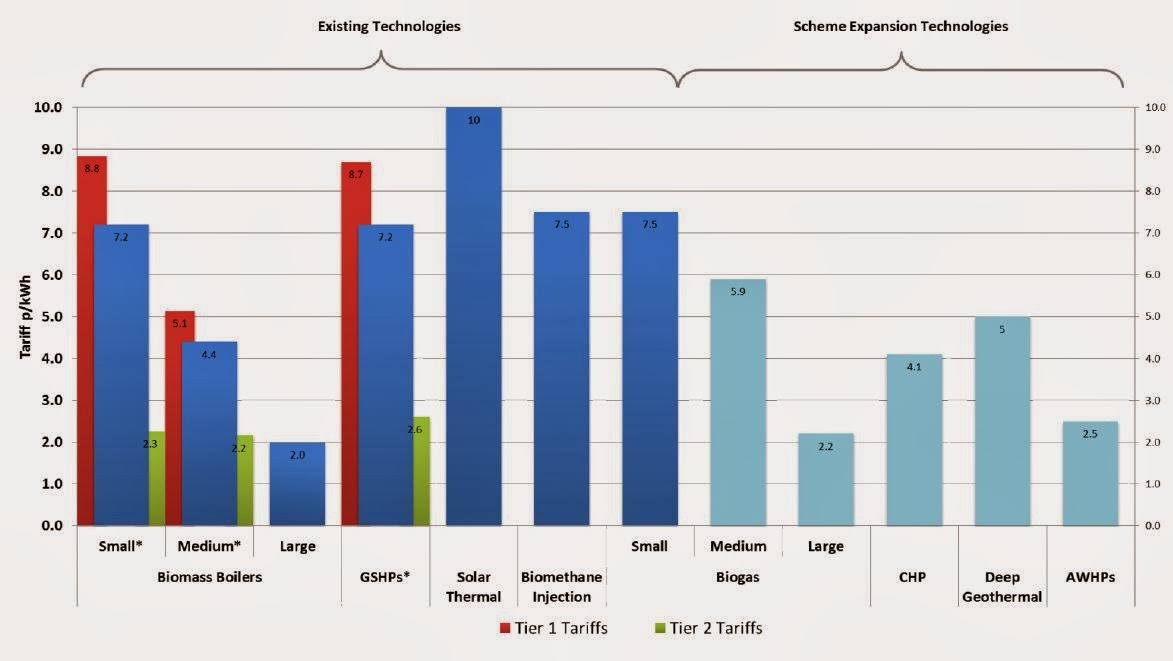
A key change is the capping of all tariffs at 10p/kWh.  This means that the RPI inflation of tariffs will stop at 10p/kWh.  For biomass it is the tier 1 small biomass tariff that is closest to this limit (n.b. the solar thermal tariff will be increased to 10p/kWh).

It is true that some renewable heat technologies are underperforming in the RHI, such as heat pumps and solar thermal.  However, DECC has recognised this and will beef up support - via increased tariffs and budgets - as well altering some requirements (such as energy efficiency).  The large biomass tariff, for example, will increase to 2.0p/kWh from 1.0p/kWh.


Eligibility

For new technologies and updated tariffs - 4 Dec 2013.  Any applications with a date of accreditation of 21 January 2013 or later will benefit from the tariff increases brought forward as a result of the Early Tariff Review consultation (this applies to ground source heat pumps (GSHP), solar thermal and biomass over 1MWth).


Energy Efficiency

DECC will not be introducing explicit energy efficiency criteria for non-domestic RHI applicants at this time. The mixed views from consultation respondents made it clear that more work needs to be done to establish a range of effective but not unduly burdensome energy efficiency measures that could be introduced into the scheme.


Biomass Sustainability Update

Based on feedback from stakeholders about industry readiness,  DECC  will postpone implementing mandatory compliance with GHG lifecycle emissions savings to Autumn 2014, so that industry and participants can monitor their processes in light of the sustainability criteria and build the audit trail necessary to demonstrate compliance.

DECC intend for the Biomass Suppliers List to be open for applications from suppliers of biomass in Spring 2014.

Subject to the availability of Parliamentary time,  DECC  intend to implement land-use sustainability criteria by 1 April 2015.


Biomass CHP

DECC will be introducing support for biomass CHP (4.1p/kWh), biogas >200kW (5.9 p/kWh and 2.2pkWh depending on size) and deep geothermal (5.0p/kWh). 

However, we do not intend to proceed at this time with support for heating only air-to-air heat pumps or biomass direct air as the consultation did not enable the development of appropriate deliverable policy.

Biogas combusion >200kWth

Subject to State Aid approval, tariffs will be set at 5.9p/kWh for installations with a thermal capacity of between 200 to 600kWth and 2.2p/kWh for those greater than 600kWth.

Deep geothermal

DECC will introduce a new tariff for deep geothermal heat at 5p/kWh. Deep geothermal heat will be defined as heat coming from a drilling depth of a minimum of 500m.

Heating only air-to-air heat pumps (AAHPs)

Although these technologies do produce renewable heat,  DECC  will not be introducing support for them at this time. This is primarily because of the risk of incentivising the installation of separate heating and cooling AAHPs in order to claim the RHI, rather than a reversible AAHP, which is likely to be more energy efficient.

Air to Water Heat Pumps and Energy from Waste

DECC will be introducing support set at 2.5p/kWh for AWHP (designed to achieve a minimum seasonal performance factor of at least 2.5) and 2.0p/kWh for the biogenic proportion of energy from waste (commercial and industrial).

Value for Money Cap and Tariff Rate of Return

From Spring 2014 tariffs across the RHI will be capped at 10.0p/kWh of renewable heat (and continue to be adjusted by RPI annually).

Biomass

To date deployment of large biomass has been below expectations and therefore  DECC  will go ahead with the proposed tariff increase to 2.0p/kWh.

Ground Source Heat Pump Tariffs

DECC will be replacing the current banded GSHP tariffs with a single tariff of 7.2p/kWh, which will be tiered.

The tier 1 tariff of 8.7p/kWh will be paid on the initial heat generated for an eligible purpose and the tier 2 tariff of 2.6p/kWh will be paid on the remaining eligible heat generated. This is equivalent to a tariff of 10.0p/kWh renewable heat assuming an SPF of 3.6.

Solar thermal

DECC will be raising the solar thermal tariff to 10.0p/kWh.

Budget management

Since implementation,  DECC  has made three quarterly degression assessments, one of which resulted in the medium biomass tariff being reduced by 5%. The outcome of the most recent assessment was published at the end of November.  DECC  will publish the fourth quarterly announcement by 1 March 2014.

In the May 2013 tariff review consultation we set out that the budget management policy would need to be developed in light of any tariff changes or scheme extensions and to reflect the outcome of the spending review for 2015/16, which has since confirmed an RHI budget in 2015/16 of up to £430m.


Having reviewed the budget management mechanism to ensure it remains fit for purpose,  DECC  will make some changes to the policy from Spring 2014 to:
  • base the deployment levels set out in the degression mechanism on refreshed market intelligence rather than the expectations that were modelled prior to the scheme’s introduction;
  • reduce the tolerance in the technology trigger for biomass under 1MWth and bio-methane injection by reducing the amount that these triggers are scaled above expected levels of deployment. They will change from being 150% of expected deployment to 120% of expected deployment. This will reduce the risk of unsustainable growth and dominance of the budget by a small number of technologies;
  • set the triggers for technologies  DECC  expects to deploy in relatively lower volumes (solar thermal, deep geothermal and all biogas) at 2.5% of the overall budget, rather than the current 5%.
Reducing uncertainty for projects with long-lead times

DECC intend to introduce a form of tariff guarantee for the largest installations (for example, those over 1MW), initially available for plant due to be commissioned by 31 March 2016. Subject to further policy development in 2014, State Aid and Parliamentary approval,  DECC  will aim for this measure to be in place from April 2015 to March 2016 and thereafter factored into the next spending review discussions on the RHI so that it can be available from Spring 2016 for plant due to commission by 31 March 2020.

Public Grants

After two years of the non-domestic RHI we think a more flexible approach to the interaction between public grants and the RHI could encourage more renewable heat installations to come forward. Pending further work alongside the 2014 review to look at the interaction between public grants and the non-domestic RHI,  DECC  intend to introduce some additional flexibility next year. We will take forward regulatory amendments to extend the eligibility window for repayment of grants and to allow some grant recipients who are unable to pay back their grants to access the RHI via reduced tariff payments.


Thursday, 3 October 2013

Events in Sussex will highlight progress in wood fuel and biomass heating sectors

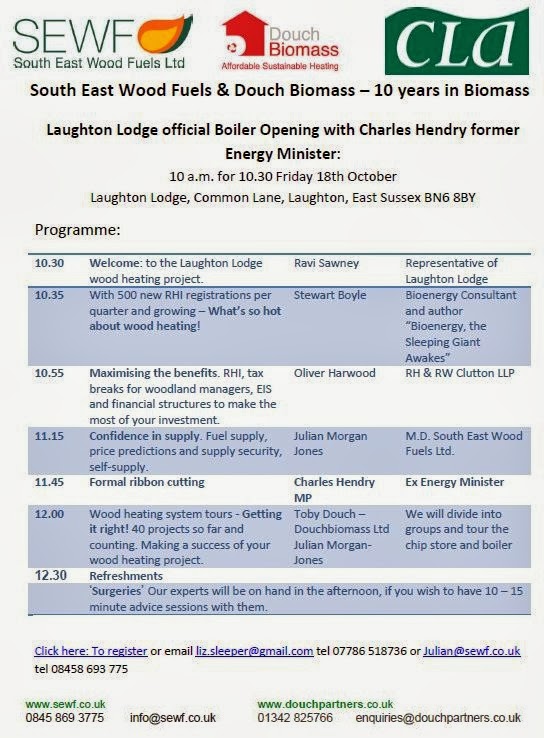
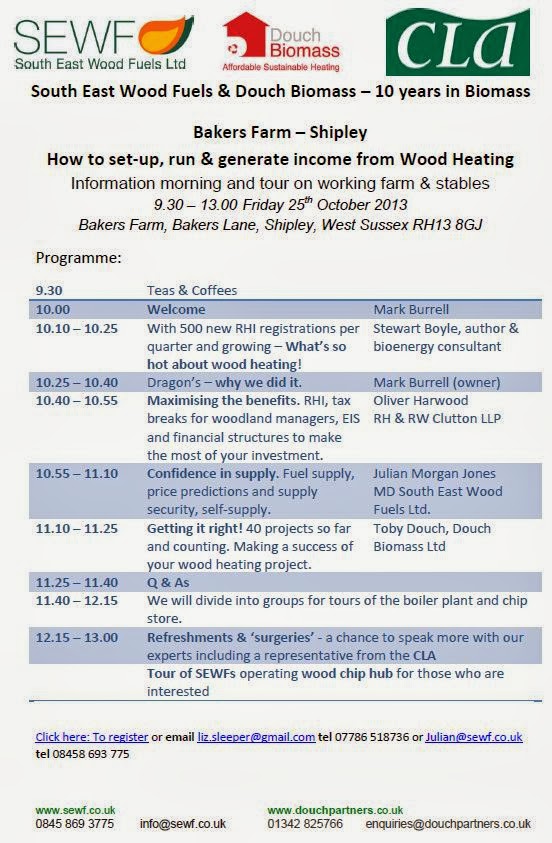
South East Wood Fuels, Douch Biomass and the CLA have announced two events to showcase new biomass heating installations in Sussex and to provide an update on the woodfuel and biomass heating sectors.

The first will take place on Friday October 18th at Laughton Lodge in East Sussex.  The district heating system at this site has recently been upgraded and a new boiler installed.  

On hand will be a range of RHI, woodfuel and biomass heating experts who will highlight recent developments in the sector.  The event also offers free 'surgeries' for those interested in undertaking a woodfuel or biomass heating project.


The second event takes place at Bakers Farm in West Sussex on Friday October 25th.  Both events are free.  To register please visit the following sites to book your place:

  1. Laughton Lodge - Oct 18th: Click here
  2. Bakers Farm - Oct 25th: Click here


Thursday, 8 August 2013

Domestic RHI - summary of scheme proposals

DECC has published its response to the consultation on the domestic version of the Renewable Heat Incentive (RHI).  The response includes a lot of detail on the types of technology that will be supported, their 'performance' and the type of properties and tenure that will be eligible.

To assist readers we have produced a summary of the proposals as they stand.  This can be found here.

The proposals for biomass heating are of particular interest to this blog.  The main points of interest include:


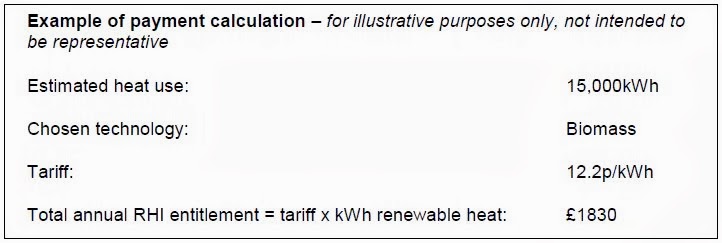
  • The tariff for biomass has increased from 8.7 p/kWh (initially proposed in 2012) to 12.2 p/kWh.  Whilst this is slightly below the 13-15 p/kWh we would have liked to see it is clearly an improvement.  The final tariff is yet to be announced but presumably it will be well before the proposed scheme opening date of April 1st 2014.

  • The tariff will be paid over seven years according to deemed heat.  This is the heat load as determined by the EPC that is created during a Green Deal assessment which is a mandatory requirement.

  • Legacy systems installed since 15th July 2009 will also be eligible providing they were installed by an MCS accredited company.  
  • Biomass equipment will need to meet meet air quality standards in relation to particulate matter (PM) and oxides of nitrogen (NOx). Legacy installations, installed between 15th July 2009 and the launch of the scheme, will not need to meet this requirement.
  • A new requirement around fuel sustainability will be introduced for  biomass installations.  To be eligible for and continue to receive RHI support for a biomass system, fuel needs to be sourced from a supplier registered on an approved supplier list. Such a list will be set up ahead of the launch of the scheme and will be the same one that is being established for the non-domestic RHI scheme.
The final point on sustainability is interesting and has important implications for wood fuel suppliers. To be included on the list, DECC intends that fuel suppliers will have to meet two criteria from April 2014:

  • Supply fuel which complies with the greenhouse gas (GHG) lifecycle emissions target of achieving 60% GHG savings against the EU fossil fuel heat average, assuming a boiler efficiency of 70%.
  • Report their performance against the relevant land criteria from the following list (although compliance with the criteria will not initially be required):

Evidence of legality and sustainability can come in two forms:

  • Category A evidence is independent certification of the timber/ timber products by any of the forest certification schemes that meet the policy requirements (such as FSC and PEFC).
  • Category B evidence is alternative documentary evidence that provides assurance that the source is legal and sustainable.
Category A evidence is the 'belt and braces' approach and undoubtedly involves the procurement of external expertise from Forest Stewardship Council and the accredited certification bodies are authorised to issue FSC certificates.

The alternative is Category B evidence and you will be glad to hear that this includes use of the Forestry Commission's Woodland Planning Grant (WPG) that falls under the English Woodland Grant Scheme (EWGS).  

However, the WPG Category B option is open to owners with less than 100 hectares of woodland, and more than 3 hectares, and whose woodlands are not certified.  As such it is envisaged that owners with more than 100 hectares will pursue the Category A, full certification option.

As ever we would recommend a good read of the full DECC document to make sure you pick up all of the salient points.


Tuesday, 30 October 2012

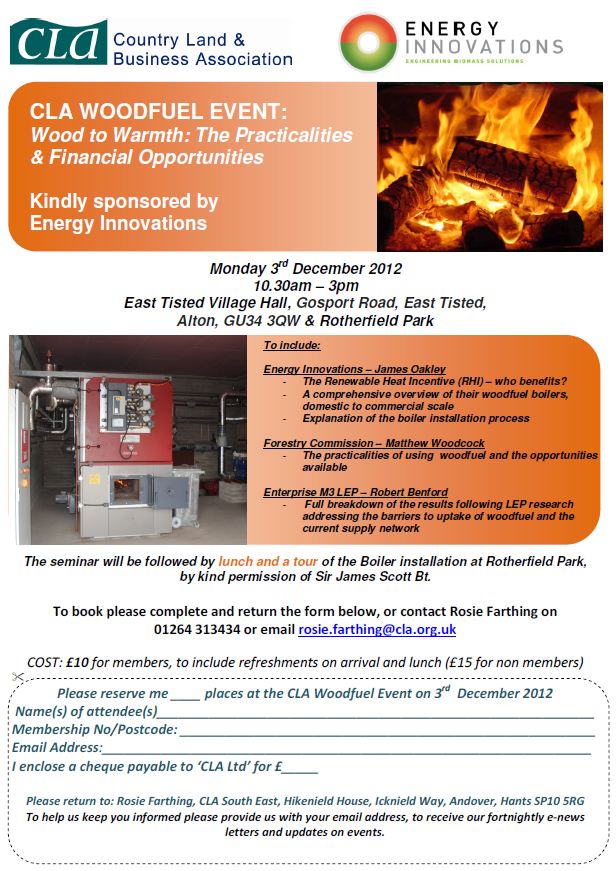
CLA Woodfuel Event


Wednesday, 8 August 2012

RHI: 100th accredited application


The 100th installation was accredited to the Renewable Heat Incentive (RHI) scheme on 19th June 2012.

The Meikleour Trust, a Scottish estate, installed a 500kWth biomass boiler to supply heat via a district heating system to a range of buildings including the main house, a greenhouse, holiday lets and other outbuildings. 

The owner also intends to expand the system to a planned housing development in the future. The fuel is local wood chip that is sourced from sustainable local forestry.

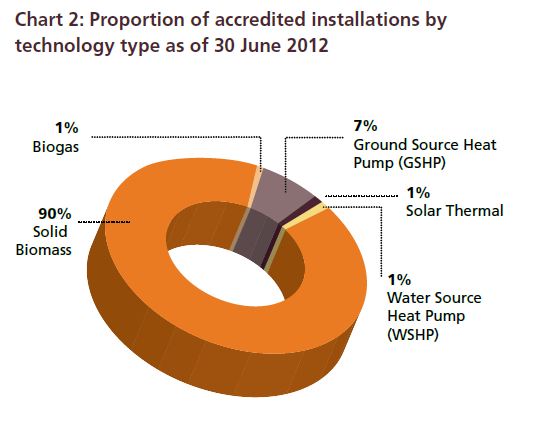
The most recent RHI quarterly report from Ofgem shows a high uptake of solid biomass installations which make up 99% of capacity and 90% of total accreditations under the scheme.

Chart 1 shows the total installed capacity accredited by the scheme since November 2011. As of 30 June 2012, a total of 49.41 MW of installed capacity had been accredited to the scheme.

Heat pumps (ground and water combined) make up 8% of accredited installations and 0.75% of capacity. 

Biogas and solar thermal technologies each account for 1% of the total number of accredited installations as well as 0.24% and 0.01% of accredited capacity respectively.


A total of 121 renewable heat installations have
been accredited under the scheme, seven of which
are preliminary accreditations.
  • Only four applications have been rejected, all because applicants had received public funds or grants.
  • 49.41 MW of total capacity has been accredited, 11.36 MW of which is preliminary.
  • A total of £350,594 in RHI periodic payments has been made to participants.


The number of accredited installations for the second quarter increased from 20 at the end of March to 121 installations accredited by the end of June.

Solid biomass installations continues to make up the majority of accredited installations and accredited capacity.

Installed capacity has increased to 49.41 MW from 5.25 MW. The amount of periodic payments made to participants has increased from £9,707 to £350,594.


Friday, 6 July 2012

RHI Update: New guidance for Applicants


Ofgem's latest update on  the RHI reports the scheme has received over 600 applications and has resulted in  payments for over 13,000 MWh of heat.  Of interest is the extremely high application acceptance rate (95%) with only three schemes having been rejected due to the receipt of capital grants (which are not compatible with the RHI).


Based on these figures it appears that only around 57 applications have been successfully processed and are receiving payments (which hints at a huge backlog of around 543 applications, the majority of which are for biomass).


Ofgem acknowledge the popularity of the scheme and the fact that it is taking longer to process applications than anticipated.  Most importantly Ofgem have highlighted the issues they  have found with heat metering under the scheme.  In response a range of new guidance materials have been made available (see below).


Heat metering issues


Ofgem has conducted a series of early site audits of RHI installations which have revealed significant problems with most installations having errors in their metering arrangements (which need to be rectified before installations can be accredited to the scheme.  Common issues identified include:
  • Meters are not installed according to manufacturers’ guidance (e.g. the meter orientation is incorrect; the meter is installed too close to a bend; or the meter is installed in the flow pipe when it should have been installed in the return pipe etc).
  • More installations qualify as ‘complex’ than as ‘simple’ for the purposes of RHI (meaning often more meters are required than applicants and their advisers might have anticipated).
  • Schematics provided for systems to date often lack clarity or fail to adequately reflect the situation on site. This means that it can be difficult for Ofgem to decide whether the heat metering strategy is appropriate for the installation. This results in a need for further clarifications and work for both applicants and Ofgem.
  • There are errors and omissions in Independent Reports on Metering Arrangements as well as inconsistencies with other documentation.


In addition to the new guides below Ofgem offers the following key advice:


  • Be clear about the triggers which make an installation ‘complex’ for the purposes of the RHI before making an application.
  • Ensure that meters can be and are actually installed in accordance with their manufacturers’ instructions.
  • Ensure that appropriate documentation is obtained from manufacturers or suppliers and retained by the owner of the installation.
  • Provide a schematic which accurately reflects the situation on site, to allow Ofgem to rely upon the meter readings it receives.
  • Ensure that Independent Reports on Metering Arrangements are proof-read and checked against other documentation by their authors before submission to Ofgem.
  • Ensure that the application is well made, by providing sufficient detail against answers and including all supporting documentation at the outset.
New guidance


Wednesday, 9 May 2012

Moving towards low carbon farming


To book your place or for more information please call the Soil Association 0117 314 5127 or email pjohnson@soilassociation.org.

The Kent Downs Woodfuel Pathfinder would be happy to assist anyone considering biomass heating as a way of reducing on farm energy use. 

For free advice and support please contact Matthew Morris on 01303 815 171 or matthew.morris@kentdowns.org.uk.

Friday, 24 February 2012

Renewable Heat Incentive - application help events

Monday, 12 December 2011

More support for community energy projects


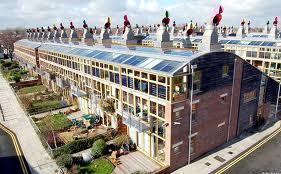
BedZed, London, Peabody Trust.
The Buildings Research Establishment has just opened another round of the Community Sustainable Energy Programme.

The Community Sustainable Energy Programme will provide £8 million to community-based organisations for the installation of microgeneration technologies , such as solar panels or biomass boilers and energy efficiency measures including loft and cavity wall insulation.

It will also provide £1 million for project development grants that will help community organisations decide if they could benefit from a microgeneration and energy efficiency installation.

The programme aims to achieve the following outcomes:    

  • Reduction in CO2 emissions
  • Increased community awareness of climate change and how changes to our behaviour can reduce it
  • Increased skills base of local trades (for example, local builders and building-service subcontractors working on renewable energy projects for the first time)
  • Reduction in energy bills
  • Reduction in reliance on imported energy and increased independence from commercial energy suppliers
  • Stronger partnerships within local communities with lasting social benefits
  • Growth of local enterprise in new technologies
Due to the opening of the Renewable Heat Incentive (RHI) applications for the current CSEP round will only be accepted for heat generating technologies and energy efficiency measures only.

Deadline for the receipt of completed applications will be 5pm Friday 29 February 2012.

For full details on how to apply please visit the BRE CSEP webpages.

Monday, 5 December 2011

National biomass suppliers database launched

The Forestry Commission’s Biomass Energy Centre (BEC) and the Carbon Trust have jointly launched the National Biomass Suppliers Database - a new way for people to find local and national companies which can supply them with woodfuel.

Since the introduction of the Renewable Heating Incentive (RHI), many more people are considering installing woodfuel-powered heating, but they are often unaware that the woodfuel supply chain is well established in many parts of the country.

The new map-based listing, which is also available on the Biomass Energy Centre website, includes the details of around 300 fuel suppliers operating across the UK.

The new system will make it easy to find the nearest, or preferable, fuel supplier, and the service is free - woodfuel suppliers can be included simply by registering and submitting their details online.

Forestry Commission England recently announced its Woodfuel Woodland Improvement Grant, which will increase the amount of wood entering the supply chain from currently under-managed woodlands.

Tuesday, 29 November 2011

Renewable Heat Incentive is open for business

DECC has now announced the launch of the Renewable Heat Incentive (RHI) Scheme and Ofgem's systems are now open and available to accept applications.

We have had a initial look at the online application process and it appears to be relatively simple.  However, you will need all paperwork close at hand (in electronic format) to increase the chances of completing the process in one sitting.  You can of course save the application and return later if you need to source additional information.

A few points of interest:
  • The person applying should be the authorised signatory for the organisation
  • You will need details of a valid bank account and proof that the bank account provided is held in the name of the organisation/company (e.g. copy of a bank statement which shows the account name, address, sort code and account number with financial information blackened out)
  • For 'simple' schemes Ofgem will respond within 20 working days
  • For 'complex' schemes Ofgem will reply within 30 working days
  • You will need to apply for preliminary accreditation if you installation date is greater than one month from the present (application) date AND your biomass boiler is over 200kWth (i.e. medium scale and above)
  • You will need to attach (or post) a series of documents so it would be worthwhile ensuring these are all at hand before you start.
  • You will need to be able to separate capital costs from non-direct costs (i.e. installer costs, planning costs and anything not attributable directly to the purchase or construction of the physical plant)
For further information, useful links and details on how to apply to the scheme please visit the RHI website: http://www.ofgem.gov.uk/RHI.

For a summary of some of the documents and information which participants may be required to submit please refer to the following document “Summary of supporting information for RHI applicants”:


If you have any queries please contact the Ofgem E-Serve RHI Team on 0845 200 2122. The helpline opening hours are 8:30am until 5pm Monday to Thursday, and 8:30am until 4:30pm on Fridays.

Alternatively, you can send an email to RHI.Enquiry@Ofgem.gov.uk.  It is recommended that complicated enquiries are sent via email.

Good luck!


Friday, 11 November 2011

£10m to boost woodland management for woodfuel

A new £10m grant scheme to revitalise woodland management has been announced by Forestry Commission England today, 10 November 2011. The new scheme aims to produce woodfuel by improving roads and access for extraction.

Around half of England’s woodlands are undermanaged. There are many reasons for this but one is certainly the high cost of extracting timber so that it can be brought to market. Supporting owners and managers to improve roads and access will reduce harvesting costs and once again make woodland management economically viable.

Pam Warhurst, Forestry Commission Chair said:
“There is an old phrase that says “A wood that pays is a wood that stays.” We are delighted to be able to launch this new scheme to revitalise the economic viability of sustainable woodland management by helping get timber to market. It will create rural jobs and help grow the green economy.”

Applicants will have to have long term management plans for the woodlands that meet the new UK Forestry Standard.  The plans will say how much timber they expect to harvest over the next decade so we will be able to see clearly what the benefits are from each new road built.

The new Woodfuel Woodland Improvement Grant (or Woodfuel WIG), will improve the infrastructure of undermanaged woodlands and contribute to the costs of marketing timber. As well as supplying the growing woodfuel market from thinnings and other operations, well managed woodland can also produce high quality timber. In turn this management improves the quality of woodlands for wildlife.

Woodfuel WIG is available throughout England but most of the funds are targeted towards the South East, South West and Cumbria, where there is greater potential for woodfuel supply.

This new grant is open for applications now and will operate alongside the Farming and Forestry Improvement Scheme, recently launched by Defra to provide comprehensive support to the woodfuel supply chain.

Woodfuel Woodland Improvement grant key features
  • This new grant supports the sustainable production of woodfuel and other timber products and runs to the end of the 2013/14 financial year
  • Work will need to meet the UK Foresty Standard
  • The grant offers 60% towards the cost of work, and doesn’t take account of the timber income that results
  • To apply for a Woodfuel WIG, applicants must have an approved, up to date Woodland Management Plan, and work must be completed and claimed for by 28 February 2014
The following main operations are supported:
  • Roads, tracks and other infrastructure to assist the extraction of timber from woodland. Support will be based on 3 quotes and grant paid on the production of receipted invoices
  • Woodland inventory and costs associated with managing harvesting contracts. Support for this work is based on standard costs

Monday, 15 August 2011

Evening briefing seminars: Presentations

The presentations from the recent briefing sessions can be read or downloaded via Scribd using the following links:

Matthew Woodcock - Forestry Commission: Biomass heating examples
http://www.scribd.com/doc/62320782/KDWfP-Biomass-heating-examples

Stewart Boyle: The Renewable Heat Incentive
http://www.scribd.com/doc/62320257/KDWfP-Renewable-Heat-Incentive-overview-and-examples

Matthew Morris: Kent's woodland resource
http://www.scribd.com/doc/62318444/KDWfP-Kent-s-Woodland-Resource

If you have any questions about these presentations, or any other related matter, then please feel free to contact us at the following email address: matthew.morris@kentdowns.org.uk