Showing posts with label heat meter. Show all posts

Wednesday, 9 January 2013

RHI - consultation on change to heat metering requirements


Welcome to our first blog post of 2013.  

In the spirit of 2012 we will commence the year with yet another consultation on the RHI!


Whilst this latest consultation is fairly straightforward it will have important implications for installers, particularly those that have been preparing their own IRMAs (Independent Report on Metering Arrangements).

Also, as the proposals are likely to incur additional costs for both installers and consulting engineers looking to provide IRMAs it may well be worth taking a few minutes to read the consultation and send your feedback to Ofgem.

Ofgem's current guidance on metering can be found here.

The consultation has been prompted by the apparent low quality of IRMAs received by Ofgem to date:


  • Early site audits of RHI applications revealed a high level of errors in metering arrangements, particularly in the location or installation of meters.
  • Many of these errors would impact on the accuracy of heat generation data but had not been identified in the IRMAs submitted.
  • IRMAs received to date are often inconsistent with other documentation or show poor understanding of the RHI eligibility requirements. As a result, Ofgem has been unable to rely on IRMAs to verify the eligibility of metering solutions, thus considerably reducing their value to applicants and Ofgem.
  • Overall the errors found in IRMAs to date are felt to be indicative of two main issues: inadequate levels of independence and inadequate levels of scheme and technical knowledge.
In response to these challenges Ofgem is now consulting on six proposals:

Proposal 1:

The applicant will need to stipulate that ‘the IRMA author must have no contractual or other relationship (beyond any contractual arrangement to produce an IRMA) with the metering installer, the applicant or the system designer’.

Proposal 2: 

RHI applicants will need to verify the eligibility and competence of their IRMA author by asking the author to confirm a series of statements within the RHI IRMA report template:

  • The author has read and is familiar with the RHI Guidance documents and RHI Scheme Regulations 2011, in particular the metering requirements;
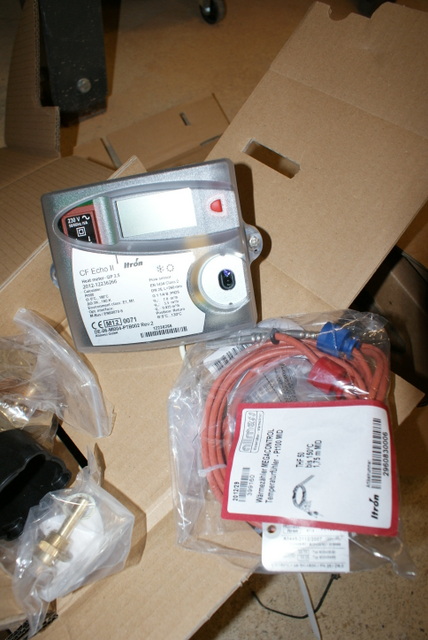
  • The author is able to detect meters which have been fitted and/or located incorrectly alongside any other defects or system configurations which could adversely affect the meter‟s ability to accurately measure heat production;
  • The author is familiar with the metering requirements of the MID Annex 1 and is able to determine whether or not a meter is compliant with MID Class 2 metering requirements;
  • The author understands the difference between „simple‟ and „complex‟ metering arrangements as specified in the RHI Guidance documents and is able to determine which of these arrangements applies to the applicant‟s circumstances; and
  • The author is able to determine whether or not a schematic diagram accurately reflects (in sufficient detail) the applicant‟s physical installation and heating systems.

Proposal 3:

For further clarity, the following additional changes be made to the RHI IRMA report template:

  • questions in the report template will be made more explicit;
  • questions relating to external pipe work and additional buildings will be included;
  • a higher level of evidence for compliance will be set including the provision of photographs;
  • additional questions will be included on the evidence of MID Class 2 accuracy of meters;
  • to support the questions on evidence of meter accuracy and meter conformity, specific evidence (in the form of document copies and/or photographs) must be appended to the template. For example, this can include photocopies and photographs to confirm MID Class 2 accuracy. This will be in line with the evidence requirements set out in our published „RHI Frequently Asked Questions – Metering‟7; and
  • inclusion of the following additional declaration which the IRMA author must sign to confirm that the installation has met the RHI eligibility criteria (see here for guidance).

Proposal 4:

To recommend that all IRMA authors undergo assessment to increase their technical and scheme knowledge via a recognised assessment programme.  Ofgem suggests that such assessment programmes are in development (e.g. via The Building and Engineering Services Association (B&ES), Building Services Research and Information Association (BSRIA), Chartered Institute of Building Services Engineers (CIBSE) and Energy Services and Technology Association (ESTA).

Proposal 5: 

That all meters be robust against tampering.

Proposal 6: 

The sharing information on the quality of IRMAs with the IRMA authors themselves and with their assessment, trade or professional body, in order that those bodies are able to address any issues and provide the appropriate protection to the public.


The consultation letter can be found on the Ofgem website using the following link:


The consultation extends for 8 weeks with responses due by the end date of 4th March 2013.


Monday, 19 November 2012

Update on RHI scheme

As the first anniversary of the Renewable Heat Incentive approaches we thought we would take a quick look at progress to date.

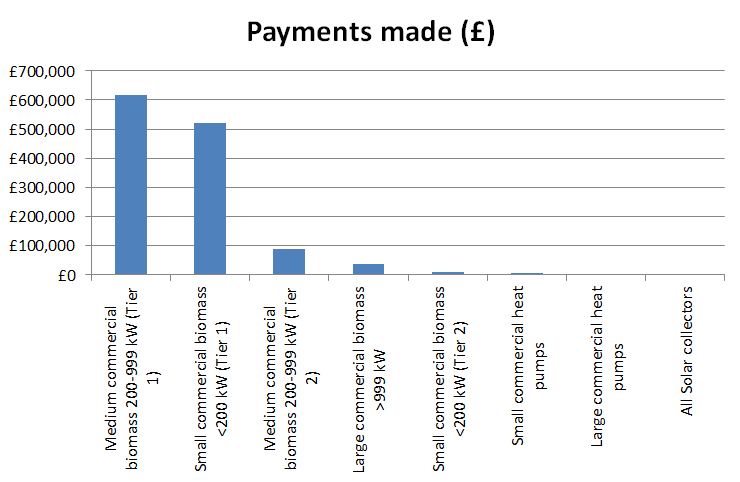
In terms of overall numbers the results are modest.  In England the number of accredited installations is 406.  Of these 358 (88%) are for biomass boilers, 25 (6%) for solar thermal and 19 (5%) for ground source heat pumps.

Data Source: Ofgem, 19/11/2012
The relatively low uptake in the solar thermal and ground source categories is interesting and suggests that these technologies are yet to find traction in commercial situations.  This low uptake may also be due to the popularity of the Feed in Tariff which has probably diverted attention towards solar PV, particularly where biomass is not an option.

The results also show that the RHI tariff is yet to be used for deep geothermal, municipal sold waste or bio-methane installations.  As these technologies are often used at larger scales it may be that other incentives are being favoured, such as the Renewables Obligation Certificate (ROC).  Another factor is the high capital cost of these technologies which undoubtedly take longer to plan and finance.  Uptake of the RHI might therefore pick up in time, but in the absence of any other information from DECC (e.g. pre-accreditation) it is hard to tell.

Biomass romps ahead

At 358 installations (commercial) biomass heating is leading the renewable heat scene at the moment.  Based on our experience these installations are mainly to be found on farms and estates and often focus on a large property that is connected to multiple domestic and non-domestic properties in close proximity.  We are also seeing smaller domestic systems that involve multiple dwellings connected to a single boiler.

Date Source: Ofgem, 19/11/2012
Uptake in the new build/refurbishment sectors is happening, albeit at a much slower rate.  While planning applications for large regeneration projects and new housing are coming through, particularly in the Growth Areas and Growth Points of Kent, the specification of biomass heating is rare, which seems odd given the interest from private finance houses in RHI-based investments and ESCo business models.

The integration of other renewable heat technologies alongside biomass does not yet appear to be common either.  Even though solar thermal and biomass are best friends, to use a Jamie Oliver saying, we are yet to see it in action.  This may be because of high capital cost of biomass which could be excluding secondary/complementary technologies (i.e. biomass is often sized to be as close to 100% of the heat load as possible with oil for peak which often makes the business case for complementary technologies less attractive).

Uptake in Kent?

Unfortunately the Ofgem statistics do not allow analysis at region or county levels.  However, based on the work we are doing and the people we speak to, many of the large farm estates (particularly those with woodland interests) have made enquiries about the RHI and biomass technologies and several sites have gone ahead with projects.

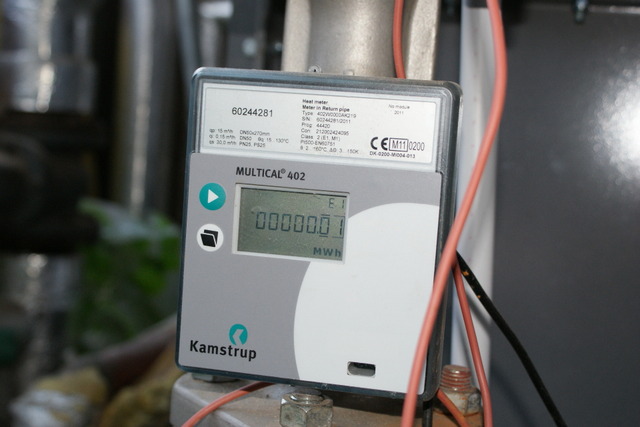
Kamstrup heat meter in action
However, in the grand scheme of things uptake is still slow.  We think that whilst interest levels are high the upfront capital cost of biomass remains the single largest barrier and prevents many from proceeding further.  We know from the pre-feasibility studies we have carried out for people that the business case for biomass in the right situation is extremely compelling (i.e. 5 to 6 year payback, 10%+ return over the lifetime of the installation, 50% fuel cost reduction for wood chip).

650 kW Binder at Hever Castle
Whilst we agree that biomass heating projects have a long lead in time, and take considerable project/business development, there may be a case for installing presenting finance options (if they have them) at a much earlier stage.

Domestic RHI on its way...

Don't forget that the purely domestic version of the RHI is being consulted on at the moment.  This scheme is due to open in Q2 or Q3 2013.  Our current thinking is that the tariff proposed for domestic biomass in the consultation is currently too low to make a significant difference in payback (and thus uptake).  If you are interested in the RHI and are in a situation where you could qualify for the commercial RHI (e.g. 2 or more domestic dwellings connected to a single boiler) you may well be better off taking action now.  We hope that the tariff under the domestic RHI improves and we will keep a keen eye on the consultation response by DECC.

Can we help?

The Kent Downs Woodfuel Pathfinder can provide pre-feasibility support for people considering biomass heating.  By 'pre-feasibility' we mean the assessment of viability and the development of an initial (non-market tested) business case.  We can also support people as they engage with the installer network.

If you would any help with the RHI and biomass heating then please get in touch with us on 01303 815 171 or matthew.morris@kentdowns.org.uk.  

Due to the way our project is funded our support needs to be provided mainly within Kent and should preferably link to woodfuel supply chains in/near the Kent Downs AONB.  If in doubt just call!  


Friday, 6 July 2012

RHI Update: New guidance for Applicants


Ofgem's latest update on  the RHI reports the scheme has received over 600 applications and has resulted in  payments for over 13,000 MWh of heat.  Of interest is the extremely high application acceptance rate (95%) with only three schemes having been rejected due to the receipt of capital grants (which are not compatible with the RHI).


Based on these figures it appears that only around 57 applications have been successfully processed and are receiving payments (which hints at a huge backlog of around 543 applications, the majority of which are for biomass).


Ofgem acknowledge the popularity of the scheme and the fact that it is taking longer to process applications than anticipated.  Most importantly Ofgem have highlighted the issues they  have found with heat metering under the scheme.  In response a range of new guidance materials have been made available (see below).


Heat metering issues


Ofgem has conducted a series of early site audits of RHI installations which have revealed significant problems with most installations having errors in their metering arrangements (which need to be rectified before installations can be accredited to the scheme.  Common issues identified include:
  • Meters are not installed according to manufacturers’ guidance (e.g. the meter orientation is incorrect; the meter is installed too close to a bend; or the meter is installed in the flow pipe when it should have been installed in the return pipe etc).
  • More installations qualify as ‘complex’ than as ‘simple’ for the purposes of RHI (meaning often more meters are required than applicants and their advisers might have anticipated).
  • Schematics provided for systems to date often lack clarity or fail to adequately reflect the situation on site. This means that it can be difficult for Ofgem to decide whether the heat metering strategy is appropriate for the installation. This results in a need for further clarifications and work for both applicants and Ofgem.
  • There are errors and omissions in Independent Reports on Metering Arrangements as well as inconsistencies with other documentation.


In addition to the new guides below Ofgem offers the following key advice:


  • Be clear about the triggers which make an installation ‘complex’ for the purposes of the RHI before making an application.
  • Ensure that meters can be and are actually installed in accordance with their manufacturers’ instructions.
  • Ensure that appropriate documentation is obtained from manufacturers or suppliers and retained by the owner of the installation.
  • Provide a schematic which accurately reflects the situation on site, to allow Ofgem to rely upon the meter readings it receives.
  • Ensure that Independent Reports on Metering Arrangements are proof-read and checked against other documentation by their authors before submission to Ofgem.
  • Ensure that the application is well made, by providing sufficient detail against answers and including all supporting documentation at the outset.
New guidance