Showing posts with label renewable heat premium payment. Show all posts

Tuesday, 21 January 2014

RHPP due to end soon - £2,000 grant towards the cost of a biomass boiler


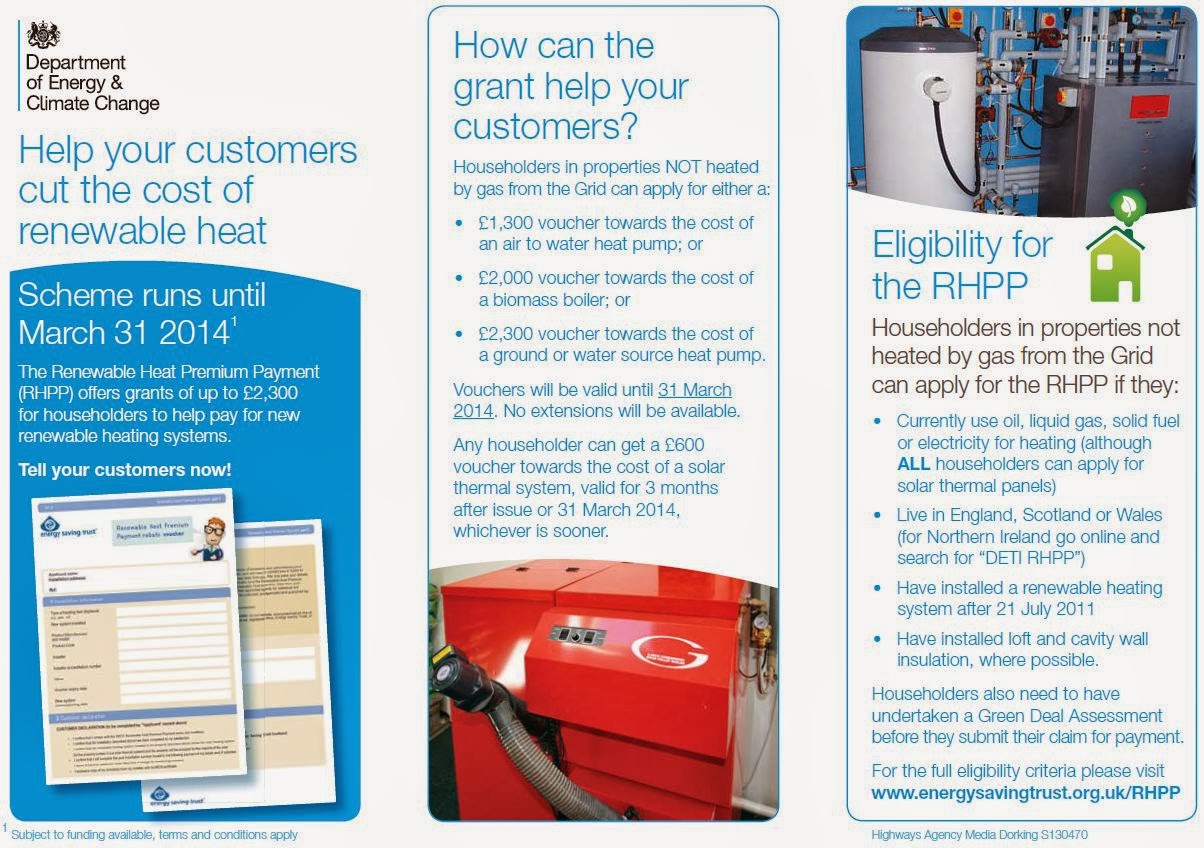
Last chance for off-the-gas-grid households who want to make the most of the Government’s one-off grant designed to help meet the costs of installing renewable technologies in homes across the country.

The Renewable Heat Premium Payment Scheme will close on March 31st 2014 and householders are encouraged to apply now before it’s too late. 

Grants of up to £2,300 are available for households to help pay for new renewable heating systems including biomass boilers and ground, water source or air-to-water heat pumps.

The cut-in date for this scheme is 21st July 2011 and participating households must have undertaken a Green Deal assessment.

Vouchers will be valid until 31 March 2014  when all required paperwork will need to be submitted for payment  to the Energy Saving Trust. No extensions will be available to this deadline.

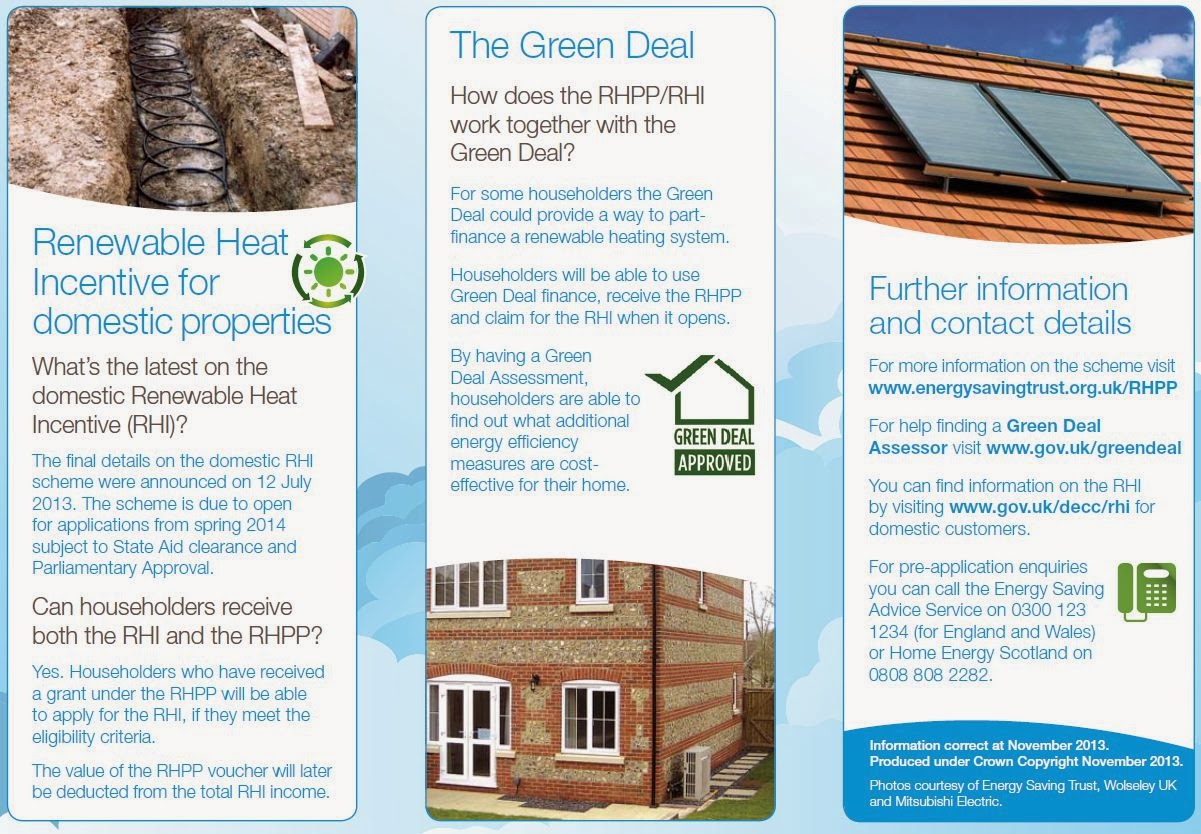
The following leaflet has now been developed to explain the benefit of applying in customer friendly language and where to go for more information.


Friday, 17 August 2012

RHPP Community Scheme: Open now for applications


If you are a community organisation looking for an opportunity to use bulk buying to bring down the cost of installing renewable heat in domestic properties in your area you may be eligible for the Communities Scheme

The Department of Energy and Climate Change Renewable Heat Premium Payment (RHPP) Community Scheme will support communities to deliver clusters of domestic renewable heating systems.

The RHPP Community Scheme aims to provide communities with the opportunity to cost-effectively organise local buying groups for renewable heating systems, potentially accessing bulk discounts and facilitating easier deployment for installers.

The Scheme will support installation of renewable heating systems in homes by providing vouchers to householders. It is targeted at making renewable heating affordable for middle to low income households and aims to maximise carbon reduction by reaching homes with high carbon heating systems that are expensive to run (especially those off the gas network) and ensuring that heating systems are installed after or alongside energy efficiency measures. Development support will also be provided to successful groups.

  • Technologies that are supported under the scheme include:
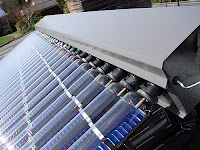
  • Solar thermal panels
  • Heat pumps (air to water, ground source or water source, excluding air to air and exhaust air heat pumps)
  • Biomass Boilers

When is the deadline?

Applications opened July 24th and will run until September 7th

Want to know more?

More detailed information, supporting documentation and an opportunity to apply can be found by accessing the Energy Saving Trust website.

Please read documentation before applying, should you have any questions please don’t hesitate to contact the communities team on 02920 467 015 or by emailing communities@est.org.uk.

Tuesday, 7 August 2012

Renewable Heat Premium Payment for Communities


Our friends at Oxford Renewables have kindly summarised the key points of the RHPP2 scheme (Renewable Heat Premium Payment) which focuses on community-scale projects.

Scheme Aims:

'The RHPP Community Scheme aims to provide communities with the opportunity to cost-effectively organise local buying groups for renewable heating systems, potentially accessing bulk discounts and facilitating easier deployment for installers... 

The scheme is targeted at making renewable heating affordable for middle to low income households... RHPP2 Communities Scheme also aims to maximise carbon reduction by reaching homes with high carbon, expensive heating system (especially for those off the gas network) and ensuring that heating system are installed after or alongside energy efficiency measure.'

Eligibility:

'...legally constituted community benefit organisations or community groups. all lead organisations must have a community benefit structure... aims to support low to middle income homes... communities connected to the mains gas network are... less likely to be funded'

Stage 1 application

'...will be open from 24th July to 7th September...communities should be able to explain what they would like to achieve, identify who they think they will need to work with, what they think they will be able to deliver successfully.'

Project Co-development stage:

'...Proposals will include details of the number of installations to be funded, level of funding required and details of the group will work with households and the private sector... there will be two sets of workshops to help groups through the process'

Stage 2 application:

Applicants wil be able to set their own value for household capital grants up to maximum levels across different technologies (equivalent between 10% and 40% of capital cost depending on how well your project meets the scheme criteria)... applications will be scored against the following criteria:

  • value for money
  • innovation and replicability
  • legacy and learning
  • deliverability

Implementation stage:

'...grants will be paid on completion of installations and themajority of the work will ned to be complete by 31st March. However, groups will be allowed to complete the last 35% of their installations by the end of June 2013 as long as 65% of their installations are complete and grant claimed by 31st March. 

Funding for renewable heat installations will be paid direct to householders on completion of their installation.

The scheme is being administered by the Energy Saving Trust - click here for full details.

Eligible technologies:


  • Solar thermal panels
  • Heat pumps (air to water, ground source or water source, excluding air to air and exhaust air heat pumps)
  • Biomass Boilers


Weblinks

1. Areas that are most likely to attract funding.

2. These are groups that have already received grants to determine available energy efficiency measures and that may be interested in this programme too.

3. Using this tool will help identify the area within which the community has to be located to attract the funding.

4. FAQs

5. Energy Saving Trust RHPP2 pages.

6. DECC policy web pages.

Tuesday, 24 July 2012

£8m Community Renewable Heat Scheme Opens


The successful Renewable Heat Premium Payment (RHPP) scheme has been extended to include an £8m fund for community led projects.

Community groups up and down the nation will be able to bid for a share of the fund to install low carbon heating technologies including solar thermal panels, biomass boilers and heat pumps into homes in their local area. 


Community-based organisations including community co-operatives, voluntary groups, social enterprises and development trusts will be eligible to apply.


Community groups will need to submit a first stage application to the Energy Saving Trust by 7 September 2012. 


Applications will be judged on a range of criteria, including the project’s vision, potential benefits for the local area, potential partners and any relevant experience of delivering similar projects.


The Department of Energy and Climate Change (DECC) expects to support between 50 and 100  projects with the £8million fund and will announce the winners in December this year.


Full details can be found on the Energy Saving Trust website.


The Kent Downs Woodfuel Pathfinder can provide free support for communities interested in biomass heating, both domestic and commercial. Please contact Matthew Morris on 01303 815 171 or matthew.morris@kentdowns.org.uk for more details.

Monday, 2 April 2012

RHI: consultation on interim cost control

DECC has launched a consultation on possible approaches to cost control for the RHI.

The document focuses on the amount of notice that would be provided and is largely informed by the difficulties that were caused by short-notice changes to the Feed in Tariff.  The proposals range from one month, one week and no notice.
The document also clarifies the structure of the RHI budget.  It is interesting to note that each year has a fixed budget and any underspend will not be carried over to the next year. 
As of 18th March 2012 298 applications hd been received, of which only 11 have been accredited.  Based on the current level DECC expects that spend in 2011/12 will be approximately £2m, which is somewhat short of the £56m allocated to 2011/12 (although this includes £25m for RHPP Phase 2).
Based on this uptake DECC suggests that the proposed interim cost control measure would not be needed and suspension would not occur.
However, based on our recent interaction with installers there is likely to be a step-change in the number of new applications over the next quarter as both new systems and post July-2009 projects are submitted.
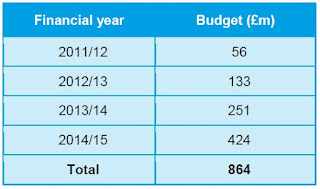
Annual RHI budget (Source: DECC)
Predicted budget allocations for 2012/13 are:
  • £15m - from installations already accredited
  • £40m - new installations coming on stream


The main points from the consultation are as follows:
  • The Renewable Heat Incentive continues to be a top priority for Government as a means to reduce our carbon emissions and because it is central to delivering our strategic framework for heat. It is therefore essential that the RHI policy is sustainable and that we have the ability to ensure that year to year spending does not exceed available funding.
  • This consultation sets out a proposed interim cost control measure that would suspend the RHI until the next financial year should estimated spending reach a level where the budget could be breached.
  • Only new applications would be affected. Accredited installations already receiving the RHI tariff from Ofgem would continue to receive that tariff. Applications submitted to Ofgem prior to the suspension would be processed as normal.
  • Current application levels are low relative to the available budget and if these levels were to continue the proposed interim cost control measure is unlikely to be needed. However, there is a high degree of uncertainty about how the market will respond and we need to be prepared for unexpected changes in uptake. Having this interim approach set out in advance will ensure that Government is able to respond quickly if required and that stakeholders will be sighted on future action.
  • The proposed circumstances under which suspension would occur will be specified in the RHI regulations and will include a predetermined trigger that would set off suspension and a fixed notice period before the suspension begins.
  • We intend to frequently publish the data being used to monitor progress towards the trigger. This will allow the market to make informed decisions about the likelihood of suspension.
  • We are proposing this policy as an interim measure. Over summer we plan to consult on a longer-term flexible degression-based mechanism which would automatically reduce tariffs should spending against the overall budget or deployment of certain technologies exceed forecasts.
Friday, 30 March 2012

Renewable Heat grant scheme extended

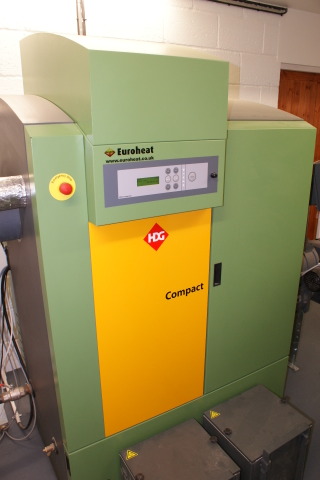
HDG chip boiler installed by North Downs Wood and Heat
On 26 March, DECC announced a second phase to the Renewable Heat Premium Payment scheme, which will provide further short term support for installations of renewable heat technologies in the household sector.

The new phase of the scheme will run in Great Britain and again focus on houses not heated by mains gas. As with phase 1, there will be two parts to the scheme: a voucher for private householders and a competition for social landlords. Consideration is being given to the introduction of a Community Competition.

Statistics for the RHPP indicate that 785 biomass boiler grants have already been issued.   The second phase of the scheme, worth £25m (£10m more than the first phase), should provide even greater support for the installation of renewable heat technologies in the household sector.

The RHPP runs in parallel with the Renewable Heat Incentive (RHI), the World's first financial incentive for renewable heat.  This is open for commercial heat installations (which includes multiple domestic properties connected to a central biomass boiler).

RHPP Phase 1

This phase of the scheme will run until 30 March 2012. Applicants should note that the on-line application form will be removed from the Energy Saving Trust website during working hours on 30th March 2012. Regardless of when customers applied for or received their voucher, and in order to be eligible to receive their grant, all completed claims must arrive at the address printed on the voucher (Energy Saving Trust, Edinburgh) before midnight on 31st March 2012.

As part of the scheme, DECC and EST ran a competition for social housing providers to part-fund projects to install renewable heating. See below for a list of the winners who were awarded funding.

RHPP Phase 2

Under the new voucher scheme, homes not heated by mains gas will be able to apply for grants for air-to-water-source and ground and water source heat pumps, biomass boilers and solar thermal. All householders can apply for grants for solar thermal. There are minimum energy efficiency criteria, and householders must agree to complete customer questionnaires, as well as making provision for the installation of a meter to monitor their energy use and performance of their heating system.