Showing posts with label Kent. Show all posts
Showing posts with label Kent. Show all posts
Tuesday, 12 August 2014


Friday, 15 March 2013
MULTIFOR woodfuel conference - free places available for selected delegates
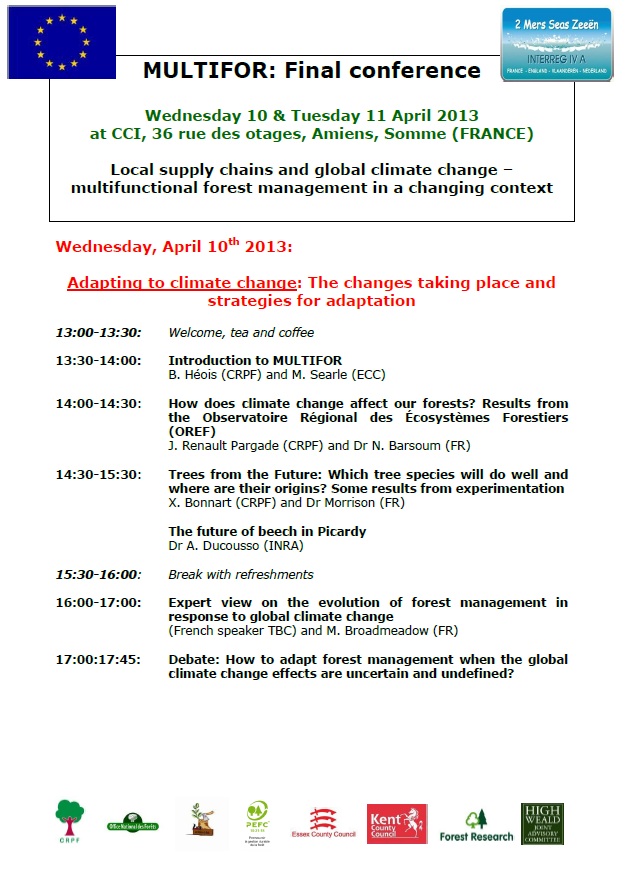
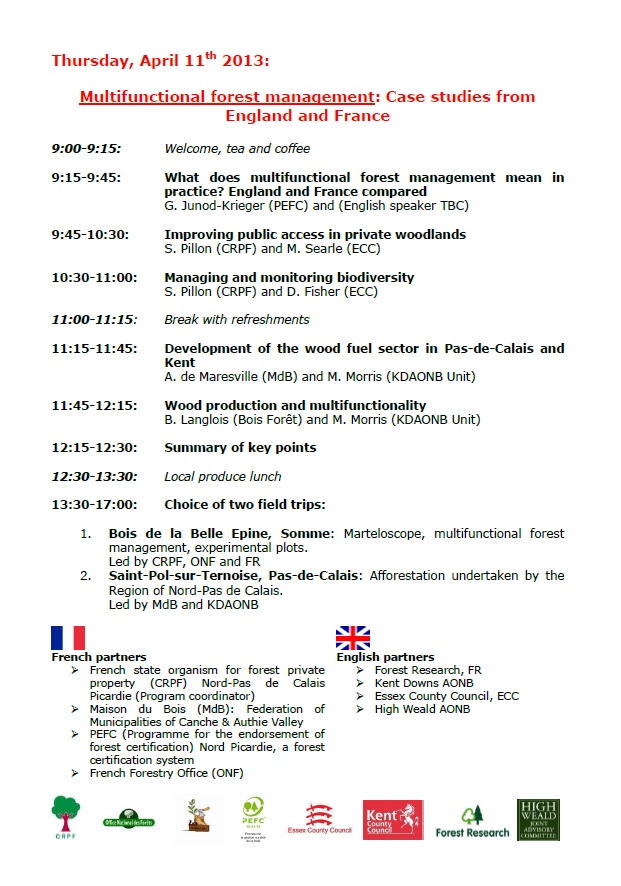
The final conference for the MULTIFOR (Multi-Functional Forestry) project will take place in Amiens in France on April 10th and 11th.
This EU ERDF funded project has been active since 2010 and has explored a range of topics ranging from woodfuel (hence the Kent Downs Woodfuel Pathfinder), adaptation of forestry management in a changing climate and improving public access in private woodlands.
The conference will include speakers from a range French and English organisations involved in both research and the practical application of new approaches that promote multi-functional woodland management.
The Pathfinder project can fund a limited number of delegates (maximum 15).
This includes travel (by coach) to and from Amiens and overnight accommodation and breakfast (lunches will be provided by the conference organiser).
If you are interested in attending please call Matthew Morris on 01303 815 171 as soon as possible to discuss.
To qualify for a funded place it is preferable that you:
Full details of the conference are below. Please do note hesitate to call to discuss attending the conference (01303 815 171).
This EU ERDF funded project has been active since 2010 and has explored a range of topics ranging from woodfuel (hence the Kent Downs Woodfuel Pathfinder), adaptation of forestry management in a changing climate and improving public access in private woodlands.
The conference will include speakers from a range French and English organisations involved in both research and the practical application of new approaches that promote multi-functional woodland management.
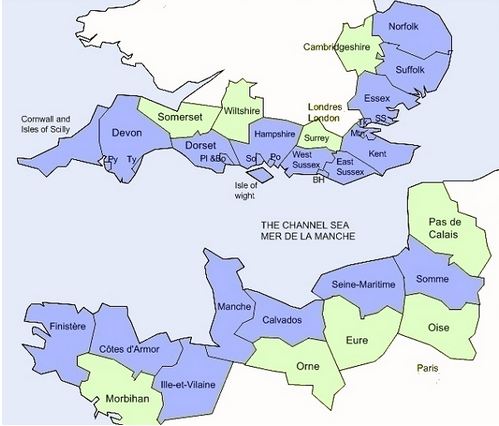 |
| Interreg IV A Eligible Area |
This includes travel (by coach) to and from Amiens and overnight accommodation and breakfast (lunches will be provided by the conference organiser).
If you are interested in attending please call Matthew Morris on 01303 815 171 as soon as possible to discuss.
To qualify for a funded place it is preferable that you:
- Have a demonstrable connection with woodland management, woodfuel, climate change in forest ecosystems, public access in woodland or multi-functional woodland management in general.
- Work in the eligible area for the Interreg IV A 'two seas' programme (see map above)
- Can commit to attending the conference on April 10th and 11th.
Full details of the conference are below. Please do note hesitate to call to discuss attending the conference (01303 815 171).
Friday, 30 March 2012
Asian Longhorn Beetle found in Kent
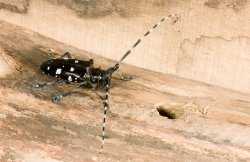 |
| Asian Longhorn Beetle |
This is the first time an outbreak of this pest has been found in the UK, and it is being treated extremely seriously. Fera and the Forestry Commission are taking urgent steps to try to eradicate the outbreak before it has the chance to spread further afield.
Several larvae of the beetle were found inside a poplar tree during a routine survey by the Forestry Commission at a site in the Paddock Wood area. Scientists from the Commission's Forest Research agency had been monitoring an area around the site where an adult beetle had been found in 2009, and this is the first evidence of infestation. It is thought the beetles originated from wood packaging used to import stone from China at an adjacent industrial site.
The beetle is not native to the UK, and poses a serious threat to a wide range of broadleaved trees and shrubs such as maple (including sycamore), elm, horse chestnut, willow, poplar, birch and some fruit trees.
Speaking about action to eradicate the outbreak, Martin Ward, Head of Plant Health Policy at Fera, said,
“Our plant health inspectors and the Forestry Commission are
conducting a survey to determine the extent of this outbreak. They will be
contacting all those within the survey area over the next few days and weeks
with a view to inspecting all potential host trees for signs of the beetle. In
the meantime we would urge members of the public, local businesses and
landowners to be on the alert for the beetle and let us know if they find
anything.”
Adult beetles are large (about 20 - 40 mm long) and shiny
black with variable white markings. Their antennae are particularly
distinctive, being much longer than their bodies (up to twice the body length)
and are black with white or light blue bands. The larvae of the beetle feed
undetected on the inside of the plant, and can kill it or leave it weakened and
susceptible to further pest and disease damage.
The most obvious symptoms of ALB damage are the circular
adult exit holes, which are about 10 mm in diameter and are generally found in
the main trunk and above. The adult beetles usually emerge from these holes
between May and October.
Dr John Morgan, Head of the Forestry Commission's Plant
Health Service, said,
“It’s difficult to say exactly what measures will need to be
taken until we have completed the initial survey work to determine the extent
of the outbreak. However, we will need to remove any trees found to be
infested, and it is possible that we will need to remove potential host trees
around the original site as a precautionary measure. Eradication measures to
treat outbreaks in the US and Italy have resulted in the loss of tens of
thousands of mature trees.”
Anyone who suspects they have seen an Asian longhorn beetle,
or evidence of its presence, should contact the Fera Plant Health Helpline on
0844 248 0071 or email planthealth.info@fera.gsi.gov.uk If possible, the beetle
should be caught and placed in a secure container so that an inspector can
collect it. The beetles are not harmful to humans, although they should be
handled with caution because they can nip the skin.
Subscribe to:
Comments (Atom)