Showing posts with label Woodland Trust. Show all posts

Monday, 9 March 2015

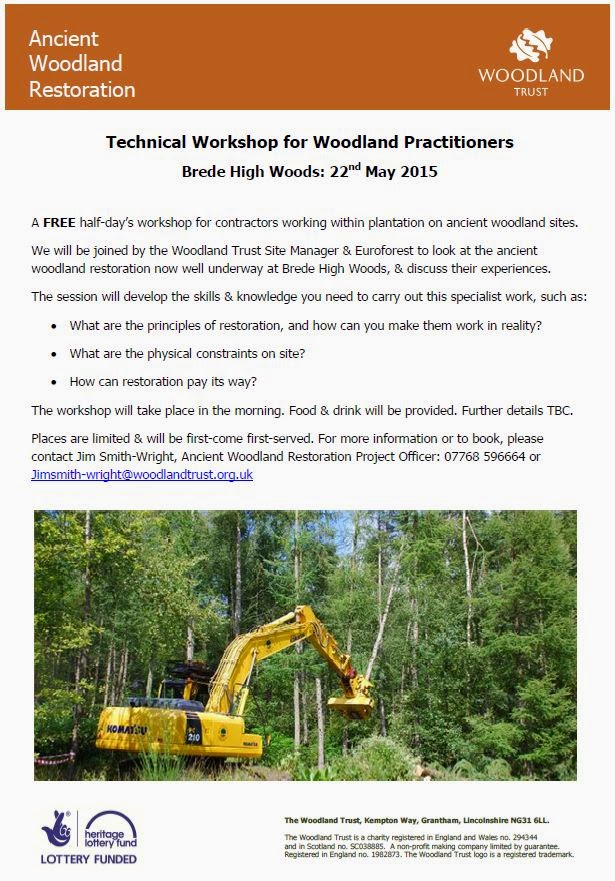
FREE Woodland Trust event - Technical Workshop for Woodland Practitioners

Another event for you - this time by the Woodland Trust on May 22nd.

All details are below.  Please contact Jim Smith-Wright for more details and to book places.


Tuesday, 12 August 2014

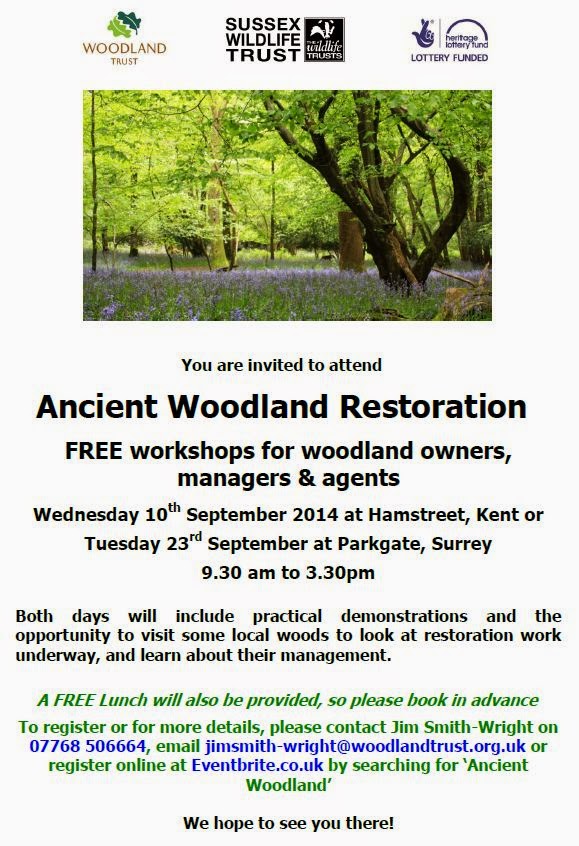
Ancient Woodland Restoration - FREE workshops


Monday, 24 September 2012

Healing Landscapes: trees and society twenty-five years on from the Great Storm


One day conference hosted by the Department of Geographical and Life Sciences, Canterbury Christ Church University.

Saturday 20th October 2012, from 10.00 in the Powell Building.

October 2012 is the 25th anniversary of the ‘Great Storm’ that toppled some 15 million trees in southern and SE England. 

This one day conference uses the anniversary to celebrate the legacy of the storm and the importance of trees to society, especially their impact on education, community, health and well-being.

The conference also celebrates the planting of the Jubilee Orchard at the Canterbury campus as part Canterbury Christ Church University’s 50th Jubilee celebrations. 

The orchard is part of the ‘Bioversity’ initiative to foster the green spaces of St Augustine's Abbey as part of the Canterbury World Heritage Site. The orchard is registered as part of the national NHS Forest.

The conference is open to all students and staff and to members of the public and registration is FREE. 

We need to know numbers for refreshments, seating, etc., so you MUST register with the Department of Geographical and Life Sciences.

To register for the conference please ring Jaimie Morris or Maria Hamilton on 01227 782331/782337 or email maria.hamilton@canterbury.ac.uk


Programme

10.00 Welcome and introduction

Session 1: Healed landscapes? Twenty-five years since the Great Storm

10.15-10.45 Releasing history – the Great storm and the history revealed.  
Andrew Richardson, Finds Manager, Canterbury Archaeological Trust.

10.45-11.15 The Great Storm - tree and fungi responses to the hurricane 
Ted Green, Ancient Tree Forum

11.15 – 11.35 Refreshment Break

11.35 – 12.05 The Great Storm and UK woodlands

12.05 – 12.35 Windthrow trees, Nature’s survivors: East Kent case studies 

12.35 – 13.25 LUNCH

Session 2: Healing landscapes – trees, society and well-being

13.25 – 13.55 Forest schools – saving our children from nature-deficit disorder
Clair Hobson Earthcraftuk, Kent / Executive Board Member of the Forest School Association

13.55 – 14.25 A sense of place - community woodlands as local resources
Jenny Tippen, Chair of Ashford Community Woodland

14.25 – 14.45 Refreshment Break

14.45 – 15.15 The Woodland Trust – ‘Creating woodland together’
John Harvey, Woodland Trust, Kent

15.15 – 15.45 England’s Community Forests – involvement, inclusion, environmental regeneration and green infrastructure creation
Ann Bartleet, Chair of Thames Chase Trust, Community Forests

15.45 – 16.00 End of conference.
Tuesday, 11 September 2012

Survey of woodland owners – your views please!

The BritishWoodlands2012 survey is run by the Sylva Foundation and supported by Natural England. We'd also like to hear from farmers and other land managers who are considering creating woodland on their land.

The survey asks about motivations for woodland management, planting and support.

The survey builds on work that has been carried out by Cambridge University‟s Department of Land Economy on five occasions over the last 50 years. Their most recent survey report from 2005 provides some context for a current project entitled "Private Woods in Crisis?"


We hope the survey will help us to:

  • gauge the current level of sustainable forest management in British privately-owned woodlands
  • assess the potential for woodland creation
  • assemble evidence of the level of public benefits that are delivered from private woodlands
  • find out why some woods remain unmanaged
  • provide ideas to contribute to improvements in grants and to grow the domestic timber markets

The survey should take about 20-30 minutes to complete. All data will be treated with the utmost confidentiality. Results will be presented in an amalgamated version only and will be used to help inform us about how we can best support the woodland and forestry community.

People who take the survey will be invited to a woodland conference at Oxford University to be held in December 2012 at which the results of the survey will be discussed. 

The survey is supported by Royal Institute of Chartered Surveyors, Forestry Commission, Woodland Trust, Natural England and the Institute for Chartered Foresters.

For further information contact Chris.Reid@naturalengland.org.uk

We are encouraging woodland owners, managers and agents to complete the new online questionnaire survey by 30 September 2012.


Monday, 23 April 2012

Tree planting good for cereal yields


Picture courtesy of Mike Townsend

A new report commissioned by the Woodland Trust and written by Harper Adams University highlights the value of tree shelter belts to farmers in combating the effects of drought.

The report, Managing the drought - A review of the evidence of the benefits of native trees species for shelter on the water regime of pasture and arable crops, pulls together studies from UK and other temperate agriculture systems to show how trees planted as shelter belts help to reduce wind speeds, meaning water loss through evapotranspiration is slowed. This allows the sheltered crop to retain more water and use it efficiently.
In the UK such shelter belts are relatively uncommon, but studies have shown cereal yields of sheltered crops can be higher than that for unsheltered crops, particularly in years when the weather is hot and dry.

Mike Townsend, Woodland Trust Conservation Advisor said, "This report makes it clear that tree shelter belts could be of real value in the development of sustainable agriculture, especially as we face a changing climate and growing demand for food.
"Naturally, trees will compete for water and nutrients, reducing crop yields directly adjacent to the shelter belt. However, these reductions typically only occur up to a distance of one to two tree heights away. Any loss after that point is significantly outweighed by the increase in yield achieved by more efficient water use.

"More research is needed, but this is promising start and shows that good farmers should indeed consider planting more trees." 
Read Mike Townsend's blog for more detail on the report.

Friday, 13 April 2012

Royal Forestry Society - Hucking Estate free event