Showing posts with label chalara fraxinea. Show all posts

Monday, 15 June 2015

New guidance on Ash dieback in SSSI woodland

Natural England has released new guidance on Ash dieback.  

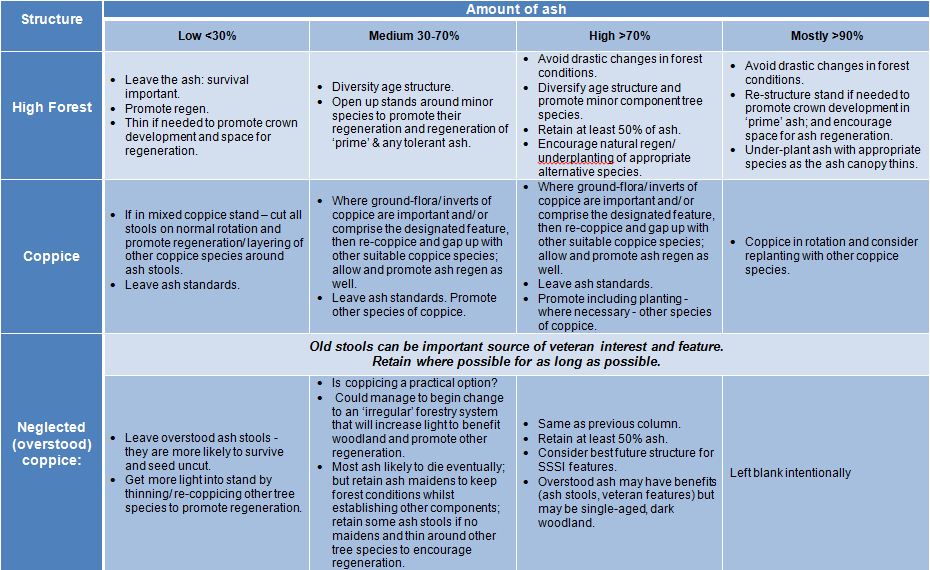
The guidance is specifically designed for SSSI woodland (Sites of Special Scientific Interest) and focuses on a set of commonly asked questions:
  • Will all my ash trees die? 
  • Should diseased trees be felled? 
  • Should I fell healthy trees now? 
  • How can I manage the structure of my wood? 
  • Should ash coppice or pollards be cut? 
  • How will the designated features be affected? 
  • How should replacement trees be established? 
  • What replacement species can be used? 
  • What should I do about sycamore? 
  • Will my wood be classed as “unfavourable”?

Over half of the woodland and wood-pasture SSSIs in England contain significant amounts of ash. As nationally important areas for the conservation of biological diversity, it is vital that the impact of ash dieback disease on the SSSI ‘features of interest’ is managed to reduce negative effects where this is possible. 

Whilst various suggestions are made in the guidance Natural England points out that there is only limited experience of implementing many of these in the UK ash dieback scenario. Therefore there is a need to trial different management strategies, monitor their effectiveness, and continue to share practical experience.

It is also very important that this guidance, and the of the Forestry Commission, is tailored to the specific conditions on each site, including: 

  • the current proportion of ash and other trees and shrubs present
  • the woodland structure
  • existing issues and challenges acting on the wood
  • its context in the surrounding landscape
  • the SSSI features of interest
  • the owner’s objectives
  • public access and safety
The advice has been summarised in the table below.  The full document can be downloaded here.


Tuesday, 17 June 2014

New report assesses alternative tree species to Ash

We have been closely following Ash dieback over the last two years and have spoken to many woodland managers and stakeholders about the impact of the disease.

One of the most frequently asked questions relates to how woodlands will adapt to the disease, and in particular which tree species will make effective replacements.

Until recently our response to this question was fairly limited and was based on a few species such as small leaved lime.

It is therefore very timely that Natural England has released a new report that may help guide practitioners in the selection of alternative tree species that are ecologically similar to Ash.

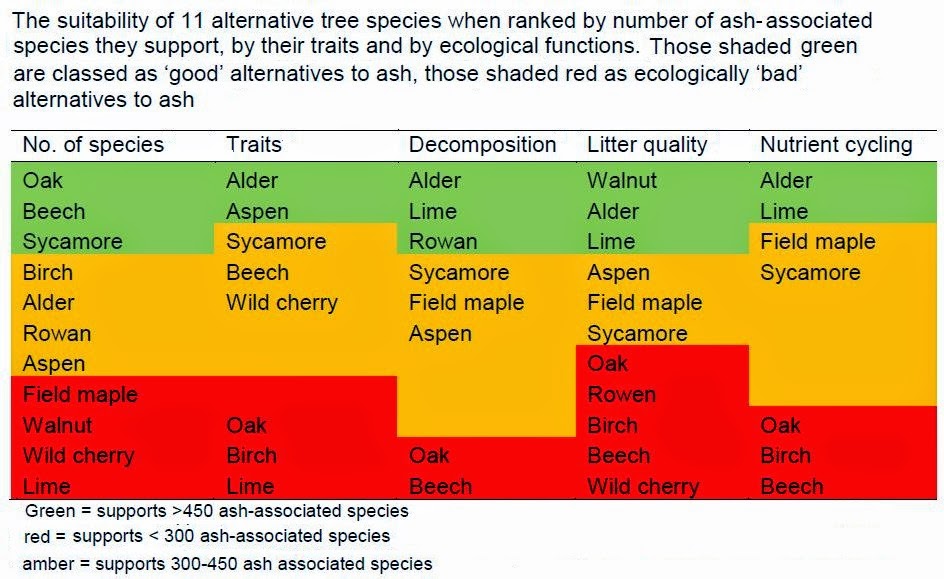
The report (Assessing and addressing the impacts of ash dieback on UK woodlands and trees of conservation importance) examines the ecological function of 11 tree species considered most likely to replace ash across the UK. 

It also provides a range of case studies showing how existing management plans may be adapted to conserve ash-associated biodiversity should significant ash dieback occur.

In this post we have attempted to summarise the main findings of the report to assist with the dissemination of the findings.  If proactive management action is being considered we recommend reading the report in full.

The eleven tree species looked at were:


The ecological similarity of these alternative to Ash was assessed by considering three main factors:
  • their ecological functioning
  • the number of ash-associated species they support
  • their traits
Ideally any alternative tree should be similar to ash in all of these characteristics.

Ecological functioning

Ash lies at an extreme of the ecological range of native tree species in the UK. It produces nutrient-rich highly degradable litter that does not form a deep litter layer and which maintains a high soil pH.

For ecological functioning the  11 alternative species were assessed in terms of leaf litter decomposition rates, litter quality (chemical and physical properties), nutrient cycling and succession rates.

A change from ash to a tree species with very different ecosystem functioning (e.g. oak or beech) will result in changes in the characteristics of the woodland: slower nutrient cycling, increased carbon storage and changes in the ground flora species present.

Ash-associated species

Around 1,000 species are known to 'use' Ash trees and tree species native to the UK support more ash-associated species than non-native tree species.

Native oak species were found to support the greatest number of ash-associated birds, invertebrate, lichen and mammal species.  

Elm, hazel, oak, aspen and sycamore were found to support the greatest number of the ash-associated species that are most vulnerable to ash-dieback. However elm remains susceptible to Dutch elm disease and is therefore not widely suitable as an alternative to ash.

Traits of alternative tree species

The traits of trees such as tree height, bark pH and fruit type indicate, in part, the type of habitat created by a tree species and the resources available to species that use the tree. Ideally the traits of any alternative tree should be as similar as possible to ash.

Of the native tree species assessed elm had the most traits the same as ash followed by silver birch and rowan.

Results

The study found that the alternative tree species that support the greatest number of ash-associated species are very dissimilar to ash when assessed by traits and ecological function. 

  • Oak supports 640 of the 955 ash-associated species and beech supports 505 ash associated species.
  • However, in terms of ecological function, oak and beech have much slower rates of leaf litter decomposition and nutrient cycling than ash and their canopies cast a much darker shade which will influence the ground flora species.
  • Alder is similar to ash with respect to ecological function (leaf decomposition rates, litter quality and nutrient cycling) but supports fewer ash-associated species (389 out of 955)
As such the method that is most suitable to assess how similar the alternative tree species are to ash will depend on the objectives at the site, for example maintaining ash associated species or maintaining the woodland character and ecological function.

Management scenarios

Six management scenarios that could be applied to woods infected with ash-dieback were considered over two time periods (1-10 years and 50-100 years). The scenarios were:
  1. Non-intervention – stands are allowed to develop naturally with no interventions.
  2. No felling with natural regeneration promoted – no felling but otherwise stands initially managed for natural regeneration.
  3. Felling – all ash trees and coppice removed in one operation with, if necessary, additional trees of other species cut to make the operation more viable.
  4. Felling and replanting – all ash trees and coppice removed in one operation with, if necessary, additional trees of other species cut to make the operation more viable. Then active management to replant with alternative tree and shrub species.
  5. Thinning – regular operations to thin stands by removing diseased and dead trees or coppicing ash, with, if necessary, additional trees of other species cut to make the operation more viable.
  6. Felling with natural regeneration promoted – all ash trees and coppice removed in one operation with, if necessary, additional trees of other species cut to make the operation more viable. Then active management initially to achieve natural regeneration in the stand, with subsequent management to develop overstorey species.
In the short term (1-10 years) more ash-associated species were supported under scenario (5) ‘thinning’ than scenario (6) ‘felling with natural regeneration promoted’.

In the long-term (50-100 years) there was little difference between scenarios (5) and (6) in their impact on obligate and highly associated ash species with of these species predicted to decline in abundance or be at risk of extinction. 

However, the confidence level of these assessments is only low to medium suggesting that the actual impact on ash-associated species is currently only partially understood.

For species 'partially associated' the assessment is somewhat brighter:
  • Species partially associated with ash are generally predicted to decline initially following the onset of ash dieback but after 50-100 years the majority of partially associated species are predicted to be unchanged in abundance compared to current population levels due to an increase in the abundance of other tree species which they utilise.
Overall there is a clear difference in the response of highly associated species, which are predicted to either decline or go extinct and the majority of partially associated species which are predicted to remain unchanged in abundance after 50-100 years.

Conclusion

When woodland managers are considering which alternative tree/shrub species to regenerate or plant in order to mitigate the impacts of ash-dieback on biodiversity, the number of ash-associated species supported is only one factor to consider. 

Woodland managers should also think about other information provided in this report such as the impact alternative trees might have on ecosystem function and factors which will influence the occurrence of ash-associated species in the woodland, such as: woodland structure, food availability, the size, shape and number of holes in trees for roosting bats and hole nesting birds, interactions between species, and changes in woodland ground flora composition.

Ash dieback is just one of several diseases and other potential drivers of change within woodlands within the UK. Other tree diseases and drivers such as grazing, pollution and climate change will also need to be taken into account. 

Management for biodiversity will usually be considered together with the other objectives of woodland management including timber production, amenity, flood prevention and carbon sequestration.

Wednesday, 7 May 2014

Plant health - new grant and revised guidance from Forestry Commission

Source: Wikipedia
New support is now being offered by the Forestry Commission through a new Plant Health Woodland Improvement Grant (PH WIG) which brings together a number of previous plant health support mechanisms. 

Additionally the FC will be retaining Woodland Regeneration Grant (WRG) where the restocking is following defined Plant Health issues. 

The respective new and updated guidance is available via the following links:

Plant Health Woodland Improvement Grant

Woodland Regeneration Grant

Plant Health WIG

The PH WIG brings together elements of the following previous grant support:

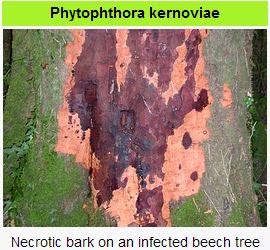
  • Removing Rhododendron within 3km of Phytophthora ramorum and kernoviae infections (which is mainly affecting south west England, although there is one reported outbreak site in Kent near Ashford).
  • Removing P.ramorum infected immature larch paying a site fee to cover the costs of professional help in implementing harvesting plans for P.ramorum infected larch

Source: Wikipedia
This new PH WIG also replaces elements of the previous WIG for removal of recently planted ash on Chalara fraxinea infected sites.

This grant is designed to cover the infections mentioned above and any subsequent plant health disease the Forestry Commission decides requires action that can be funded through EWGS.


Plant Health WRG

Due to the significant uptake of WRG in previous years and the need to maintain funding for other, higher priority, grant types, funding for WRG is
now limited to the 14/15 and 15/16 years to restocking sites related to plant health issues only. The revised guidance sets out: 
Source: Wikipedia

  • Revised eligibility requirements for WRG in relation to Plant Health payment rates and available claim years
  • Extension of the Plant Health related supplements to include Chalara infected sites

Thursday, 3 April 2014

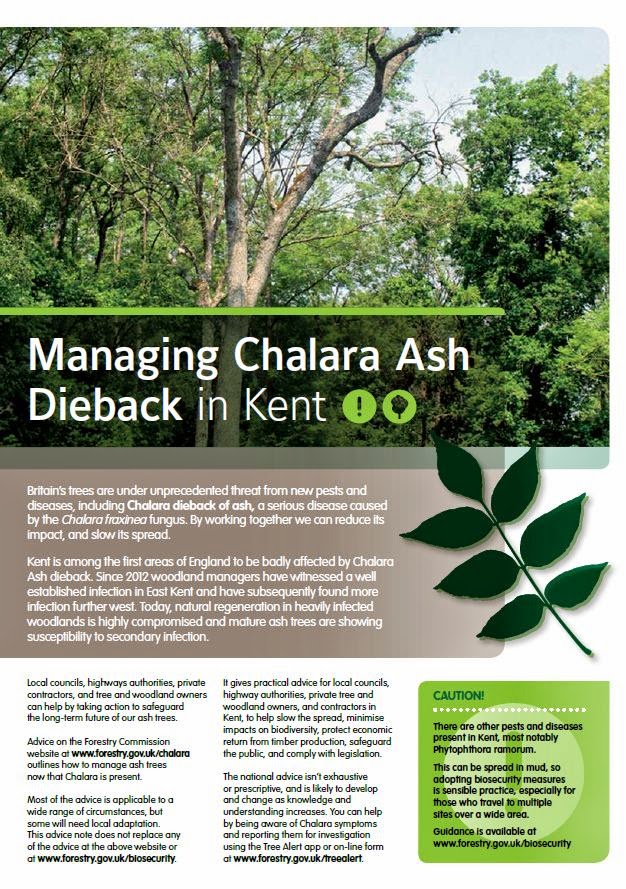
Kent’s tree experts lead on new guidance for Ash dieback

Britain’s trees are under unprecedented threat from new pests and diseases, including Chalara dieback of ash, a serious disease caused by the Chalara fraxinea fungus. 

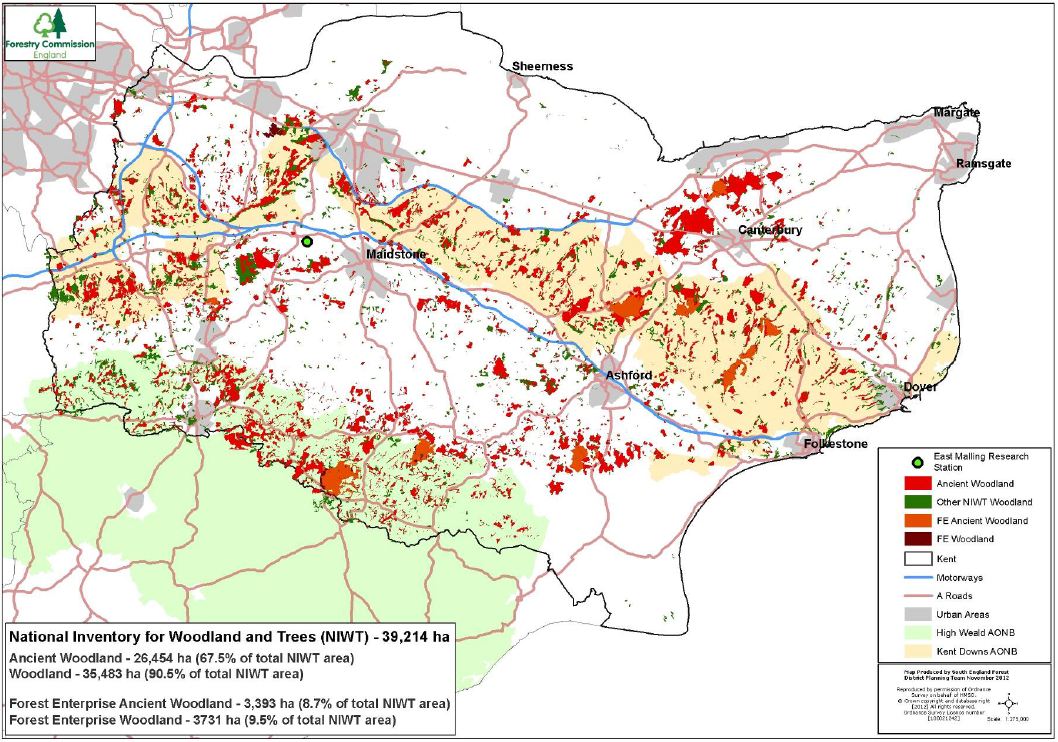
Kent is among the first areas of England to be badly affected by Chalara Ash dieback. Since 2012 woodland managers have witnessed a well-established infection in East Kent and have subsequently found more infection further west. 

Today, natural regeneration in heavily infected woodlands is highly compromised and mature ash trees are showing susceptibility to secondary infection.

Ash is the most common tree in Kent (almost a fifth of all trees).  This, combined with the observed rate of spread and the high level of infection already present, make eradication of Chalara impossible.

The Kent Downs AONB Unit has worked closely with partners in the Arboriculture Association, Forestry Commission and Kent County Council to produce a guide which offers practical advice for local councils, highway authorities, private tree and woodland owners, and contractors in Kent. 

The main aim was to provide practical advice that might help slow the spread of Ash dieback, particularly from woods in high infection areas in the east of Kent to other locations in the west of Kent, and beyond, where infection rates are currently low.  

Other objectives were to provide advice that minimise impacts on biodiversity, protects economic return from timber production and safeguards the public.

The guide provides a general overview of the disease and its current status before providing specific guidance for woodland managers and those managing tress in urban and sub-urban environments.  

It includes summary advice on how to manage infected ash trees in conservation areas and development sites, trees with preservation orders and ancient, veteran and heritage trees.  The guide also considers ash trees adjacent to highways, public open spaces and private property.


The guide was co-written by Jonathan Harding from the Forestry Commission, Dan Docker from Tunbridge Wells Borough Council, Mike Sankus from the Arboriculture Association and Tony Harwood from Kent County Council. 

The project was managed by the Kent Downs AONB Unit as part of the ADAFOR Interreg project, a cross-border forestry initiative that seeks to integrate knowledge and expertise to facilitate enhanced forest management and adaptation.

The guide is available to download for free our Google Docs folder.

For more information please contact:

Matthew Morris (Woodfuel Development Manager)
01303 815 171
Matthew.morris@kentdowns.org.uk


Tuesday, 3 December 2013

China bans import of Ash from Europe


AQSIQ Import ban notice
China has banned the import of ash (Fraxinus Excelsior) in log and sawn timber form from Europe.  This adds to the existing ban for the import of seeds and nursery stock.  

China has been a large importer of ash over the last few years this ban is significant for those involved in the trade.  

Whilst there are other important markets for ash, for example firewood, this immediate cessation of exports may have an impact on price for some parts of the supply chain.

Some commentators have suggested that woodland owners cease felling ash (for export) until the longevity of the ban is established.  

Other commentators, such as the Forestry Commission, have also suggested that woodland owners might consider delaying the felling of ash.  However, this is to prevent the loss of resistant trees rather than a temporary cessation of activity oriented towards export markets.


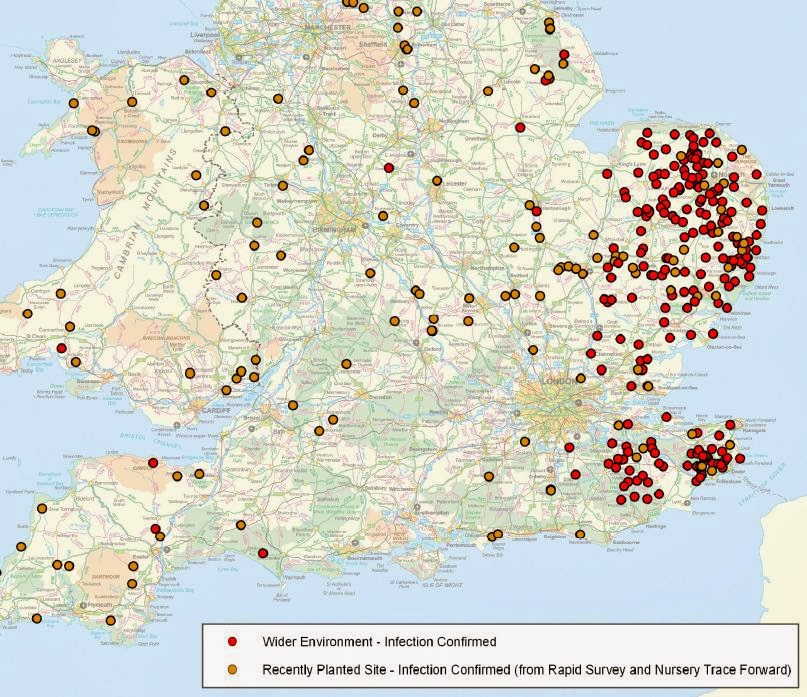
Ash dieback distribution (Source: Forestry Commission)
Interesting China recommends that local forestry administrations should reinforce surveillance of ash dieback and implement emergency response plans.  In Kent, where ash dieback is now widespread, local guidance is being prepared and County emergency planners have developed a response plan.

China's ban is immediate and will remain in place until the status of the epidemic allow the ban to be removed.  

Given that the impact of ash dieback is only beginning to be felt in the east of England and Kent it could be that China's plan stays in place for several years.

This could also be an opportunity for the UK.  If ash can no longer be exported easily from the UK this might be positive for those involved in indigenous supply and consumption.  This blog is not aware of the economics of timber for export to China but our guess is that ash firewood supplied locally is probably far more valuable (as is most firewood)!

Tuesday, 18 June 2013

Biomass CHP takes off in Kent (...and other news)

Many apologies for the lack of blogging of late.  We have been busy with various projects following the MULTIFOR conference in April (more on this soon) and are busy preparing for a new phase of activity.  We hope to get back up-to-speed over the next few weeks.  In the meantime here is a quick round up of recent events.


Firstly, more good news from Berties Woodfuel at Hadlow.  Not content with winning 'Start up Business of the Year in the 2012' from Kent Excellence in Business Award Berties is now in the final stages of the Business Accelerators scheme.  Our congratulations go to Peter and his team.  More details can be found here.


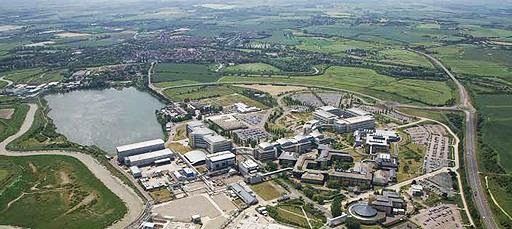
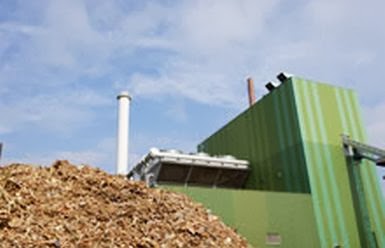
Estover Energy, has confirmed its plans to build a 10 MW biomass CHP (combined heat and power) on the former Pfizer site at Sandwich.  The project at Discovery Park will provide around 10 MW of electricity and 20 MW of heat and will supply all of the heat and electricity needed on-site.  It will also export power to the grid.  Estover has already gained approval for two plants in Scotland and one in North East England.  

Estover's supply manager, Ben Heathcoat Amory, has provided us with a briefing on the Sandwich project and its likely implications for  wood chip supply chains in Kent and Sussex.  

Discovery Park - Sandwich
Public exhibitions are taking place this week (w/c June 17th) and the planning application with be submitted soon afterwards.  More details can be found here.


Biomass plants are a bit like buses - they all arrive at the same time!  In the same week that Estover announced their plans, STEAG New Energies announced that they have been given planning permission for a waste wood biomass CHP plant at Ridham Dock in Sittingbourne.  The plant will  produce 25MW of power and up to 10MW of heat.

The implications for biomass supply chains as a result of these new developments is potentially significant. The Estover plant will require around 100,000 tonnes of low-grade wood chip a year and the STEAG plant will burn approximately 160,000 tonnes of waste wood a year.  

STEAG biomass CHP plant
Given that only 46% of Kent's woods are actively 'worked' the Estover plant should create sufficient new demand to stimulate management in many under-utilised woods.  

The Pathfinder project will maintain contact with Estover with the aim of developing a programme of support for the supply-chain focusing on topics including sustainability, harvesting best practice, deer management and bio-security.

Finally, we would like to remind readers about Ash dieback (Chalara Fraxinea).  On various site visits recently we have noticed that many of the Ash woods are infected with Chalara, particularly those we have visited in the East Kent Downs. 

 In addition to weak foliage in the canopy there is clear evidence of the disease in coppice re-growth, natural regeneration and recently planted sites (<10 years).  

The latest information and guidance from the Forestry Commission can be found here.

Friday, 21 December 2012

Latest forest Inventory reports published


The Forestry Commission have released the latest National Forest Inventory (NFI) which estimates quantities of broadleaved species in British woodlands.  Due to the outbreak of ash dieback (Chalara) this edition of the NFI has a special focus on ash.

The NFI provides a record of the size and distribution of forests and woodlands in Great Britain and information on key forest attributes. 
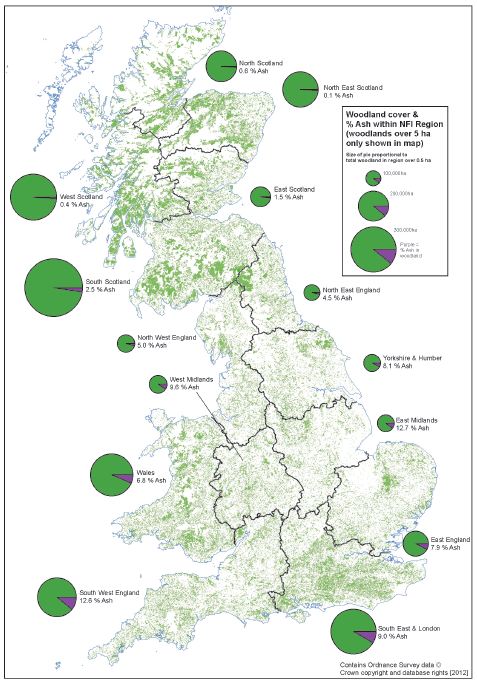
Total woodland cover with
proportion of ash by NFI region

This report provides estimates of the stocked area, numbers of trees and standing volume in living broadleaved trees within forests and woodlands in Great Britain as at 31 March 2011.

The report provides a particular focus on the ash species, expressing estimates of quantities of ash in the context of quantities of all broadleaved species. 

Information in this report includes estimates for England, Scotland and Wales, and individual regions within England and Scotland, each broken down by Forestry Commission and private sector ownership. 

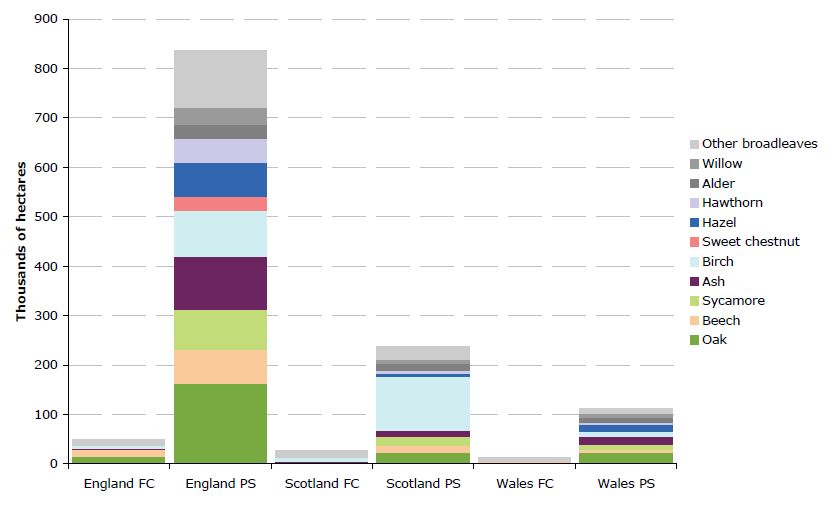
Stocked area by principal broadleaved species
Estimates are also provided for individual age and size classes of the broadleaved and ash tree populations.

More detailed reports and analysis can be found on the Forestry Commission website here.

Key Findings

  • The estimated stocked area of broadleaves within Great Britain is 1.3 million hectares
    • 142 thousand ha is ash (or 11% of all broadleaves and 5% of all species (both conifer and broadleaves).
  • There are 1.4 billion broadleaved trees in British woodlands of over 0.5 hectares (of which ash trees are estimated to number 126 million)
  • In addition, there are an estimated 4.2 billion broadleaved seedlings and saplings in British private sector woodlands
    • of which ash constitutes an estimated 39%.
  • Total broadleaved standing volume on the private sector estate is estimated to be 227 million m3
    • the estimate for the Forestry Commission estate is 13 million m3.
  • Ash accounts for approximately 14% of total broadleaved standing volume in Great Britain.
  • Ash tends to be younger and marginally smaller than broadleaved species as a whole:
    • Trees aged between 20 and 100 years account for most broadleaved standing volume; while for ash very little is over 80 years of age.
Information on the amount and distribution of ash trees outside NFI woodland can be found on the Countryside Survey website. This report includes small copses of less than 0.5 hectares, linear features containing trees less than 5 metres in width (including hedgerows and lines of trees) and individual trees (including some veterans).

The key findings from this report are as follows:
  • Key Findings The estimated area of ash in Broadleaved woodlands <0.5ha in size is 21.69 000ha.
  • Ash is found in different landscape components, in fields and field boundaries, alongside rivers and streams and particularly in hedgerows.
  • Ash is the fourth most abundant tree species in small woodland patches (<0.5ha) in GB after Oak, Birch and Hawthorn.
  • It is more abundant in England (12.1 000ha) than Scotland or Wales but in England Sycamore and Beech are also abundant.
  • There are estimated to be 2.7 million individual ash trees (outside of woodland) in the countryside and ash is the 2nd most common species of individual tree.
  • Most ash trees tended to be in low to mid-range DbH categories i.e. >40% between 21 and 50cm DbH.
  • There were very few veteran ash trees.
  • Ash is the most common hedgerow tree species (i.e. species growing as a full standard as part of a hedgerow).
  • The estimated length of woody linear features (hedgerows and lines of trees) composed of ash is 98.9 000km across GB with most of this (86.1 000 km) found in England.
  • In analyses based on repeated vegetation plots ash trees increased in number of plots occupied on linear features, which include hedgerows, between 1978 and 2007 and in the number of area (field) plots occupied between 1990 and 2007.
Kent Tree Health Information Day

Status at 11/12/2012

Over 200 people attended the Forestry Commission's Tree Health Information Day on December 18th where a detailed briefing on Ash dieback (Chalara Fraxinea) was delivered to forestry professionals from Kent and the wider South East.

The detailed presentations from a range of tree experts included an update on the scientific understanding of Chalara, the current status of the outbreak in the UK and the control plan that was recently introduced by Defra.

The full list of presentations, which can be found on the Forestry Commission website, were as follows:

  • Simon Hodgson - Introduction
  • Dr Joan Webber - Science Update
  • Bruce Rothnie - Chalara, where we are now
  • Martin Ward - Tree Health & Plant Biosecurity
  • Andrew Smith - The Chalara control plan
  • Dr Gary Kerr - Trees in the Landscape, silvicultural guidance on adapting to chalara
  • Jim Quaife - Trees in the built environment

This event was one of two information days delivered by the Forestry Commission during December, the other being in East Anglia where the other significant outbreaks of Chalara are located.

The event provided a chance for forestry professionals to engage with tree health experts and seek guidance on managing affected woodlands.


The Kent event also included an exhibition involving a range of related organisations, including:

Thursday, 15 November 2012

Video: How to identify Ash dieback (Chalara Fraxinea)

Well worth watching this short video if you need to know more about how to spot Ash dieback.  

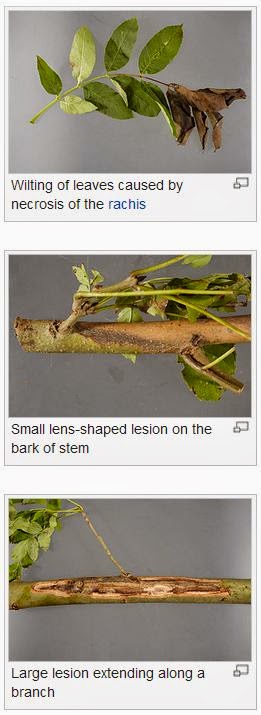
Now that it's autumn, you will need to look for the characteristic lesions of dieback, rather than for leaf symptoms.


The latest outbreak map from the Ashtag project is shown below.

Courtesy of www.ashtag.org on Nov 15, 2012.


The lastest