Showing posts with label phytophthora. Show all posts

Wednesday, 7 May 2014

Plant health - new grant and revised guidance from Forestry Commission

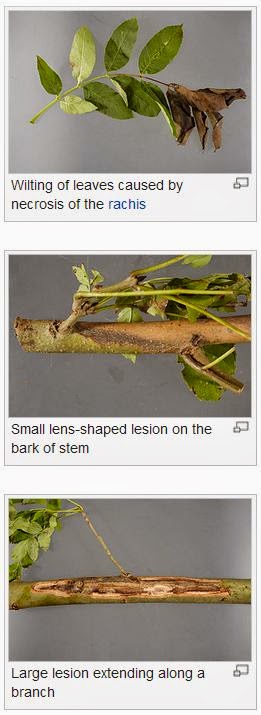
Source: Wikipedia
New support is now being offered by the Forestry Commission through a new Plant Health Woodland Improvement Grant (PH WIG) which brings together a number of previous plant health support mechanisms. 

Additionally the FC will be retaining Woodland Regeneration Grant (WRG) where the restocking is following defined Plant Health issues. 

The respective new and updated guidance is available via the following links:

Plant Health Woodland Improvement Grant

Woodland Regeneration Grant

Plant Health WIG

The PH WIG brings together elements of the following previous grant support:

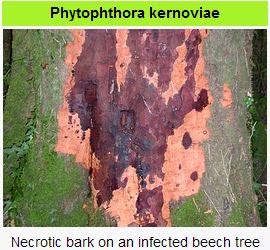
  • Removing Rhododendron within 3km of Phytophthora ramorum and kernoviae infections (which is mainly affecting south west England, although there is one reported outbreak site in Kent near Ashford).
  • Removing P.ramorum infected immature larch paying a site fee to cover the costs of professional help in implementing harvesting plans for P.ramorum infected larch

Source: Wikipedia
This new PH WIG also replaces elements of the previous WIG for removal of recently planted ash on Chalara fraxinea infected sites.

This grant is designed to cover the infections mentioned above and any subsequent plant health disease the Forestry Commission decides requires action that can be funded through EWGS.


Plant Health WRG

Due to the significant uptake of WRG in previous years and the need to maintain funding for other, higher priority, grant types, funding for WRG is
now limited to the 14/15 and 15/16 years to restocking sites related to plant health issues only. The revised guidance sets out: 
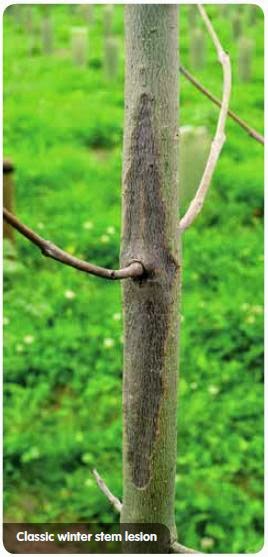
Source: Wikipedia

  • Revised eligibility requirements for WRG in relation to Plant Health payment rates and available claim years
  • Extension of the Plant Health related supplements to include Chalara infected sites

Thursday, 3 April 2014

Kent’s tree experts lead on new guidance for Ash dieback

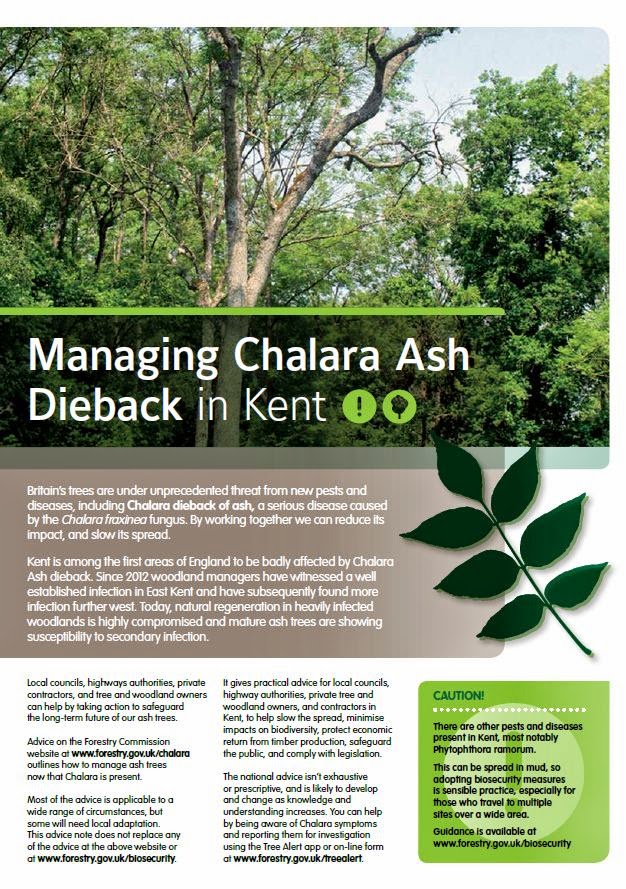
Britain’s trees are under unprecedented threat from new pests and diseases, including Chalara dieback of ash, a serious disease caused by the Chalara fraxinea fungus. 

Kent is among the first areas of England to be badly affected by Chalara Ash dieback. Since 2012 woodland managers have witnessed a well-established infection in East Kent and have subsequently found more infection further west. 

Today, natural regeneration in heavily infected woodlands is highly compromised and mature ash trees are showing susceptibility to secondary infection.

Ash is the most common tree in Kent (almost a fifth of all trees).  This, combined with the observed rate of spread and the high level of infection already present, make eradication of Chalara impossible.

The Kent Downs AONB Unit has worked closely with partners in the Arboriculture Association, Forestry Commission and Kent County Council to produce a guide which offers practical advice for local councils, highway authorities, private tree and woodland owners, and contractors in Kent. 

The main aim was to provide practical advice that might help slow the spread of Ash dieback, particularly from woods in high infection areas in the east of Kent to other locations in the west of Kent, and beyond, where infection rates are currently low.  

Other objectives were to provide advice that minimise impacts on biodiversity, protects economic return from timber production and safeguards the public.

The guide provides a general overview of the disease and its current status before providing specific guidance for woodland managers and those managing tress in urban and sub-urban environments.  

It includes summary advice on how to manage infected ash trees in conservation areas and development sites, trees with preservation orders and ancient, veteran and heritage trees.  The guide also considers ash trees adjacent to highways, public open spaces and private property.


The guide was co-written by Jonathan Harding from the Forestry Commission, Dan Docker from Tunbridge Wells Borough Council, Mike Sankus from the Arboriculture Association and Tony Harwood from Kent County Council. 

The project was managed by the Kent Downs AONB Unit as part of the ADAFOR Interreg project, a cross-border forestry initiative that seeks to integrate knowledge and expertise to facilitate enhanced forest management and adaptation.

The guide is available to download for free our Google Docs folder.

For more information please contact:

Matthew Morris (Woodfuel Development Manager)
01303 815 171
Matthew.morris@kentdowns.org.uk


Wednesday, 24 October 2012

Update from Forestry Commission: EWGS application process, Larch felling moratorium and ash dieback (Chalara)


New application process

The Forestry Commission (FC) has created an online facility which allows applicants to apply for EWGS, felling licences and to submit agent authority forms. As an alternative to our paper forms applicants can now complete and submit applications via our website, which will then be sent straight to our Area offices for processing. This can save time and money on needing to print and post forms and provides a one stop shop for those who wish to carry out their work online. 
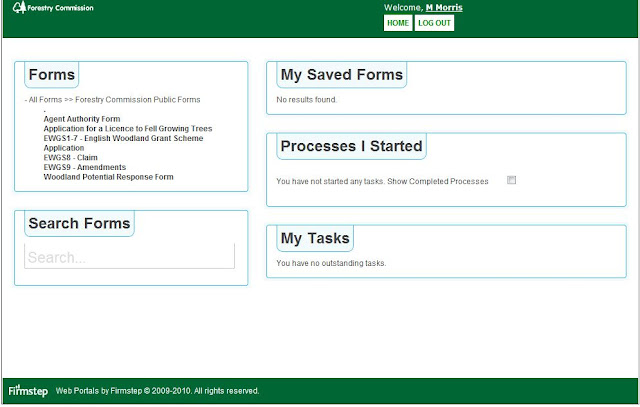
Screenshot of new application gateway
For more information on our forms and how to sign up please visit the Webforms and Guidance page of our website. To help assist you with the application process we have also created an easy to use guide which can also be viewed here. Paper forms will continue to be available to applicants as well.

Interested in Woodfuel WIG, but concerned about getting a Management Plan (WPG)?

To access Woodfuel WIG applicants must have a current management plan. However, The FC recognises this might be a stumbling block to accessing Woodfuel WIG for some applicants. Therefore, if an applicant wishes to apply for Woodfuel WIG on part of their woodland, it is acceptable to produce a management plan specifically for the area included in the WWIG.

Applicants must be aware that whilst this is acceptable for Woodfuel WIG it is not acceptable for WPG and will therefore, not be eligible for funding under the terms of WPG. In order for a management plan to be funded through WPG it must cover the entire ownership within a landscape unit. This is deemed as meeting the ‘property’ requirements as per Operations Note 3.

Larch Felling Moratorium

As with previous years the FC is introducing a moratorium on the felling of larch during the winter
months due to Phytophthora infection. Full details are available in a revised Operations Note 23. This moratorium affects the felling of larch in zone 1 only. There have been recorded outbreaks of the Phytophthora pathogen in Zone 2, but these are isolated incidences mainly associated with previous rhododendron infection. The FC has decided therefore not to extend the ban on approving larch felling to Zone 2 for this winter. The FC will resume the processing of felling licenses containing larch during May 2013.

EWGS and RDPE Transition

The current RDPE programme (2007-2013) is drawing to a close and negotiations are under way with the EU, Defra and the delivery bodies (FC/NE/RPA) to plan the transition to the next programme. The FC objective, so far as is possible, is to allow existing commitments and ongoing applications to continue with minimum change. However the following issues are highlighted to allow applicants time to plan ahead. Please note these are based on the current situation and could change. Budget pressure across the RDPE programme as a whole may mean the FC has to cease accepting applications before 31st December 2013.
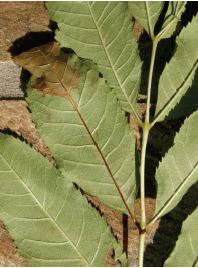

Ash foliage affected by Chalara
Chalara dieback of ash (caused by the fungus Chalara fraxinea)

Letters have been sent to Forestry Commission customers whose trees or woodlands may be at risk, a copy of the letter and further information are available on the dedicated Chalara webpage.