Wednesday, 7 March 2012

Rural Economy Grant (REG) launched

Rural economy grants, which could be worth more than £1 million each, will enable entrepreneurs in rural areas to take life-changing opportunities to grow their businesses through the Rural Economy Grant scheme, increasing both their competitiveness and profits.
 
The Rural Economy Grant (REG) provides grants to enable a significant ‘game-changing', transformational performance in farm, forestry, tourism, agri-food businesses and micro businesses in rural areas in England.

The £60 million REG has been established in response to the findings of Defra's Rural Economy Growth Review (launched in November 2011), which through consultation and an in-depth analysis of a broad range of research, identified large grants (of £25,000 up to circa £1 million) are needed in key business sectors to unlock significant rural economic growth potential.

Project applications will need to demonstrate that as a result of a grant their business will achieve a significant step change in performance (such as job creation, increased turnover, access to new markets etc).  The REG application process is competitive and those projects offering the greatest return on grant investment will be more likely to be successful.

Investment in the Forestry Sector

This priority within REG can offer a range of support to help the forestry and timber sector to significantly transform their business competitiveness, productivity and environmental
efficiency, whilst better utilising forest resources to strengthen and respond to market demand for products such as woodfuel.  Projects in woodlands with significant local importance where active management can positively increase its sustainability and develop its economic potential will also be eligible for support.

Support for primary processing associated with the above must demonstrate significant increases in economic and environmental efficiencies in forestry and timber micro-enterprises (businesses with less than 10 employees with an annual turnover or annual balance sheet total of under €2 million).

The focus will be larger scale projects (projects with a total investment above £62,500 and grant request of at least £25,000) that can demonstrate that the investment will move the business significantly beyond current practice.

Grant investment is available to support:
  • Creation/development of new businesses in the forestry and timber sector
  • The modernisation of primary processing
  • The use of new technology in micro-enterprises
  • Product and market development and product ‘substitution’ in favour of timber and promotes great use of locally sourced timber
  • Developing business capacity in micro-enterprises producing high quality woodfuel

Investment through RDPE does not substitute grant opportunities that should be pursued through other existing grant schemes such as the Woodfuel WIG or the Renewable Heat Incentive (RHI).

Primary Processing is defined as all activity post felling but before industrial processing (for example logs, rough planked or chipped timber or simple enhancements to the quality of that product through drying/seasoning). Industrial processing is defined as anything that changes the primary product (for example lamination, pelletising, jointing etc).

Three main themes are being considered under the Forestry Priority for REG:


A. The Modernisation of Supply Chains

Up to 40% of eligible costs can be supported to improve the co-operation and collaboration in the sector leading to more effective and sustainable supply chains.  Support will facilitate:
  •  Co-operation and collaboration to improve supply chains
  • The development of ideas and initiatives that improve the effectiveness and sustainability of supply chains
  • The development of new or established supply chain relationships that increase the
  • environmental efficiency and sustainability of the business
  • An increase in the sector’s ability to address
B. The Development of New Products and Markets

Up to 40% of eligible costs can be applied for to support businesses that want to work together to develop new products, processes or technologies with the aim of strengthening the sector. Support will facilitate: 
  • Increasing the use of timber as a substitute for less sustainable materials
  • Increasing the number of products that use lower grades of timber
  • Increasing the contribution of timber products in adapting to climate change
C. The Development of the Market for High Quality Woodfuel

Up to 40% of eligible costs can be applied for to support woodland owners and woodfuel businesses to produce a clean, efficient and renewable energy source, Support will facilitate:
  • Increasing the supply and quality of both wood chip and fire log woodfuel
  • Increasing the use of wood fuel sourced on and for use on farm/holdings
  • Increasing the amount of woodland in sustainable management
  • Generating sustainable and energy efficient woodfuel businesses

Support for Primary Processing Equipment to deliver against the themes
The minimum REG grant award is £25,000 and a maximum of up to 40% can be applied for.
In all cases applicants for primary processing equipment must be able to demonstrate that they are micro-enterprises, seeking to significantly transform their business and that the project can clearly demonstrate it is addressing a high level/strategic need within REG.

Eligible Primary Processing Equipment:
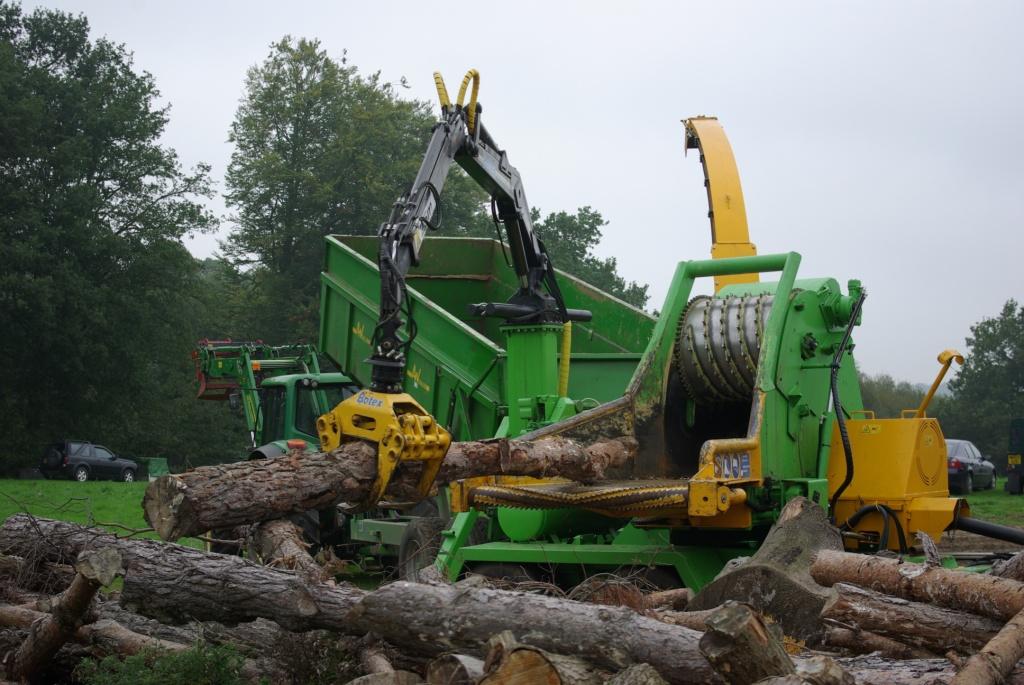
  • Timber processors and harvesting heads for primary processing use
  • Tractor mounted chippers
  • Self propelled chippers
  • Tractor mounted firewood processors
  • Mobile saw bench
  • Tractor mounted forestry grabs/tongs
  • Low impact equipment and equipment that addresses difficult terrain
  • Forwarders
  • Forestry trailers

Round 1 - Outline Application (Deadline 5pm, 30 April 2012)
This initial stage allows you to provide us with an outline of your project, detailing how you anticipate it will fit with the overall aims of the appropriate theme (farm competiveness, agri-food, tourism, forestry, and micro-enterprise), the need and demand for the investment, and benefits of your project.

Full Application

If your Outline application is endorsed, you will be invited to submit a Full application. The Full application is a more in-depth stage - requiring the submission of a full business case / business plan and supporting evidence to demonstrate the need and demand, impact, value for money and deliverability of your project and how it will make a game changing difference to your business and local economy. You will also need to provide three like-for-like quotations for all project costs.

Who Can Apply?

The following businesses across England are eligible to apply (please see section 7 of the
Applicant Handbook for further details):
  • Farmers
  • Rural based enterprises
  • Forestry contractors
  • Woodland owners
  • Horticultural businesses
  • Rural Growth Networks
  • Not for Profit/ Companies Limited by Guarantee
For support contact:
South East RDPE delivery team:

01932 357083
rdpedeliverysoutheast@DEFRA.GSI

Friday, 24 February 2012

Renewable Heat Incentive - application help events

Thursday, 23 February 2012

Maximising Opportunities for the Forestry and Woodland Sectors


The RDPE Network, working with organisations from Forestry and Woodland sectors is holding a free workshop for members of the Forestry and Woodland Sectors on Thursday 8 March 2012 in Birmingham. 
  • Location: Birmingham
  • Date: Thursday 08, March 2012
This workshop provides the opportunities to discuss the recent changes to the RDPE Programme in relation to the Forestry and Woodland Sectors as well as giving you an opportunity to feed in your ideas with regards the post-2013 policy and implementation (see Draft agenda and booking form).

Please return your booking form by Friday 2 March 2012. Places are limited so return your booking form early to secure your place.

The focus of the day is discussion, so each session will provide a brief overview / case study to stimulate further dialogue.

The event is FREE to attend and refreshments and lunch will be provided.

Tuesday, 21 February 2012

Support for Forestry Apprenticeships in the South East

We're all starting to see some interesting developments in the markets for wood and we anticipate this will help bring management back to many woods where it's been uneconomic for many years.

However, if we're to service these markets it's likely we'll need some new staff in in the mainstream forest industry.

Many of you are already aware that the Forestry Commission has managed to garner a little extra support from Defra to support 'main stream' forestry apprenticeships.


We've been talking to Plumpton college about the formal training that supports apprenticeships and seeking practical advice from forestry contractors.

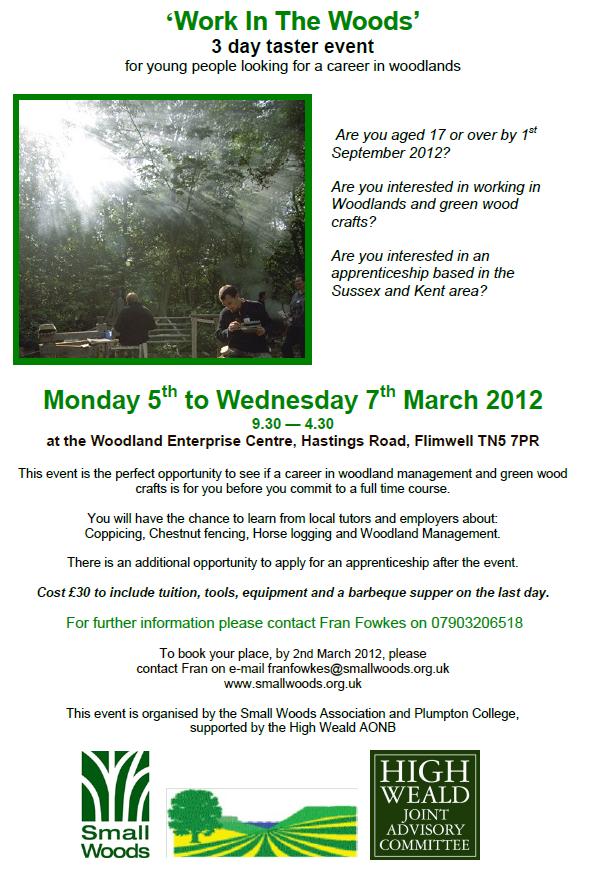
The FC is also working with the Small Woods Association which has organised a 'Work in the Woods week' from 5-7th March at the Woodland Enterprise Centre at Flimwell in East Sussex to give potential apprentices a taste for what forestry work is really like.


In the afternoon of Wednesday the 7th there will be a barbeque where potential employers can come to meet potential apprentices. This will be followed by a short meeting for forestry contractors who are considering taking on an apprentice where we'll outline the support available and discuss the practical training which is really needed and the barriers which we collectively need to overcome.

If any of you are directly interested or know of someone who might be, either as someone seeking an apprentice or looking to become an apprentice, please see the contact details above.

If you would like to attend the barbecue and learn more please let me know no later than Monday the 5th March.

The UK Government has also recently announced a 'cash injection for business to boost youth jobs':

Thousands of companies will be receiving a letter calling on them to play their part in getting young people earning or learning.

Employers will be able to access cash to help cover the cost of taking on fresh talent through a ‘wage subsidy’.  The subsidy will be paid to companies for taking on young unemployed people and is designed to cover costs like National Insurance contributions.

The wage subsidy will pay £2,275 to employers for every 18 – 24 year old unemployed person they employ from the Work Programme.

It is open to all businesses, voluntary organisations and charities.

Payments for the majority of business will be made after the young person has been employed for 26 weeks.  For smaller enterprises these payments will be staggered, with the first payment after 8 weeks and the rest after 26.  This recognises that smaller businesses need a boost to their cashflow to make the jobs viable.

The wage incentive will also be available for part time positions, with a rate of £1,137.50 if someone is employed between 16 and 29 hours.

The Youth Contract was launched in November and aims to lift all young people out of unemployment.  It will also support at least 20,000 extra incentive payments worth £1,500 each for employers to take on young people as apprentices, taking the total number of payments available to 40,000.

250,000 additional work experience places will be created through the Department for Work and Pension’s work experience and sector-based work academies programmes.

Extra support will be given through Jobcentre Plus in the form of weekly, rather than fortnightly, signing-on meetings, more time to talk to an adviser and a National Careers Service interview.

Employers can register their interest in supporting the Youth Contract and can find out more via the DWP website at www.dwp.gov.uk/youth-contract/.

Friday, 17 February 2012

Woodfuel WIG training days

If you are seeking to engage new woodland owning clients, access ‘roads’ grants and increase your expertise in forest road building these FREE training days are designed to help you to access the Forestry Commission Woodfuel Woodland Improvement Grant.
Register now on one of the following one-day workshops for professional woodland managers aimed at demystifying the Woodfuel Woodland Improvement Grant (Woodfuel WIG).

Flimwell Woodland Enterprise Centre, EAST SUSSEX
Tuesday, 28 February 2012 09:00 to 16:30
http://woodfuelwigwoodlandenterprise.eventbrite.co.uk

Englefield Estate, HAMPSHIRE
Thursday, 8 March 2012 09:00 to 16:30
http://woodfuelwigmortimerwestend.eventbrite.co.uk/

You will learn how the grant operates, understand its technical requirements and be able to compile a Woodland Improvement Grant calculator. You will come away fully equipped to confidently recommend the scheme to owners, help them towards a successful application, and improve the profitably of their inaccessible compartments with high quality, grant-aided roads and tracks.

You will be able to quiz the WIG administrator, our consultant engineer and Forestry Commission representatives about all aspects of forest roads and grant aid. And you will come away with a valuable resource pack containing all of the information you need to help your clients to improve their woodland’s infrastructure and capital value.
It will be a packed day – but it’s not all classroom; after a complimentary lunch there will be an afternoon site visit to discuss some of the theory in a real-life situation.

BOOK NOW! Click on the links above to register or call 01494 568976.

Further events are planned for the MIDLANDS, YORKSHIRE & THE HUMBER, CORNWALL and SOMERSET.  To register your interest for forthcoming events please call 01494 568976 or email events@ngagesolutions.co.uk with your contact details.

Places are limited and we expect that there will be high demand for these events so please book early to avoid disappointment.

Wednesday, 1 February 2012

£40m for Expansion East Kent programme

In November 2011 Kent County Council received the green light from Government for its £40 million bid to drive new jobs and business growth in East Kent.  

This follows the announcement by the Government of £950 million to help create and safeguard more than 200,000 jobs across England through the Government's Regional Growth Fund.

The Regional Growth Fund – East Kent, which is to be known as ‘’Expansion East Kent’, has a target to generate 5,000 jobs via grant support for the expansion of both new and existing businesses.  This is in addition to the Enterprise Zone established at Discovery Park.

Given the large population in East Kent, and its relative remoteness to existing woodfuel supply chains, there may be an opportunity for existing biomass businesses to expand their operations into East Kent. 

There is already a lot of activity surrounding waste wood, largely as a result of the way that household waste contracts are evolving.  Recent application to demolish the redundant cooling towers at the former Richborough power station also suggests that plans for the Richborough Energy Park are gaining momentum.

The wood pellet supply chain in East Kent is probably the most poorly developed and this might benefit from new 'hubs' that established pellet suppliers can supply from. 

Given the cost of delivery of pellets its competitiveness against locally produced wood chip is questionable, particularly for small volumes.  However, the relatively sparse woodland cover, compared to that in the Downs and Weald areas, also means that delivered chip can also be relatively expensive.

Whether chip and pellet feature in any of the existing projects biomass projects in unclear, but with the opening of the Renewable Heat Incentive and the forthcoming Green Deal expansion of woodfuel supply chains in East Kent may be an opportunity for some, particularly if it is linked to other activities such as clean waste wood aggregation, arboriculture and woodland management.

Grants will be made available to all sizes of applicants from £25K for small businesses up to £2.5 million for businesses with over 250 employees: 

  • Springboard grants of up to £25,000 for start-ups and small businesses with less than 10 employees
  • Larger Grants for Investment and Growth, worth up to £2.5 million
  • Business Critical Infrastructure Grants, to support the delivery of infrastructure projects which will benefit a number of businesses such as High Speed rail line enhancement on the Ashford – Ramsgate route.

The fund will be administered by Locate in Kent and will be available from Spring 2012.  Full details and the application process are yet to be published.

Monday, 16 January 2012

Charity makes woodland fuel plea


Pearl Bordered Fritillary (picture courtesy D E Newland)
Managing neglected English woodlands to produce wood fuel could boost declining species of flowers, conservationists have said.

Plantlife has revealed that one in six woodland flower species is threatened with extinction, with plants hit by the "perfect storm" of under-managed woods, increasing deer populations and too many nutrients in the environment.

But sustainable woodland management to provide wood fuel could generate a low carbon energy source that people could buy to support their local countryside, in the same way as buying local farm produce, and improve woods for wildlife.

Plantlife said that in 1950 around half the country's woodlands were coppiced or scrub.

But by 2010, 97% of woods had become "high forest", with tall trees cutting out light and affecting plants, as well as creatures such as pearl-bordered fritillaries which rely on them.

Plantlife's landscape conservation manager Andrew Byfield said: "All flowering plants require light to grow.

"We think of woodland plants growing in deepest shade but most woodland plants like glades, woodland edges, thin woodlands and rides."

According to the plant charity, rare species including lady orchids and green hound's-tongue have suffered from a lack of woodland management such as coppicing.

More common species such as violets, primroses, early purple orchids and wood anemones also need well-managed woods to flourish.

Mr Byfield said English woodlands were losing their diversity as a result of the lack of management, as well as the pressure on plants from deer and the impact of nutrients which lead to over-growth of species such as brambles.

Monday, 12 December 2011

More support for community energy projects


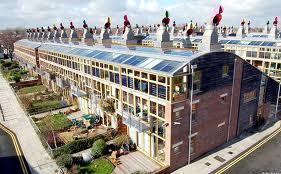
BedZed, London, Peabody Trust.
The Buildings Research Establishment has just opened another round of the Community Sustainable Energy Programme.

The Community Sustainable Energy Programme will provide £8 million to community-based organisations for the installation of microgeneration technologies , such as solar panels or biomass boilers and energy efficiency measures including loft and cavity wall insulation.

It will also provide £1 million for project development grants that will help community organisations decide if they could benefit from a microgeneration and energy efficiency installation.

The programme aims to achieve the following outcomes:    

  • Reduction in CO2 emissions
  • Increased community awareness of climate change and how changes to our behaviour can reduce it
  • Increased skills base of local trades (for example, local builders and building-service subcontractors working on renewable energy projects for the first time)
  • Reduction in energy bills
  • Reduction in reliance on imported energy and increased independence from commercial energy suppliers
  • Stronger partnerships within local communities with lasting social benefits
  • Growth of local enterprise in new technologies
Due to the opening of the Renewable Heat Incentive (RHI) applications for the current CSEP round will only be accepted for heat generating technologies and energy efficiency measures only.

Deadline for the receipt of completed applications will be 5pm Friday 29 February 2012.

For full details on how to apply please visit the BRE CSEP webpages.

Friday, 9 December 2011

DECC announces launch of two new community energy funds

In addition to the recently launched woodfuel woodland improvement grant (WF WIG) and Farming and Forestry Investment Scheme (FFIS) two more funding sources have been announced.

The Local Energy Assessment Fund (LEAF) and Rural Community Energy Fund are aimed specifically at community energy projects and are potentially very useful for getting projects implemented.

Whilst the LEAF project has demanding timescales it may be possible for some groups to take advantage, particularly if the scope of the project is tightly defined and there are plenty of people willing to get involved.

Details of the Rural Community Energy Fund are still emerging and an announcement is expected in January.

£10 MILLION LOCAL ENERGY ASSESSMENT FUND (“LEAF”) UP FOR GRABS

The Department of Energy and Climate Change, has announced a new £10 million fund to help local communities in England and Wales develop energy projects. The fund will run as a “competition”, with the chance for around 200 community organisations to receive up to £50,000 each to understand local energy efficiency, renewable energy generation issues and to get things started in local communities.

The Local Energy Assessment Fund (LEAF) will be managed by a number of community networks and administered by the Energy Saving Trust. This is a short-term scheme where work will need to be completed by end of March 2012.

The deadline for applications is in two weeks so you must act fast!  The first round closes at noon on the 22nd December.

The second round will close to applications at noon on 20 January 2012 with successful communities notified at the end January.

Additional details of how to apply can be found on the Energy Saving Trust's Green Communities website.  Advisors are available on 02920 467 015.

The grant fund is intended to help communities to prepare for new opportunities in sustainable energy and climate change arising from the Green Deal, Renewable Heat Incentive (RHI) and Feed in Tariffs. The grants can be used to fund projects that follow the Energy Hierarchy (reduce energy use, use energy efficiently, generate renewable energy).

RURAL DEVELOPMENT FUND

The Chancellor announced in his Autumn Statement, the creation of a £15m Rural Community Energy Fund (2012-2015) that will be developed by DECC and DEFRA.  More details will emerge in January 2012. 

In the meantime full details of funding for community energy projects can be found on DECC's website.

Monday, 5 December 2011

National biomass suppliers database launched

The Forestry Commission’s Biomass Energy Centre (BEC) and the Carbon Trust have jointly launched the National Biomass Suppliers Database - a new way for people to find local and national companies which can supply them with woodfuel.

Since the introduction of the Renewable Heating Incentive (RHI), many more people are considering installing woodfuel-powered heating, but they are often unaware that the woodfuel supply chain is well established in many parts of the country.

The new map-based listing, which is also available on the Biomass Energy Centre website, includes the details of around 300 fuel suppliers operating across the UK.

The new system will make it easy to find the nearest, or preferable, fuel supplier, and the service is free - woodfuel suppliers can be included simply by registering and submitting their details online.

Forestry Commission England recently announced its Woodfuel Woodland Improvement Grant, which will increase the amount of wood entering the supply chain from currently under-managed woodlands.

Tuesday, 29 November 2011

Renewable Heat Incentive is open for business

DECC has now announced the launch of the Renewable Heat Incentive (RHI) Scheme and Ofgem's systems are now open and available to accept applications.

We have had a initial look at the online application process and it appears to be relatively simple.  However, you will need all paperwork close at hand (in electronic format) to increase the chances of completing the process in one sitting.  You can of course save the application and return later if you need to source additional information.

A few points of interest:
  • The person applying should be the authorised signatory for the organisation
  • You will need details of a valid bank account and proof that the bank account provided is held in the name of the organisation/company (e.g. copy of a bank statement which shows the account name, address, sort code and account number with financial information blackened out)
  • For 'simple' schemes Ofgem will respond within 20 working days
  • For 'complex' schemes Ofgem will reply within 30 working days
  • You will need to apply for preliminary accreditation if you installation date is greater than one month from the present (application) date AND your biomass boiler is over 200kWth (i.e. medium scale and above)
  • You will need to attach (or post) a series of documents so it would be worthwhile ensuring these are all at hand before you start.
  • You will need to be able to separate capital costs from non-direct costs (i.e. installer costs, planning costs and anything not attributable directly to the purchase or construction of the physical plant)
For further information, useful links and details on how to apply to the scheme please visit the RHI website: http://www.ofgem.gov.uk/RHI.

For a summary of some of the documents and information which participants may be required to submit please refer to the following document “Summary of supporting information for RHI applicants”:


If you have any queries please contact the Ofgem E-Serve RHI Team on 0845 200 2122. The helpline opening hours are 8:30am until 5pm Monday to Thursday, and 8:30am until 4:30pm on Fridays.

Alternatively, you can send an email to RHI.Enquiry@Ofgem.gov.uk.  It is recommended that complicated enquiries are sent via email.

Good luck!


Monday, 21 November 2011

Good turnout at Woodfuel Pathfinder contractors event

The function room at the Dog & Bear in Lenham was packed to the gunwales last Thursday as forestry contractors from Kent and Sussex gathered for a roller coaster update on apprenticeships and training, grants and the evolving market for woodland products.

Around 70 people representing a wide range of businesses with an interest in the forestry and woodland management sectors attended the event.  There was a lot of interest in the new woodfuel grant (WF WIG) from the Forestry Commission, LEADER and the new Farm and Forestry Investment Scheme (FFIS). 

Mike Furness from Ngage Solutions, the company responsible for delivering the WF WIG in the South East said:

"It was great to have a packed room to spread the word to.  We have already had two firm follow-up calls for significant roading schemes as a result of the event and we would encourage anyone with an interest to get in touch."

Feedback since the event also suggests a high level of interest in the LEADER and FFIS schemes, both of which are designed to assist rural businesses invest in green projects and new machinery.

There was a lot of debate on the night about how potential apprentices could be identified and retained in the forestry sector.  Some delegates also raised concerns about the cost of equipment and training for new staff.  However, a quick show of hands revealed that six businesses were considering taking on apprentices.  The training providers in attendance at the event (Plumpton College and Concept Training) also expressed great interest in supporting these businesses with work-based learning for apprentices.

The Forestry Commission provided a summary of how markets for woodland products, and in particular wood fuel, are developing and highlighted several examples of installed biomass heating schemes and local wood chip supply chains.

As the evening progressed a clear message emerged: A good package of support for the land-based sector still exists, and with the recent announcement of two major new grants (with a combined total of £30m funding) now is the time to pick up the phone and find out how your business can take advantage. 

The presentations from the event can be found here:

The imminent opening of the Renewable Heat Incentive (RHI) at the end of November will provide a strong market-based opportunity for the forestry sector over the next few years.  If your business needs support on any of the subjects covered in this article then please do not hesitate to get in touch with the Kent Downs Woodfuel Pathfinder on 01303 815 171 or matthew.morris@kentdowns.org.uk.

Monday, 14 November 2011

£20m for farming, forestry and horticultural businesses

Alan TYERS - Hayrolls, Highdown Farm
http://www.redraggallery.co.uk/
A new £20 million fund to help farming, forestry and horticultural businesses to become more efficient at using resources has been launched. The scheme aims to help businesses to become more competitive and more profitable, whilst reducing the impact of farming on the environment.

This announcement comes only a few days after the launch of the new £10m Woodfuel Woodland Improvement Grant by the Forestry Commission.

Farmers, foresters, woodland owners, agricultural contractors and horticulturalists can apply for grants of up to £25,000 to invest in green projects, new machinery and improvements to animal health and welfare so their businesses can grow in an environmentally friendly way.

The Farming and Forestry Improvement Scheme will fund projects that:
  • save energy and reduce carbon emissions
  • reduce dependence on artificial fertilizers through better use of manures
  • improve soil quality
  • improve animal health and welfare
  • save and recycle water
  • promote woodland management by processing timber more efficiently

In Kent the LEADER programme has been very successful at providing RDPE grants for a wide variety of land-based and rural businesses.  It is understood that the new FFIS scheme may replace LEADER, although there is underspend in some other regions and this may be used to top-up the Kent LEADERs (providing there is enough demand to warrant an extension).

More information on LEADER, the new FFIS scheme and a range of other topics will be provided at our forthcoming contractors event at the Dog & Bear (Lenham) on Thursday, November 17th. 

There are still some places left so please contact us if you would like to come along (matthew.morris@kentdowns.org.uk , 01303 815 171).

Friday, 11 November 2011

£10m to boost woodland management for woodfuel

A new £10m grant scheme to revitalise woodland management has been announced by Forestry Commission England today, 10 November 2011. The new scheme aims to produce woodfuel by improving roads and access for extraction.

Around half of England’s woodlands are undermanaged. There are many reasons for this but one is certainly the high cost of extracting timber so that it can be brought to market. Supporting owners and managers to improve roads and access will reduce harvesting costs and once again make woodland management economically viable.

Pam Warhurst, Forestry Commission Chair said:
“There is an old phrase that says “A wood that pays is a wood that stays.” We are delighted to be able to launch this new scheme to revitalise the economic viability of sustainable woodland management by helping get timber to market. It will create rural jobs and help grow the green economy.”

Applicants will have to have long term management plans for the woodlands that meet the new UK Forestry Standard.  The plans will say how much timber they expect to harvest over the next decade so we will be able to see clearly what the benefits are from each new road built.

The new Woodfuel Woodland Improvement Grant (or Woodfuel WIG), will improve the infrastructure of undermanaged woodlands and contribute to the costs of marketing timber. As well as supplying the growing woodfuel market from thinnings and other operations, well managed woodland can also produce high quality timber. In turn this management improves the quality of woodlands for wildlife.

Woodfuel WIG is available throughout England but most of the funds are targeted towards the South East, South West and Cumbria, where there is greater potential for woodfuel supply.

This new grant is open for applications now and will operate alongside the Farming and Forestry Improvement Scheme, recently launched by Defra to provide comprehensive support to the woodfuel supply chain.

Woodfuel Woodland Improvement grant key features
  • This new grant supports the sustainable production of woodfuel and other timber products and runs to the end of the 2013/14 financial year
  • Work will need to meet the UK Foresty Standard
  • The grant offers 60% towards the cost of work, and doesn’t take account of the timber income that results
  • To apply for a Woodfuel WIG, applicants must have an approved, up to date Woodland Management Plan, and work must be completed and claimed for by 28 February 2014
The following main operations are supported:
  • Roads, tracks and other infrastructure to assist the extraction of timber from woodland. Support will be based on 3 quotes and grant paid on the production of receipted invoices
  • Woodland inventory and costs associated with managing harvesting contracts. Support for this work is based on standard costs

Monday, 31 October 2011

Woodland Contractors Workshop - Nov 17th, Lenham, Kent


Kent Downs Woodfuel Pathfinder: Woodland Contractors Workshop
Dog & Bear (Lenham, Kent) on November 17th at 7pm – Free Buffet
After many years the markets for Kent’s woodland products are improving, woodfuel is starting to provide opportunities for lower quality material (particularly at a local level) and people are increasingly recognising the value of wood as a sustainable product. 

If, as an industry, we are to take advantage of these developments we need a robust and evolving network of woodland contractors.  Appreciating that there is a huge range of business models we would like to better understand what would help existing contractors develop their businesses to respond to the improving conditions.

The workshop will also provide an update on support available to the sector including:

·         The evolving market opportunities
·         The FC’s new Woodfuel Woodland Improvement Grant
·         Grant support for machinery & business development
·         Funding for apprentices

The Kent Downs Woodfuel Pathfinder is a joint Forestry Commission and Kent County Council project (with funding from the EU ERDF Interreg IVa programme) exploring what temporary support would help the woodland industry evolve to become fully self-supporting delivering:

              Market driven sustainable management of Kent’s woodlands
              Maintenance of Kent’s landscape character & secure local jobs
              Carbon lean & sustainably sourced fuel for local heat

Over 70 contractors from Kent, Surrey and Sussex are being invited to this event.  It provides an opportunity to tell us what would help YOU, learn about new initiatives and network with other companies operating in the sector. 

Places are limited.  Please email matthew.morris@kentdowns.org.uk (or call 01303 815 171) to reserve a seat.


Thursday, 27 October 2011

Ofgem update on RHI Phase 1: Large scale biomass tariff reduced

SusCon boiler room, Dartford, Kent
Ofgem have released further information on the status of the RHI Phase 1 launch, delayed from last month.

DECC has announced that the Renewable Heat Incentive regulations have been laid before Parliament, with the aim of opening Phase 1 of the scheme to applicants by the end of November 2011 (subject to Parliamentary approval).

"We have now updated the Renewable Heat Incentive Regulations to reflect the required change to large scale biomass tariff by the European Commission.  The large scale biomass tariff has been revised from 2.7p per kWh to 1p per kWh."

Ofgem is ready to start accepting applications as soon as regulations come into force, although the exact date of this is dependant on parliamentary timetables.

For more information visit either DECC's website on the RHI www.decc.gov.uk/rhi or Ofgem's website on the RHI www.ofgem.gov.uk/rhi

Wednesday, 19 October 2011

Woodfuel Woodland Improvement Grant open for applications

The value of wood as a sustainable resource, either as timber or as woodfuel is growing.

The Kent Downs has a long history of traditional coppice management and is well suited to respond to such market led opportunities.

Of course, sensitive and sustainable woodland management is crucial to the character and ecology of the Kent Downs and provides jobs for local people.  However, traditional sweet chestnut products are growing in popularity and new products are being developed.

The growing market for wood as a sustainable fuel, encouraged by the Government’s Renewable Heat Incentive (RHI) and the Kent Downs Woodfuel Pathfinder offers market opportunities for the lowest quality wood and ‘offcuts’ produced when creating other wood products.

The greatest opportunities lie in:

  • Using your own wood to supply your own heat needs;
  • Adding value to your lower quality wood by selling woodfuel locally, or
  • By selling the end product - heat.
The volatility and the inevitability of increasing prices of fossil fuel means locally produced woodfuel offers a secure and sustainable supply where production and supply is undertaken by local people.


The Woodfuel Woodland Improvement Grant offers support of 60% of the costs of:

  • roads, loading areas, tracks and other infrastructure which will allow you to harvest wood products;
  • assessing the amount of timber which could be sustainably harvested; and
  • the costs of managing harvesting contracts.
Further details can be found on the Forestry Commission website.

If you are interested you will first need an approved woodland management plan, for which the Forestry Commission also offer support through the Woodland Planning Grant.

Contact your local Woodland Officer for further information.